
A scene every player knows. A hard position, the clock is ticking, no ideas. Your hand reaches for the hint button — an arrow lights up, you make the move, the game rolls on. A week later you get almost the same position. And the same emptiness in your head.
The hint worked. It just didn't teach you anything. And that is not your fault: almost every chess hint in the world is built this way. It hands you an answer before you have had a chance to ask yourself a question.
Why a ready-made move teaches nothing
Memory is unfair: it carefully keeps what you dug out yourself and easily lets go of what you were given. Psychologists call it the generation effect, but you can see it without the science: think back to learning multiplication tables — what stuck was not what you peeked at, but what you sweated over.
When an arrow shows the move, the one step that makes you stronger — the search — drops out of the process. You never scanned the board, never asked "what is hanging? what opens up if I move away?", never rejected three bad ideas on the way to a good one. That invisible work is the training. The arrow does it for you — like a machine that lifts the barbell itself.
A living coach knows this, which is why a good coach almost never names the move. They ask a question: "slow down — what changed after his last move?" You find the answer yourself — and that is why it stays with you.
The ladder: three steps instead of one answer
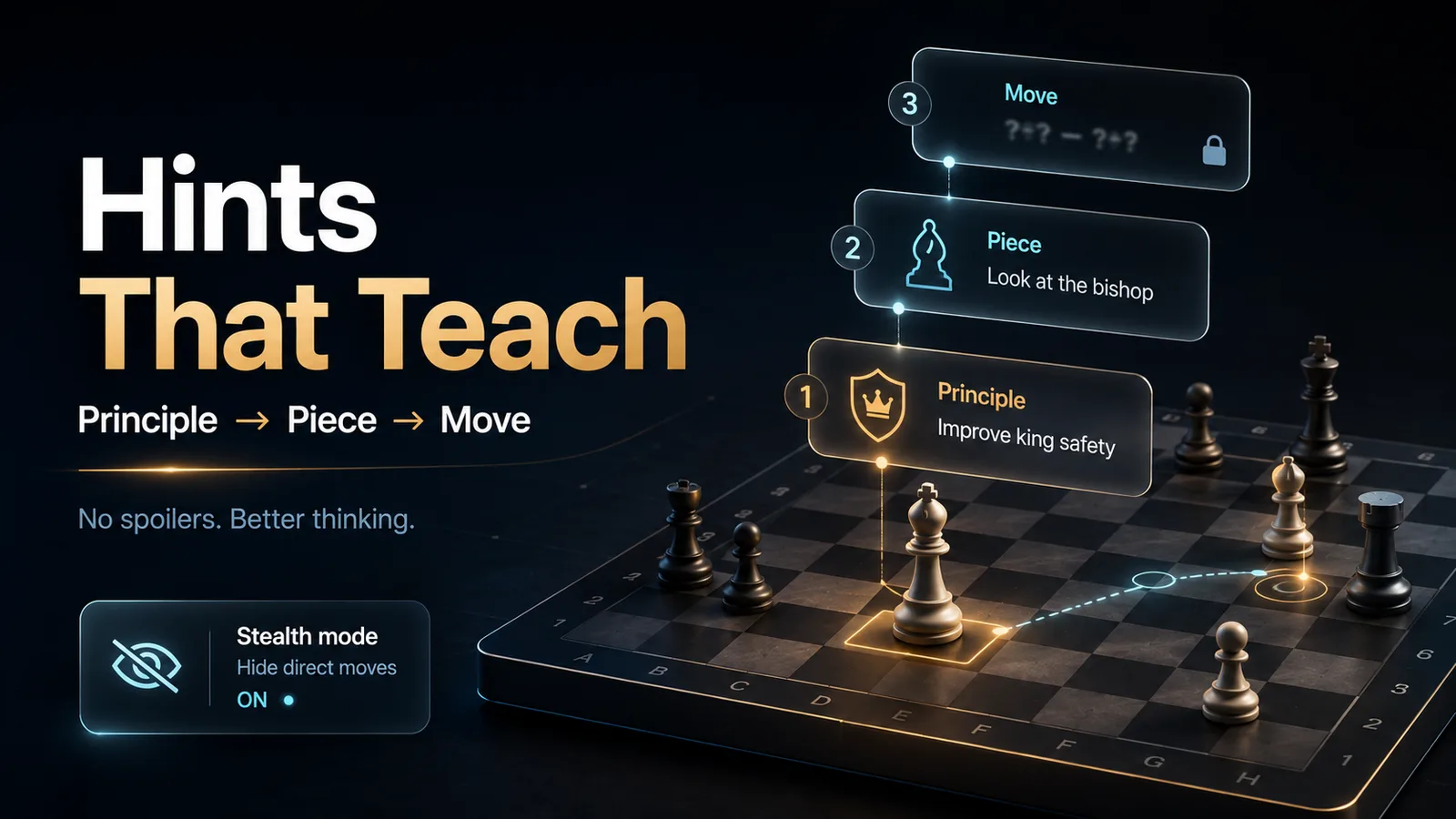
We built our hint the way a coach gives one — as a ladder, where each next step opens separately and you do not have to climb all the way.
Step one — the principle. No piece, no move — just the idea to think with: "check every check and capture first", "find your most passive piece — it barely has moves", "his last move left something undefended". That is the coach's question. What follows is your minute of silence.
Step two — the piece. If the minute went nowhere, the board highlights what to move. Where — is still your job, and usually the bigger half of it: finding the right square for the right piece is far easier than stumbling onto the right piece out of sixteen.
Step three — the move. For emergencies. Honestly: if you are here more often than on step one, the ladder degenerates into an ordinary arrow — and teaches exactly as much.
And after your move the coach tells you how it went: found the idea — you will hear it; played past it — you will learn what exactly you missed. Finding something and instantly learning that you found it is the fastest learning loop there is.
"But the ladder is slower!"
It is. In this game. But the point of training is not this game — it is the next one: a move you climbed to from step one, you will find in a week with no ladder at all. A move an arrow showed you — you will not. You have already run that experiment: see the scene in the first paragraph.
The exam: stealth mode
Every few days, play a game in stealth mode — everything is off: hints, arrows, evaluation. Just you and the board, like at a tournament table. It is an honest measurement: if the step-one principles have started surfacing on their own — they are yours now. Which is what this was all about.
The ladder works in every game at 99chess.com — free, no signup. Press H. Climb no higher than you need.