
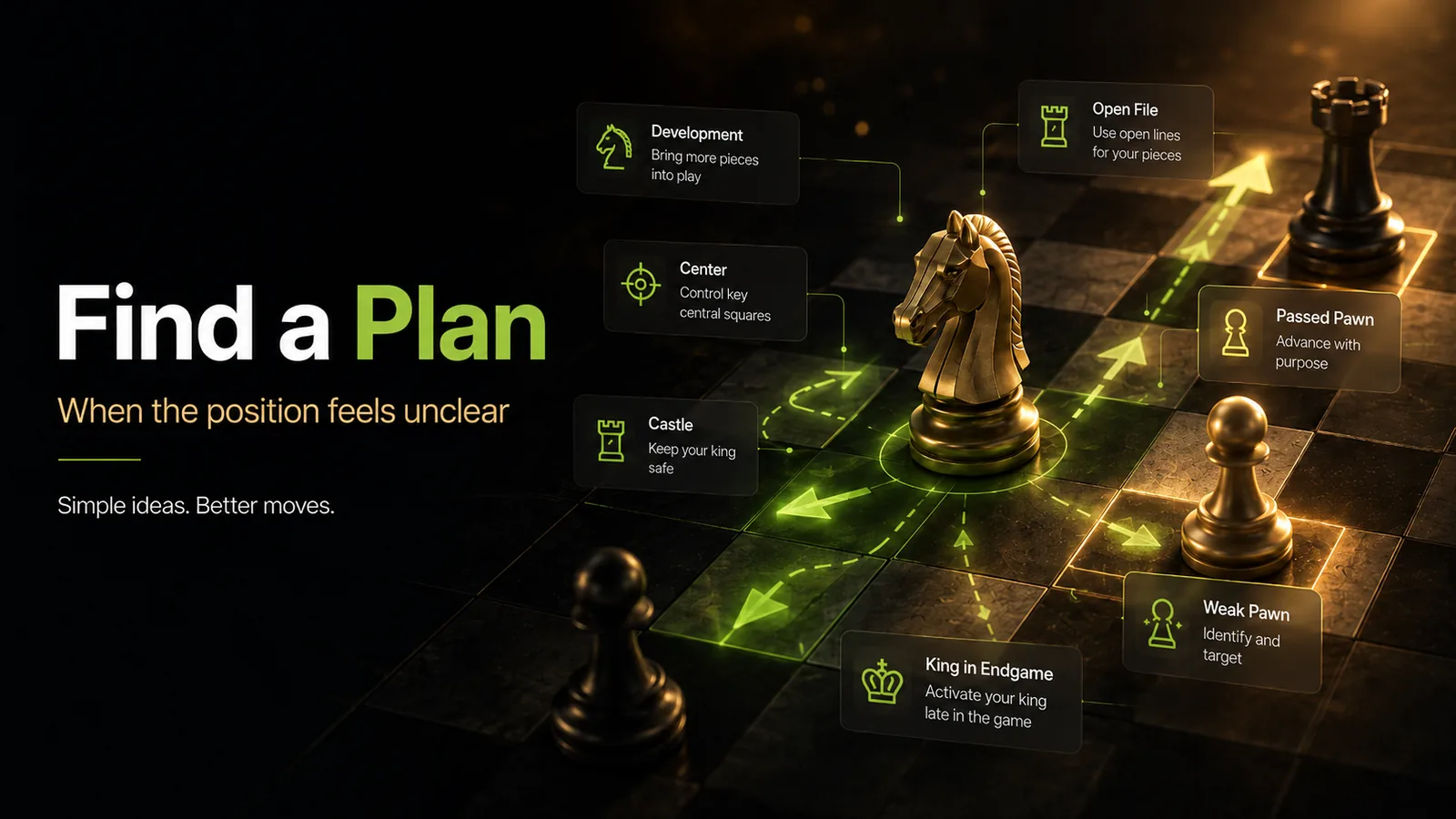
The opening is over. The book moves ended with it, the pieces are out, the king is safe — and then comes the pause where your hand reaches for "something, anything". Usually that is a pawn move on the edge of the board or a pointless check. The advice "play with a plan" does not help here: it never explains where a plan comes from.
The good news is that a plan is not fifteen moves of calculation. It is the answer to one question: what is this position a fight about, and what am I doing to win that fight. And there is a road to that answer — a short list of questions asked in a strict order.
The order matters more than the content
The most common amateur mistake is not a wrong plan but a plan out of turn. Someone launches a kingside attack while a knight hangs in the centre. Lovely idea; the position ends before the idea arrives.
So the questions run top to bottom, and the next one only makes sense once the previous is closed.
1. Is anything threatening me right now?
Direct threats come first: mate in one or two, a piece under attack, a pin about to fire. While that is on the board, general plans do not exist: defend, move away or trade. This is not timidity, it is sequence. A position where you "did not have time" is almost always a position where somebody was making plans instead of looking at a threat.
2. Are all my pieces in the game?
If the knight is still on b1 and the bishop on c1, you already have a plan and it is called "develop". An attack with three pieces against five never works, no matter how pretty the idea.
The same place holds the rule that rescues you in any unclear position: find your worst piece and improve it. A knight on the rim, a rook staring at its own pawn, a bishop buried behind its own pawn chain — that is almost always where the best move hides when "nothing is happening".
3. Who owns the centre?
The centre is logistics, not aesthetics. A piece in the centre covers more squares and travels to either wing faster; pawns on d4 and e4 take away the squares enemy pieces need to come in. Own the centre and you decide where the game happens. Give it away and any wing activity of yours will break against a counterblow in the middle — the oldest rule in chess.
4. Where will my king be in five moves?
While queens are on the board, a king in the centre is a postponed disaster. Castling, while it is still free, is worth more than an extra pawn. And separately: if the pawn shield around your king has already been touched — a pawn pushed, a square weakened — that is not cosmetics, that is the direction of the enemy attack, and it belongs in your calculations.
5. What does the structure give me?
Once safety and development are handled, the pawn skeleton suggests the plan — it is the slowest part of the position, and therefore the most reliable:
- An open file — put a rook on it. Heavy pieces live on open files: there they hit through the position and create threats that cannot be postponed.
- A passed pawn — support it with pieces and push. Every square closer to promotion forces the opponent to spend a piece on stopping it.
- A weak enemy pawn (isolated, backward, doubled) — attack it. Even if you never win it, defending ties his pieces down: a rook babysitting a pawn is a rook out of the game.
6. Who stands better — and what follows from it
This question is about the mode of play, and it changes everything:
- You are clearly ahead — simplify. Trade pieces but not pawns, and smother any counterplay. An extra piece on an empty board wins by itself; the same piece on a crowded board may mean nothing.
- You are clearly worse — do not open the game. Open lines and trades help the side that already stands better. Cover your weaknesses, keep the tension and wait: games are lost not by a bad position but by a second bad move in a row.
7. Once the endgame starts
When the queens disappear, the king changes status: from a hunted object it becomes a fighting piece, often the strongest one on the board. "March the king to the centre" is not a poetic flourish — in most endings it is literally the first move of the plan.
How this looks in the trainer
We packed this hierarchy into the Plan card. It sits next to the board and answers "what is the fight about here" in plain words on every move, instead of an evaluation in centipawns. The wording is the same as above: "develop your minor pieces — no attack starts while they sit at home", "the e-file is open, put a rook there", "you are winning — simplify and allow no counterplay".
It follows the same order. If there is a direct threat, the card talks about that alone and says openly that general plans can wait. No threat, but the knight and bishop are home — it is about development. Everything developed and the king tucked away — the card moves on to files, passed pawns and weaknesses. Next to it sit short chips: "development", "centre", "king safety", "d-file", "passed c5" — a quick way to see what the plan was built from.
One more thing: the plan is rebuilt after every move. Play a poor one and the card says so — "your move made things worse, adjusting the plan". Win a piece and it reminds you the main task has changed: do not spill the winnings.
Turning this into a skill
Reading plans is useless unless you say your own out loud. What works is this:
- Before the move, state the plan in one sentence — in words: "I take the open file", "I get my king out", "I attack the backward d6-pawn". If the sentence will not form, you do not yet know what you are doing, and the move is probably going to be random.
- Check against the card — match or mismatch. The mismatch matters more: that is where you missed something.
- After a few games switch on stealth mode and formulate the plan with no hints at all. That is the only honest exam.
Within a couple of weeks the middlegame pause stops being a pause. Not because you memorised new schemes, but because you now have an order of questions — and in any unclear position there is somewhere to start.
The Plan card is on the hints tab in every game. Start by forming your own plan first and only then looking — that way it teaches you something.