
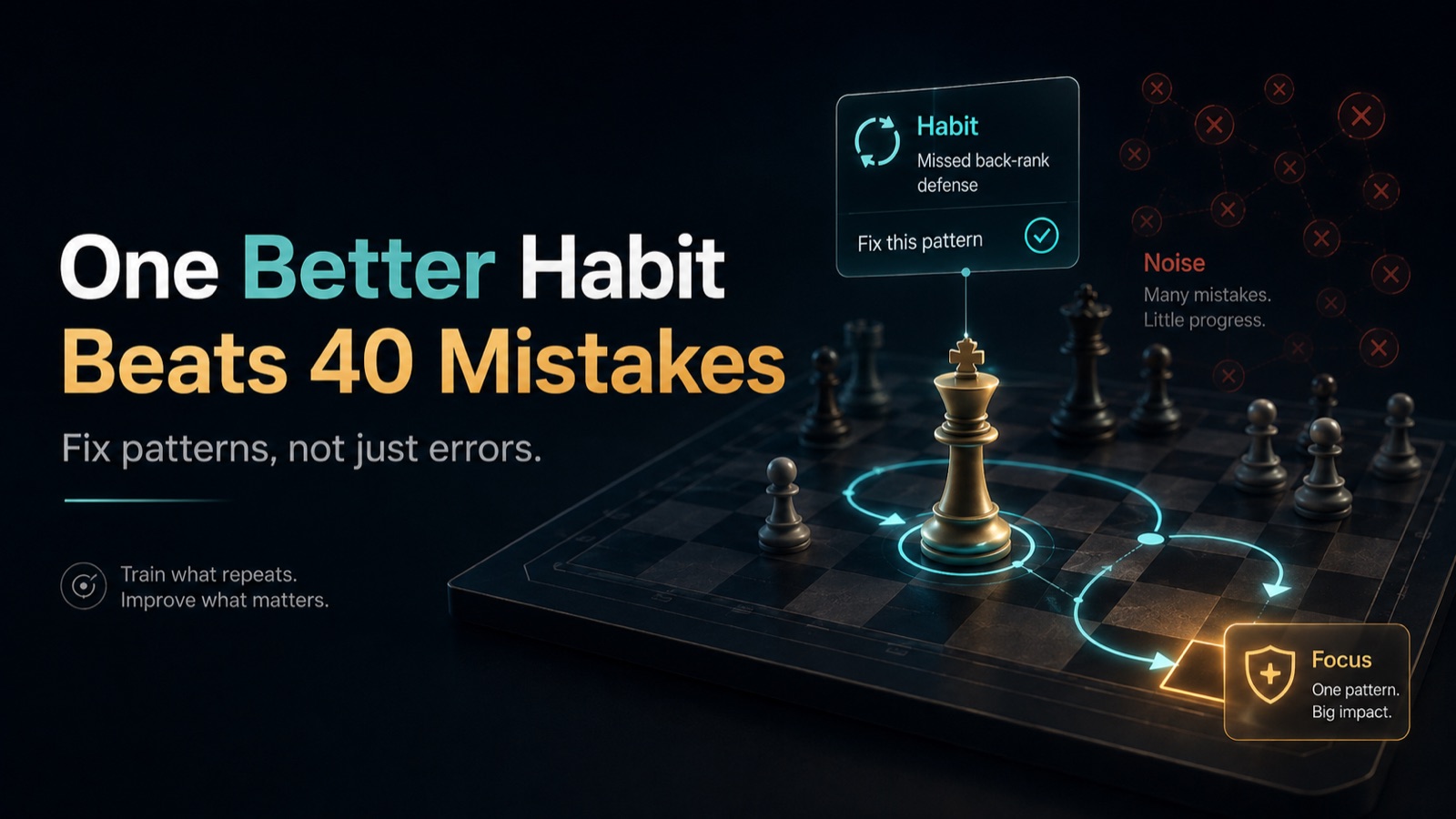
The game is lost. You open the analysis — and the screen dutifully blooms: four blunders, six mistakes, a dozen inaccuracies. Forty marks for one game. You scroll the list top to bottom, sigh, and close the tab.
Tomorrow — a new game and a new list. Also forty items long. And so on, every evening.
Here's the uncomfortable question: how many of those forty mistakes have you fixed in the past month? Not "looked at". Not "understood". Fixed — so that it stopped showing up in your games?
If the honest answer is "none", you're not alone. That's what almost everyone answers. And it's not your fault.
A list is not a lesson
Imagine a swimming coach who hands you a printout after your swim: "40 technique flaws detected" — and walks away. Stroke, breathing, head position, elbow angle, all mixed together, all in the same font. What will you do at the next practice? Exactly: the same thing as always. Because no human can fix forty things at once. Not in swimming, not in chess, not anywhere.
A list of mistakes creates the feeling of work — you did "analyse the game", after all. But awareness doesn't change the hand. Repetition changes the hand: the same correction, many times, until it becomes automatic. And for that you need to know what exactly to repeat.
Mistakes aren't scattered — they come in clusters
Now the good news, visible in any pile of amateur games: mistakes are not spread evenly. They cluster.
Of the forty marks in your game, most are random noise: you will never play that exact move again, because that exact position will never come back. But a few marks are not noise. They are the same mistake wearing different costumes. For some players it's a piece left undefended — a knight today, a bishop tomorrow, same mechanism. For others it's an open line towards their own king. For others, a trade that wrecks the structure.
That is a habit. It follows you from game to game, and it — not the other thirty-nine items — is what keeps your rating pinned. Remove it, and you'll grow faster than from memorising three openings.
Why nobody shows it to you
Because that requires looking not at the game — at the player. One game says: "there was a blunder here." A hundred games say: "this person leaves pieces undefended nine times per hundred moves, mostly in the middlegame, and more often this month than before." The first is a fact. The second is a diagnosis.
Regular analysis works the first way: game over, list delivered, goodbye. Nobody adds your games together, looks for repeats, and says: "Look, there it is, your main one. Let's start with it."
What actually works is the reverse order:
- Name one habit. Not forty items — one, in plain words: "you leave pieces undefended."
- Train it on your own games. Not on someone else's brilliant combinations — on the positions where you went wrong. Your own position is remembered by the body: "I sat right here."
- Measure frequency, not mood. Not "am I playing better" — that's unmeasurable — but "how many times per hundred moves did the habit fire this month versus last." The curve crawls down — the work is working. The rating will follow; it's always late.
What to do today
Even without any tools: open your last five lost games and look not at the evaluations but at the repeats. Which mistake shows up more than once? Work with that one — one week, that one only. It's more boring than watching another opening video. It's also what training actually is.
And if you'd rather have the repeats found for you — that's what our coach does. It adds up all your games, names your main habit in plain words, flags it right on the moves ("this is your recurring mistake — again"), builds puzzles out of your own moments, and charts whether the habit is retreating. Seven minutes a day: review yesterday's game, solve a few of your own puzzles. All of it at 99chess.com, free.
Forty found mistakes is a report. One fixed habit is growth. Don't confuse the two.