
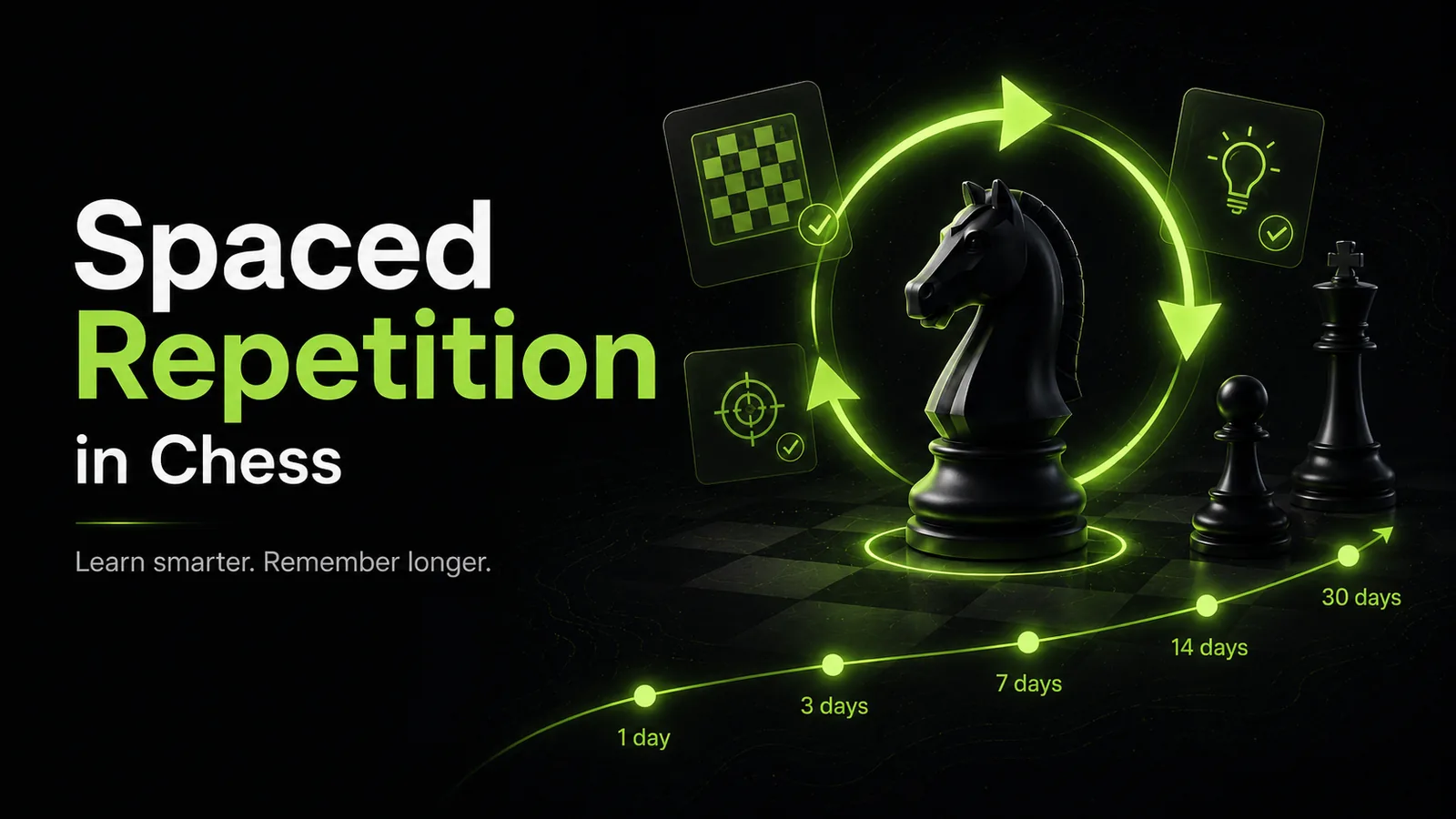
A familiar story: you solve a knight-fork puzzle, understand it completely, move on. A month later the same shape appears in your game — and you walk straight past it. This is not about memory or talent. Your brain drops whatever it did not need twice, and it does so on a schedule we have known for almost 140 years.
The forgetting curve, and the one trick that beats it
In 1885 Hermann Ebbinghaus measured on himself how fast learning decays: most of it goes in the first day, then the curve flattens. But the curve has a weak spot. Come back to the material exactly when it starts to fade, and the next decline is slower. Come back again, slower still. That is spaced repetition: not cramming more often, but returning less often — on time.
The second mechanism matters even more. What works is not rereading but trying to recall. Pulling an answer out of your head is training; recognising it once shown is barely anything. Psychologists call this the testing effect, and it is why a covered flashcard beats a highlighted page.
Languages proved the method works
Vocabulary is where the method was tested at scale. Sebastian Leitner's box system, and later SuperMemo and Anki, gave millions of people the same result: twenty minutes a day on a schedule beats three-hour weekend marathons. A word you recalled on day 1, day 3, day 7 and day 21 stays with you. A word you read twenty times in one evening does not.
The mental shift that matters: the goal is not to learn more, but to stop losing what you already learned. Everything else follows.
Chess is the same vocabulary, only visual
Here is the bridge. Back in the 1940s Adriaan de Groot showed that a strong player does not calculate much deeper than a weak one. The difference is what they see in the first few seconds. Chase and Simon explained the mechanism in 1973: a master stores thousands of familiar position fragments and recognises them whole — the way you read a word rather than the letters in it.
So chess strength is largely a matter of how many patterns you recognise on sight:
- the knight fork on f7 against an uncastled king;
- a pin down the diagonal that freezes a defender;
- deflection — a piece cannot leave because it is busy;
- rook on the seventh, smothered mate, the windmill, the square in front of an isolated pawn.
That is a vocabulary. And it fades exactly like foreign words do, along the same Ebbinghaus curve. The only difference is that most players never work with it: solve a batch of puzzles, close the tab, forget.
Repeat your own mistakes, not random puzzles
This is the detail that makes or breaks training. Random puzzles from a website are somebody else's vocabulary — you already know half of them, and you are solving them because they showed up. A real gap is a position where you already went wrong in your own game: recognition was clearly missing there, or the mistake would not have happened.
So the honest loop looks like this: play, review, turn every blunder into a puzzle, and meet it again tomorrow, in three days, in a week. Not "grind a thousand puzzles" — close thirty of your own holes so they stay closed.
How 99Chess does it
The loop is built into the trainer, using the classic Leitner scheme with five boxes:
| Box | Next review |
|---|---|
| 1 | in 1 day |
| 2 | in 3 days |
| 3 | in a week |
| 4 | in 3 weeks |
| 5 | in 2 months |
The rules are simple and deliberately strict:
- Solve it yourself, quickly, and the puzzle moves one box up. The interval grows and it stops crowding your queue.
- Solve it correctly but slowly and the box stays the same. More on this below — it may be the most important rule here.
- Miss it and you go back to the start. You will see it tomorrow: forgetting already happened, so the repetition is needed now, not in a month.
- A hint reduces the weight of the solve, and if you reveal the move itself the puzzle does not count as solved at all. Otherwise you are not cheating the system, you are cheating yourself — recognition is not trained when the answer is handed to you.
- After all five boxes the puzzle becomes "learned". You can revisit it by hand, but the schedule will not bring it back.
"Solved" and "recognised" are different states
Every repetition system has a trap: counting only correct answers. You can solve a puzzle correctly every single time and still work it out from scratch every single time — check a couple of opponent replies, make sure nothing hangs, confirm the mate. The answer is right, the box moves up, and recognition never appears. In a game where you have ten seconds for a move, it will not fire.
So we measure how long the solve took and feed that into the schedule. The budget scales with the length of the combination: roughly twenty seconds for a one-move puzzle plus ten seconds per extra move — enough to see it and verify, not enough to calculate it from nothing.
- Within the budget — the puzzle moves up a box: the pattern is working.
- Correct but slower — the puzzle stays in its box and comes back after the same interval. Not a punishment: we simply refuse to pretend it is learned.
The side effect is pleasant: time quietly filters out the puzzles you muscled through. After a few rounds your queue holds exactly what still needs attention.
How to actually get value out of it
A few things decide almost everything:
- A little every day. Five to ten minutes of reviews beats two hours on Saturday — the whole schedule assumes a daily visit.
- Debts first, new material second. Today's reviews matter more than fresh puzzles, or the backlog grows until you quit.
- Do not peek. Failing honestly and seeing the puzzle tomorrow is better than "solving" it with a hint and losing it from the schedule.
- Do not stall. If the answer does not come within half a minute, failing honestly and seeing the puzzle tomorrow beats grinding it out in three minutes and sending it to a distant box.
- Say the idea out loud. "The knight goes to f7 because the king never castled and the rook hangs" — putting it in words turns a one-off solution into a recognisable pattern.
After a month of this, what changes is not your score but how the board feels: some positions you simply see, without calculating, like a familiar word in a sentence. That is where improvement starts.