
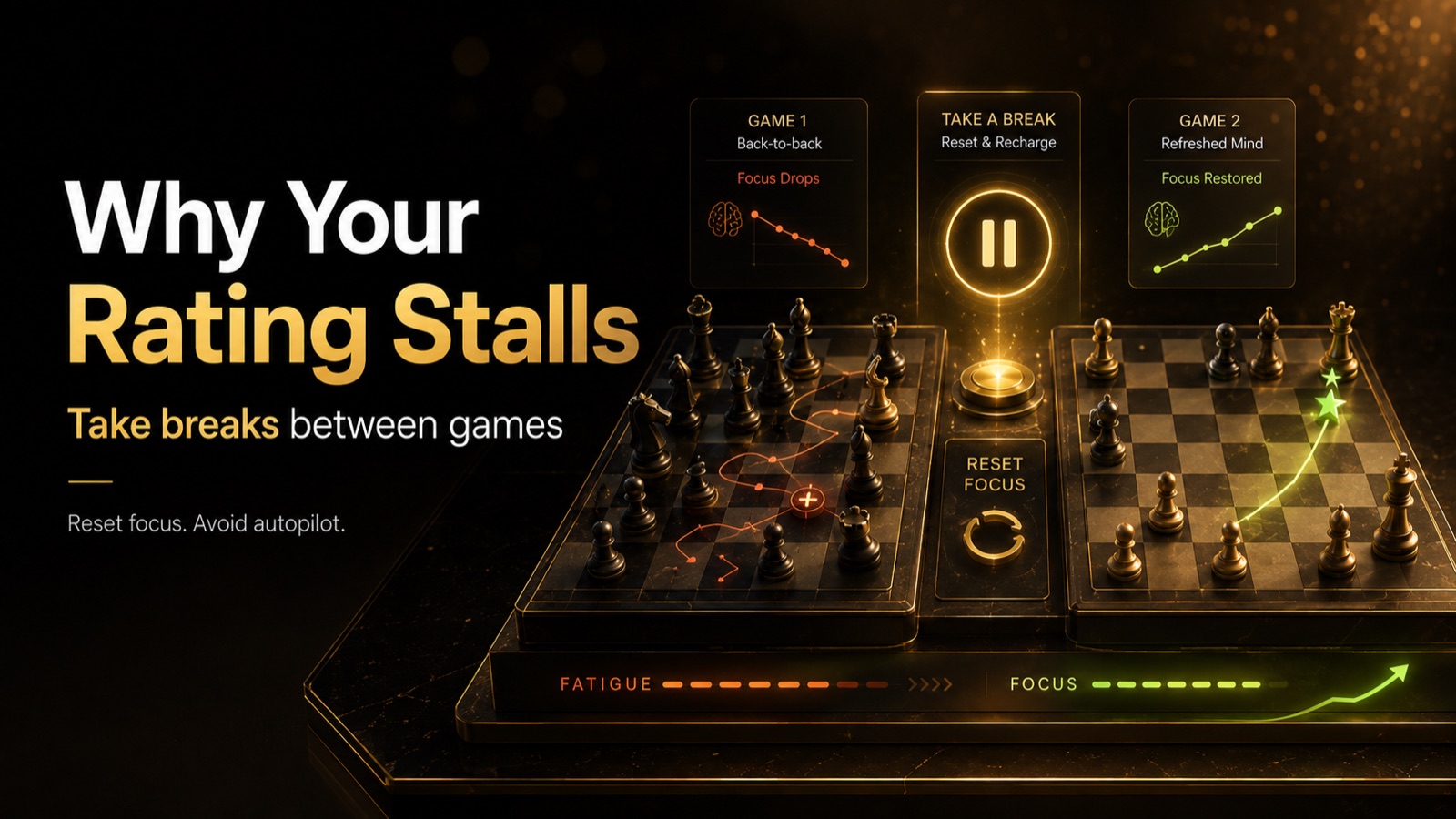
Evening. You lost a game, it stings, "one more — I'll win it back." Ninety minutes later you are eighty points down, and tomorrow it will happen again. Sound familiar? Then here is the uncomfortable truth: it is not your opponents' strength that drains your rating. It is the absence of breaks.
Streaks are not mysticism — they are data
Rating systems assume a game's outcome depends only on the strength of the two players. Reality is cruder. Analyses of large lichess datasets show that win probability also depends on the outcomes of your recent games — after a losing streak you play worse than your rating predicts. And it hits hardest not the beginners and not the masters, but the middle — the very players "stuck at 1000 with no idea why".
Poker players have long had a word for this — tilt. Anger and frustration narrow attention: you are no longer looking for the best move, you want to quickly prove the previous game was an accident. Your opponent won't notice the proof. Your rating will.
Attention is a consumable
The second mechanism is duller but more relentless. Psychologists call the ability to keep noticing rare important events vigilance — and it measurably decays after about half an hour of continuous watch: the effect was discovered back in the 1940s on radar operators who started missing signals. A chess game is exactly such a watch: ninety percent of moves are routine, but every few moves the position shouts "tactics here!" — and the one who must hear it is the tired you.
Hence the typical marathon script: game one is decent, game two is fine, in game four you hang a knight out of nowhere and cannot understand how. No mysticism: you are playing the fourth hour of a radar shift.
The brain needs a pause to record the lesson
And the third, most underrated part. A game is experience that has to settle into memory: here I locked my own bishop in, that is the fork I missed. Edinburgh psychologists showed something elegant: ten minutes of quiet rest right after learning something noticeably improves memory of it even a week later. The brain finishes filing fresh experience in the first minutes of calm — if you give it that calm.
By launching the next game five seconds after a crushing loss you do the opposite: you overwrite the previous game's lesson with a new stream of positions. Play a lot — remember nothing. That is why the effect every club player knows exists: a hundred blitz games in a week, and the play hasn't moved a millimetre.
What to do: three rules
1. A pause after every game. Five to ten minutes. Not scrolling a feed — letting your head finish writing the game down: skim it, understand the one moment where everything turned. Reviewing the game you just played is the perfect form of this pause: it is both rest from the clock and that very filing of experience.
2. Two losses in a row — emergency brake. Not "win it back" — stop. The streak data is merciless: the next game in that state is statistically your worst game of the day. Rating lost on tilt takes a week to win back.
3. Switching instead of a marathon. Between games, change your mode of thinking: solve a couple of puzzles — calm ones, without a clock. It is a different kind of work: not a watch shift but targeted recognition training. Attention gets time to recover, and puzzles on a spaced-repetition schedule teach more than "one more" autopilot game.
Quality, not quantity
Three attentive games with reviews grow you more than ten in a row on fading attention — because they grow not the games-played counter but the quality of decisions, which is what a rating is made of. We built 99chess around this rhythm: play — review with the coach — solve a few scheduled repetitions — and only then the next game. The Training tab in your profile suggests exactly how to fill the pause so it works for you.
A rating is not a reward for stamina. It is the average temperature of your decisions. Let your decisions cool down between games — and the temperature will rise.