
Evening. Your tenth game today. You play better than you did six months ago — you can feel it. And your rating sits exactly where it sat. You close the tab with a feeling that is hard to say out loud: I am doing something wrong, and I have no idea what.
This is not laziness and not a lack of talent. It is a wall, and thousands of people read the same words on it.
"I reached 1200 and hit a wall. The issue is not even that I play badly. The issue is that I don't know what to work on, and how to train it."
— a player, chess.com forum
"I've been stuck at 900 for a year. A club, books, tactics, tournaments — and still I don't understand what is wrong with my games."
— a player, chess.com forum
The engine knows everything and explains nothing
The cruel part is that the tool is already in your hands. Any engine reviews a game in seconds and shows you: here the evaluation dropped from +3 to −5. The numbers are exact. The value is zero.
"I'd like an explanation of why moves are good or bad. 'Moving your rook there blunders it because the queen can fork the king and the rook' rather than just 'stockfish says your position went from 3 to −5'. 'Learn from your mistakes' doesn't help me when I can't identify what my mistakes are."
— a player, lichess forum
And the sharpest definition we found in the whole study:
"The game review isn't able to see your plan nine times out of ten. It's a deaf grandmaster trying to lecture a beginner."
— a player, chess.com forum
Deaf, because it does not listen. It does not know what you were trying to do. It does not remember that ten moves ago you started an attack. It did not notice that you saw the threat and defended — which was the best thing you did all game. It talks about moves. But a game is not about moves. A game is about you.
What a coach actually does
Put a living coach next to you and the difference shows within a minute.
They are on your side. The opponent's move interests them only for what it changes for you: what is available now, where it got dangerous, where you won a tempo. "They should have played differently" gives you nothing — you are not playing their pieces.
They name what went right. "You spotted the threat and moved the knight away", "you castled in time", "you found the only move". A review that only scolds gets read once.
They remember the whole game. "You started pressing on the kingside and abandoned it on move fifteen." A coach connects things, because they hold the thread.
And above all, they name the pattern. "That's the third time this game you left a piece undefended." One mistake is an accident. Three is a habit. Habits are cured by awareness, and no accuracy chart will do it for you.
Why puzzles do not save you
The usual answer to a plateau is "do more tactics". People do. And they get this:
"My puzzle rating is around 1700. My game rating is 700."
— a player, lichess forum
"At puzzles, you know you have something to do. At games, you don't automatically smell the chance."
— same thread
That second line explains everything. In a puzzle half the work is already done for you: someone picked the position and said "there is something here, go find it". In a game nobody says a word. Solving puzzles and noticing that the moment has arrived are two different skills, and puzzles alone do not teach the second one.
There is an opposite extreme too — services that make you replay your own blunder. One review is worth an entire study:
"The app pulls your games, finds your mistakes and asks you to play the position correctly. I'm pretty sure that when I blundered my queen I knew what I did wrong. Re-doing it didn't make me a better player."
— an App Store review
What we are building
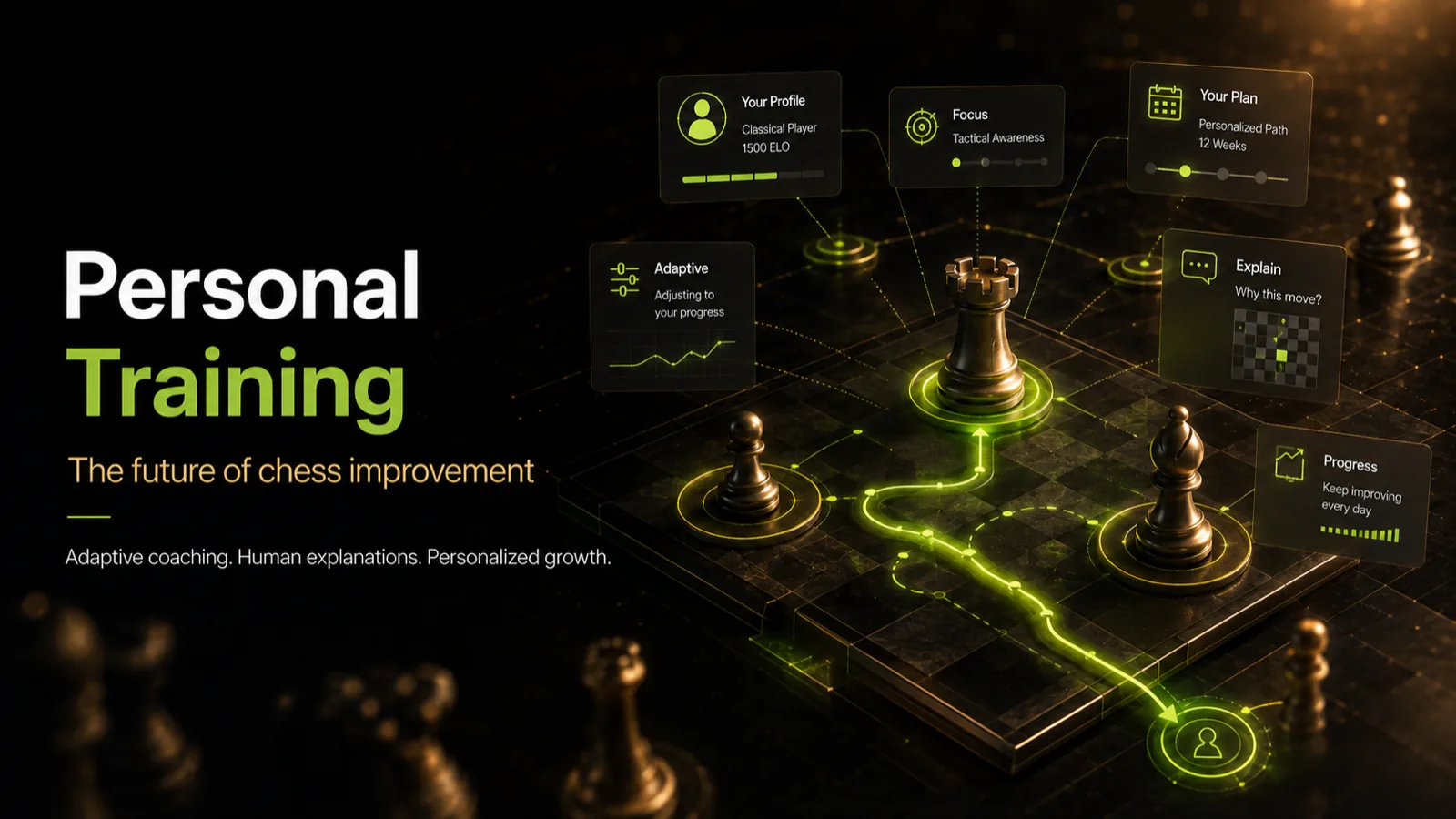
We are building a coach, not a report. The difference comes down to three things, and all three matter.
It explains your games, not games in general. Not "typical beginner mistakes", but what happened on your board last night: what your move did, how it could have been punished, whether the opponent saw it — and why you got lucky if they did not.
It does not invent. That sounds dull until you meet the opposite: confident prose about pieces that are not on the board is the most common disease of AI coaches. Ours says only what is verified against the position. When there is nothing to say, it says so briefly and honestly instead of writing something beautiful.
It carries you past a single game. Your mistakes add up to a diagnosis — not "your endgame is weak", but "you get caught by hanging pieces, mostly in the middlegame". Then that theme comes back in training, on new positions rather than the same one. Because improving means recognising a familiar idea where nobody has labelled it.
Why this makes people grow
Not because an AI is smarter than an engine — it is not. Because it removes the very thing that keeps you in place: not knowing.
Once you know what exactly does not work, training stops being a lottery. An hour a week spent on your real weakness beats ten hours spent at random. People who have been through it describe the turning point the same way:
"Having an external view on my games helped me to understand what I did wrong."
— a player, chess.com forum
That is the whole idea. No magic, no secret opening, no thousand puzzles. Just someone who watches your game with you — and says out loud what you cannot see yourself.
The board is open right now: 99chess.com. No install, no card — your first review comes minutes after your first game.