
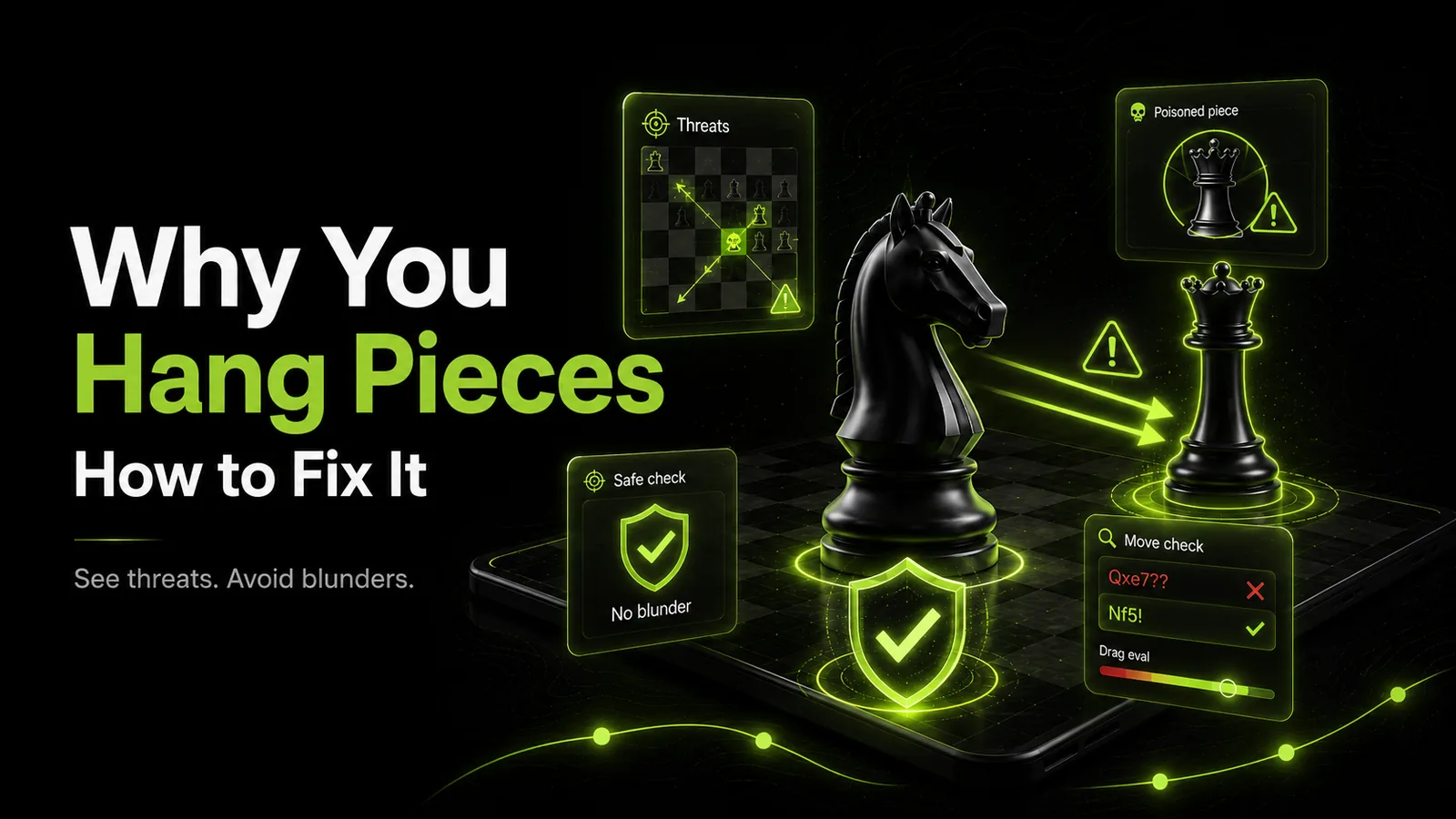
You held the position for forty moves, found a good plan, started carrying it out — and left your rook en prise. The game did not end because you lacked knowledge: "a piece under attack is bad" you learned on day one. Hanging a piece is not a gap in knowledge, it is a lapse of attention. And it is trained in a completely different way from an opening repertoire.
Why the brain misses the obvious
Blunders are not random. They have a few stable causes, and it helps to recognise them in yourself.
We calculate our own plan, not the replies
Your head is busy with your own idea: bring the knight to f5, open the file, put the rook there. In that story the opponent is an extra who will "somehow reply". Classic studies of chess thinking show that weaker players spend nearly all their time developing their own idea and hardly check what happens after the best answer. The blunder usually lives exactly there — in the reply you never looked at.
A good move switches off your guard
There is a treacherous moment right after a strong move. You found a nice idea, enjoyed it — and play the next move on autopilot, without asking yourself anything. Coaches noticed long ago: a mistake often follows a strong move, not a weak one.
We are bad at "backwards" and "from far away"
Attention is asymmetric. Forward moves and captures are easy to notice — that is an attack, we are ready for it. Quiet retreats and long-range hits across the board on a diagonal are much harder to see: nothing is moving towards you, the eye has nothing to catch. A bishop on h4 hitting d8 is the classic source of "where did that come from".
Time trouble and fatigue remove the check
The last minute of a blitz game, or move forty after a working day — that is exactly where the one check that catches blunders falls away: a short look at the position with fresh eyes. Not because you forgot how, but because there is no resource left for it.
Three questions that catch almost everything
There is an old rule by Blumenfeld: once you have finished calculating, look at the position as if you were a beginner who knows nothing about your plan. In practice it is three questions before you let go of the piece:
- What did my move change? Which square stopped being defended, which line opened, which piece was left alone.
- What is the most unpleasant reply? Not "what will he probably play", but "what is worst for me" — checks, captures, hits on two pieces at once.
- Is everything of mine defended? Run through your undefended pieces. An undefended piece is fuel for a fork, a pin and an in-between check.
That is thirty seconds. It feels like wasted time, and it is the highest-return habit in amateur chess.
How we help you see it
In training the habit is easiest to build with an external safety net — so you first learn to recognise danger, and only then start hunting for it yourself. The trainer has three things about exactly this.
- Threats. Your attacked pieces are highlighted on the board, and the colour tells you the price: yellow is minor, orange is a medium loss, red is serious. You see not "something is off", but how much exactly.
- Poisoned pieces. An enemy piece that looks free but costs you more once you take it is marked separately. That is the blunder disguised as a gift.
- Move preview. Hold a piece over a square and you get the verdict before you drop it. Not "the right move", but the price of this particular decision.
Plus the blunder alert: if a move does wreck the position, the trainer says so immediately, while you still remember what you were thinking. Reviewing that mistake two hours later is far less useful.
You must take the safety net off
Here is the main danger of hints: with them it is easy to play without checking anything. The highlight thinks for you, the habit does not grow, and in a game without highlights everything comes back.
So switch on stealth mode: it hides every hint and evaluation but keeps the alerts after the fact. You play blind, as in a tournament, and learn after the move that you blundered. That gap — "I did not see it, and I should have" — is what creates learning. A working routine: a couple of days with the highlights to learn what danger looks like, then stealth and an honest exam.
After the game: find the cause, not the mistake
In the review the board shows two arrows on each of your moves — red for the move you played, green for the move you needed. But the value is not in the fact that "there was a mistake here". Ask yourself over every blunder:
- Did I not see the threat — or did I see it and decide it was harmless?
- Was it a quiet move by the opponent, or a capture?
- What was I doing a move earlier — inventing a plan and getting carried away?
After a dozen games you will notice your blunders are of the same few kinds. Almost everyone is like that: one player never sees retreats, another keeps falling for the diagonal pin, a third only collapses in time trouble. That is no longer "I am careless" — it is a specific hole you can close.
Five habits that remove blunders
- Pause before releasing the piece. The move is already chosen — spend five seconds on the three questions above.
- After your own strong move, double the vigilance. That is where the next mistake waits.
- Look at the opponent's captures and checks first. The cheapest checks with the highest return.
- Count your undefended pieces. Two loose pieces almost always mean a fork or a double attack is available.
- Do not play important games tired. Blundering is not a character trait, it is an attention budget.
None of these habits requires knowledge you do not have. That is the good news: blunders are the fastest-fixable part of your game. Openings take months, endgames take years, and attention starts coming back within a week of deliberate practice.
You can try it right on the board: turn on threats and poisoned pieces for a few games, then switch to stealth — and see how many mistakes you catch on your own.