
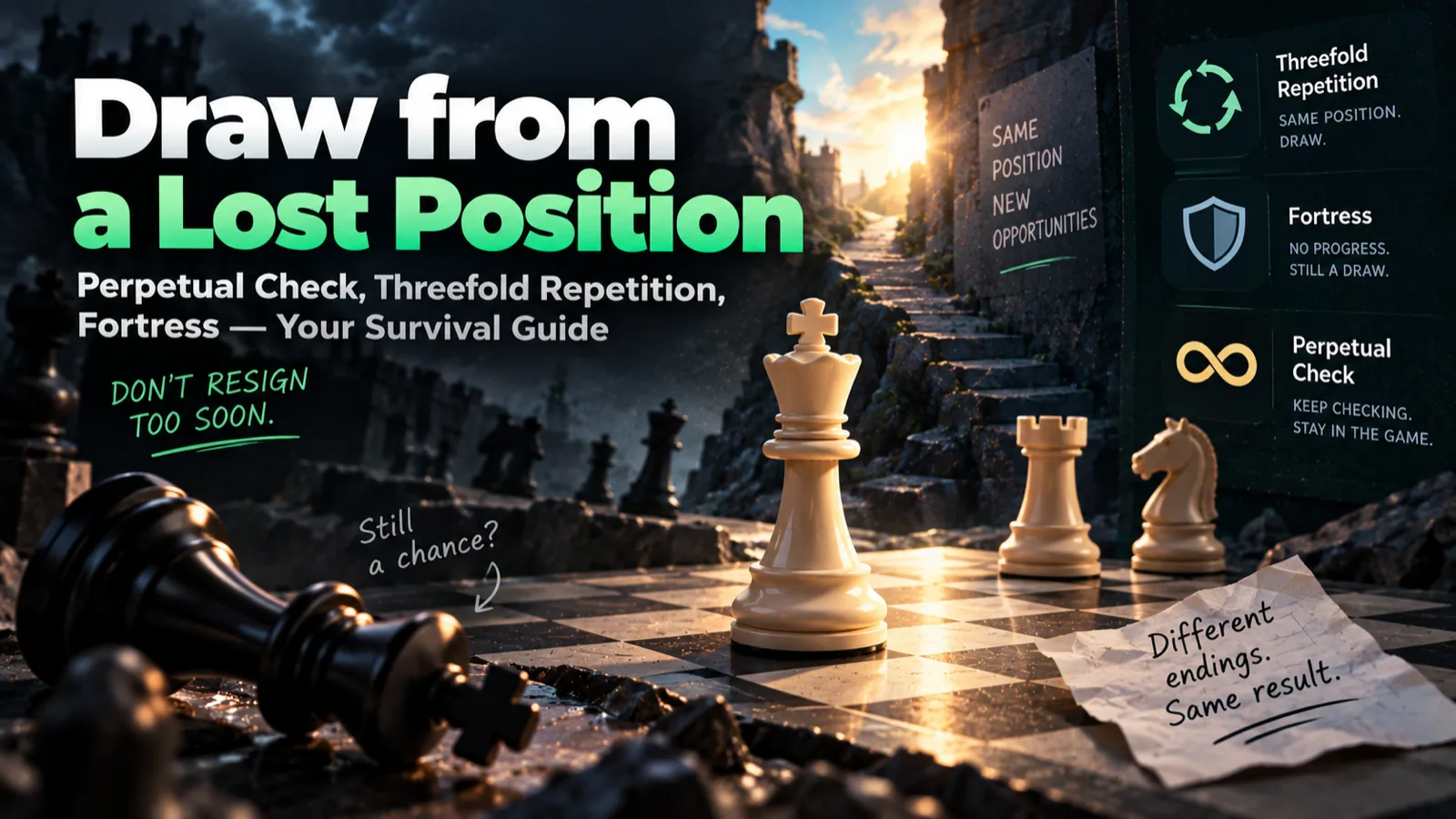
You are down a queen on move thirty. Your hand is already drifting toward the resign button — why suffer, it is over. It is not. Reviewing our students' games we keep meeting the same pattern: a player resigns in a position that still held a draw. Sometimes a draw that was one move away.
The half point you did not take is worth exactly as much as half of a win. A player who rescues two out of ten lost positions climbs faster than one who plays a better opening. Saving games is a skill with concrete techniques — and every one of them is learnable. Here is the whole kit.
Perpetual check: the draw you declare yourself
Perpetual check is a series of checks the enemy king cannot escape. You can be down a rook and two pawns — irrelevant: as long as every move you make is a check, your opponent never gets a turn to convert the advantage.
The classic picture: your opponent is up material, but their king hides behind the g- and h-pawns alone, and your queen reaches g6 and e6, or h6. Check — the king steps into the corner, check — it steps back, and the carousel spins. Material does not matter: you cannot win a game if you cannot get out of check.
A fun legal detail: there is no perpetual check rule. The FIDE laws contain no such clause — formally the draw arrives via threefold repetition or agreement. The practical meaning stays the same: an inescapable series of checks is precisely the machine that manufactures the repetition.
When to look for it: you still have a queen (occasionally a rook or two minor pieces), the enemy king is airy, and your position is hopeless. That is the moment to stop searching for ways to win material back — search for a checking route with no exit instead.
Threefold repetition and the 50-move rule: making the draw official
Two rules turn "my opponent cannot make progress" into a legal half point.
Threefold repetition: if the same position — same pieces on same squares, same side to move, same castling and en passant rights — occurs three times, either player may claim a draw. The repetitions need not be consecutive: the third may arrive twenty moves after the first. Online platforms score it automatically; over the board you must claim it.
The 50-move rule: fifty consecutive moves with no capture and no pawn move — a draw on demand. This one rescues endgames where the opponent formally has enough material but cannot convert it: rook and bishop versus rook is very often a draw in practice, and fifty moves fly by faster than they sound.
The practical corollary of both rules: in a worse position, do not move pawns and do not trade without need. Every pawn move and every capture resets the counter and creates fresh positions — you are literally erasing your own road to the draw.
The fortress: a wall that cannot be breached
A fortress is a position where the opponent has a decisive material edge and no way in. You shuffle back and forth while their extra queen bangs against the wall.
The most famous fortress many players know from painful experience on the other side: rook versus queen — set up correctly, the defender holds; a lone queen cannot chase the rook away and approach the king at the same time. Even simpler is the wrong bishop: your opponent has a rook-pawn plus a bishop that does not control the promotion square — your king parks in the corner and there is no win at all, remove every other piece if you like.
Signs a fortress might exist: a locked pawn structure, no open files for invasion, and your pieces covering the only entry squares. If there is no breakthrough, the 50-move counter finishes the job.
The rescue algorithm: four questions in a lost position
- Is there a series of checks? Examine every check, even the "pointless" ones. If the next check is unavoidable after it, you may have found a perpetual.
- Can you trade down into a drawn endgame? Giving a piece for two pawns to reach a wrong-bishop ending is the best deal on the board.
- Does a fortress exist? Lock the structure, place pieces on the entry squares — then move nothing.
- What does the counter say? No pawn moves, no captures — the clock ticks for you.
And the cheapest resource of all — stalemate, which turns +9 into a draw — has its own article, because from the other side of the board it is the most common way a draw is given away.
Resigning is a move, and it always loses
Nobody asks you to drag a bare king against queen and rook until mate — respect everyone's time. But between "hopeless" and "unpleasant" lies a huge zone where half points hide. Before you resign, spend one move's worth of time on the four questions above.
In a 99chess game review the coach shows the evaluation graph — and it makes brutally visible the moment where a "lost" position was still holding. Open any such point in the "play from here" sandbox and test the rescue against the engine with your own hands.
You can always resign later. The draw runs away faster.