
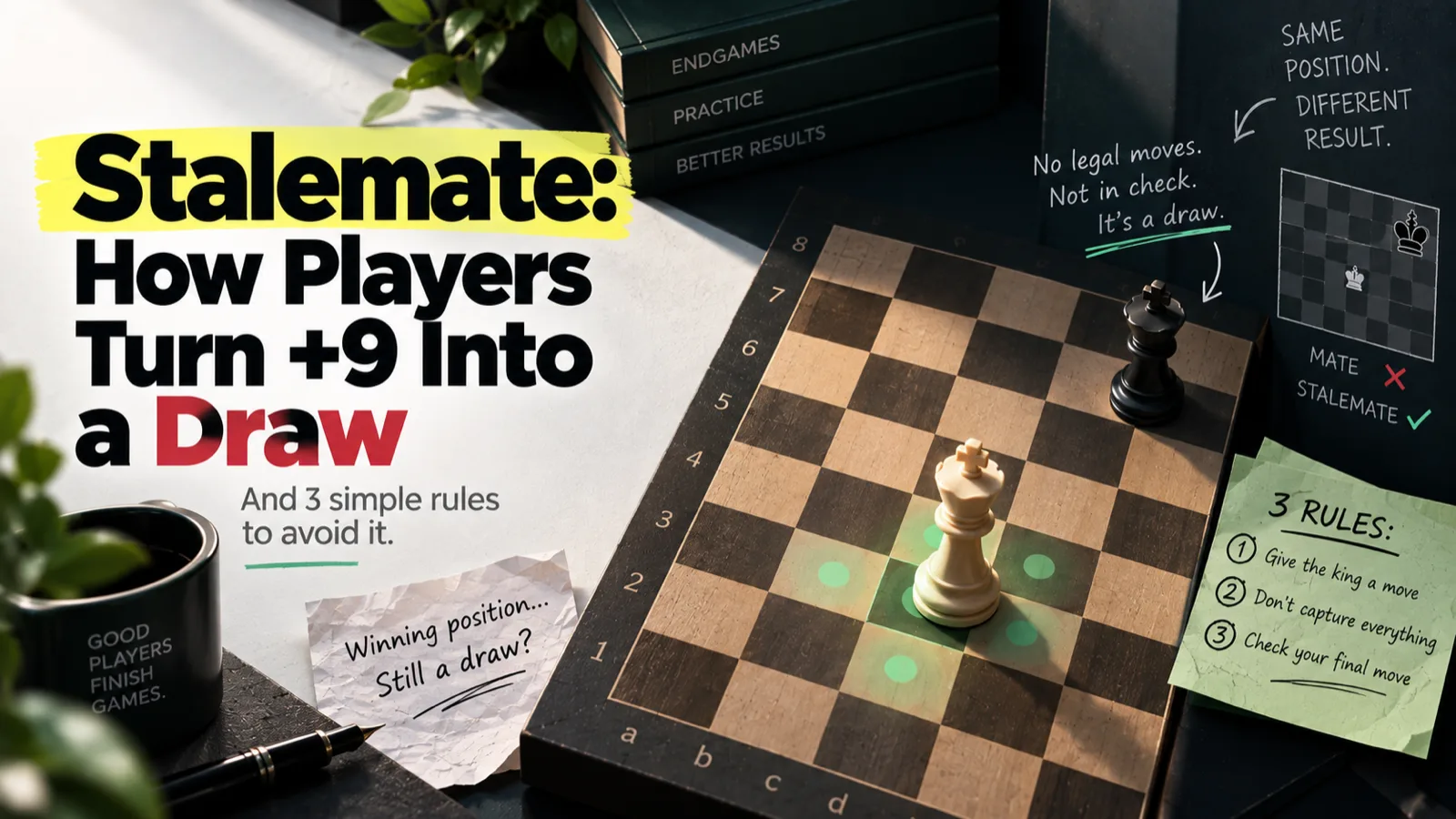
Our game reviews have a whole genre of tragedy: the engine says +9, the opponent has a bare king, mate is two moves away — and suddenly the game is drawn. Nobody blundered a queen. Nobody ran out of time. Just stalemate.
Everyone technically knows what a stalemate in chess is: the side to move has no legal move, and their king is not in check. By rule it is a draw — half a point each, no matter how overwhelming the advantage. But knowing the definition and not falling for it are different things: stalemate happens almost exclusively to the player who is winning.
Stalemate is the winner's mistake
It sounds unfair, but the logic is airtight: for the defending king to run out of squares, someone had to take them all away. The one taking squares away is the one with the pieces — that is you. Every "tidy improving move" of a queen near a bare king deletes a few squares from its list. At some point the list is empty.
Two positions come up so often they are worth knowing on sight. First: the enemy king in the corner on a8, your queen lands on c7 — no check, no moves, draw. Second: your opponent has a king and one blocked pawn; you grab the pawn — and with it the only move they had left. It was +9; now it is a half point.
Rule one: the king must always have a move
Until you are ready to deliver mate on the very next move, make sure the defending king keeps at least one free square — ideally two. There is no prize for suffocating the king "in advance": your advantage is not going anywhere, but every square you take beyond necessity brings the draw closer. In the queen mate this rule is strict: once the king reaches the edge, the queen stops approaching — only your king keeps walking.
Rule two: don't grab everything in sight
Greed is the second supplier of stalemates. Your opponent's last pawn is not loot — it is their only spare move. While that pawn can still step forward, stalemate is impossible by definition: let it shuffle along, it does not stop you from mating. Take it only if it is running to promote, or you see the forced mate after the capture. Same with promotion: a second queen on the board doubles not your strength but your stalemate risk — two heavy pieces blanket half the board at once.
Rule three: check their reply before the "finishing touch"
The most dangerous moment is the second-to-last move, when your hand is already reaching to "tighten" the position before mate. Build a one-question habit: if I play this move and it is not check — what does my opponent answer? Name their move, out loud or in your head. Found none — stop: you are looking at either mate or stalemate, and it is far better to find out before the move than after. The check takes three seconds and kills nearly every stalemate we see in real games.
When you are losing, stalemate plays for you
The coin has another side: in a hopeless endgame, stalemate is a legitimate chance to save half a point. Shed your last pawns, tuck your king into the tightest corner and invite your opponent to get greedy. Below 1400 this works more often than people admit — precisely because almost nobody follows the three rules above.
And don't confuse stalemate with checkmate: mate is a check with no defence; stalemate is no moves and no check. One word of difference — and a full point in the standings.
In the trainer these stories don't slip by: the coach marks the exact move that turned a win into a draw and explains in plain words which one was needed. And you can replay the same ending against the bot — this time without the stalemate — straight from the review, while the lesson is fresh.
Stalemate does not happen to you — your own hands make it. The good news is the same: your hands can simply stop.