
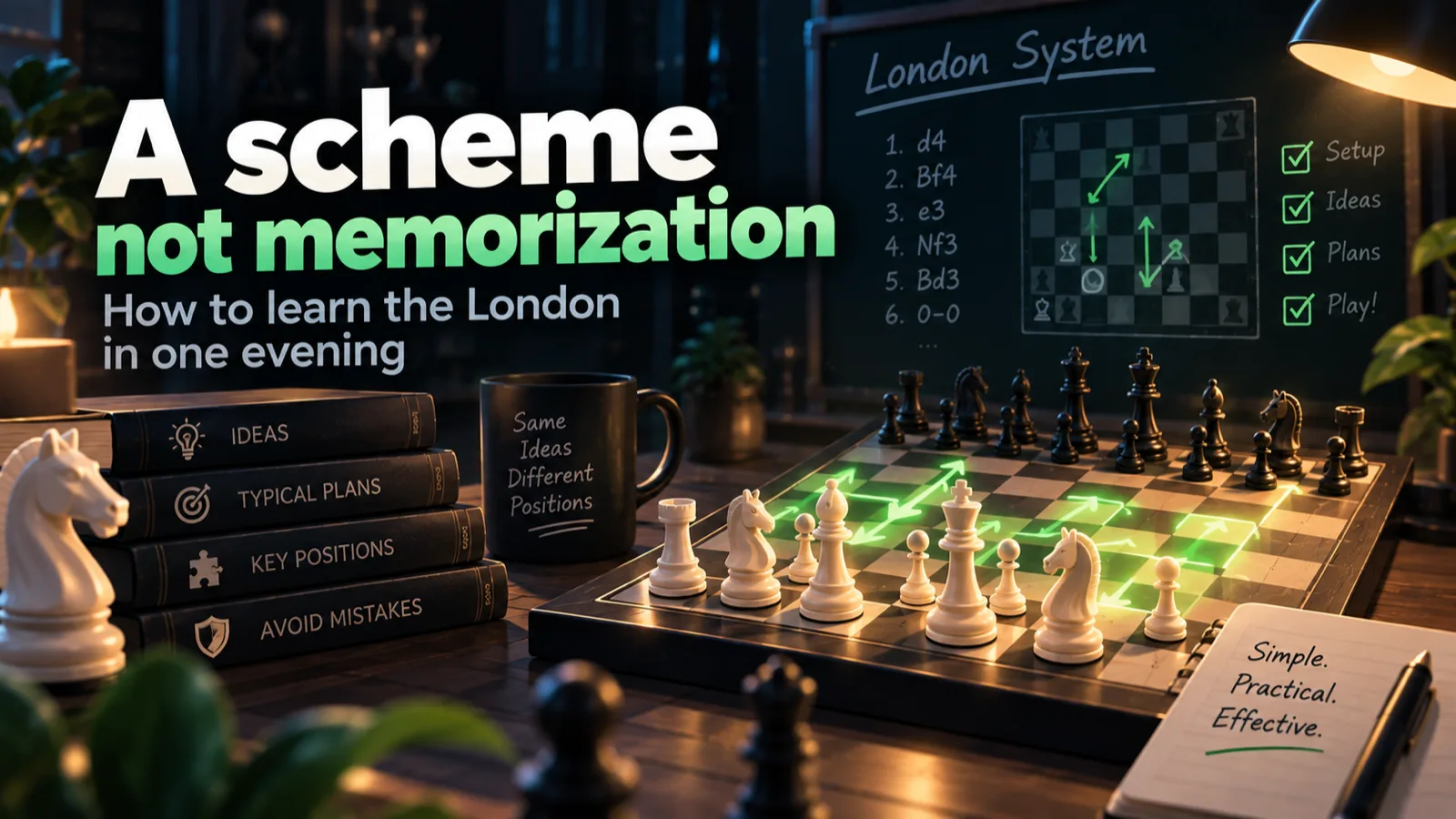
Opening course sellers don't love the London System. There's nothing to sell: instead of thirty chapters of variations, one picture. Pawns on c3–d4–e3, bishop on f4, knights on f3 and d2, bishop on d3, castle. Seven squares. Everything after that isn't theory — it's chess.
That's exactly why the London is the ideal first opening for White. We've already written about why you shouldn't study opening variations below 1600. That article left one honest question open: then what should you study? Here's the answer, on one example, in a single evening.
The London is a structure, not a variation
In a normal opening you argue with your opponent about which position to play. They pick the Sicilian — you'd better know the Sicilian. In the London there is no argument: White builds their own house regardless of what the neighbors are doing.
The only move you memorize as a rule: the bishop goes to f4 before the e3 pawn. Play e3 first and the bishop stays locked on c1, staring at the backs of its own pawns for the rest of the game. Everything else is common sense: the c3–d4–e3 wedge holds the center, the knights take their squares, the second bishop aims at h7, the king tucks away before move ten.
The move order can wander — and that's not a flaw, that's the point. Opponent played g6 instead of d5? Build the same thing. Developed a knight before the bishop? Build the same thing. The scheme needs no memory of other people's decisions.
One evening, on the clock
The plan, without romance:
- 20 minutes — the setup and the why. Not just where the pieces go, but why: bishop before e3, the wedge as a foundation, the d2-knight staying clear of the c-pawn. If you can explain every move out loud, this stage is done.
- 30 minutes — three plans. They're below. Plans are what keep the scheme alive after move ten.
- 40 minutes — assembly under resistance. Not repeating a line, but building the structure against an opponent who replies differently every time. That's the only test that means anything.
Ninety minutes. After them you don't "know the London" in the encyclopedia sense — you can play it, which is better.
Three plans instead of thirty variations
The knight rides to e5. The key square of the whole system: an outpost no pawn can challenge without a concession. Support it with f4 — and a trade on e5 opens the f-file for your rook instead of solving your opponent's problem.
The h7 battery. The d3-bishop and the e5-knight stare at the same square — h7, right next to the enemy king. Every classic London attack grows out of this battery: the bishop sacrifice on h7, the knight blow on f7, the queen swinging to the kingside via f3.
Don't open the center without a reason. The c3–d4–e3 wedge isn't decoration, it's the foundation: while it stands, your pieces work the wings in peace. Open the center only when the file that appears belongs to your rook. Against a fianchetto the system carries a separate idea — a prepared e4 break — but even that is played from a finished structure, not instead of one.
The test is a real opponent
Reciting a line from memory is not the same as playing it. The real exam looks different: your opponent replies in ways no book predicted — and you still reach your setup by move ten. In what order doesn't matter. What matters is that the house stands.
We built that exam into the trainer. In study mode the coach explains the why of every move, and the depth grows with your results — from nine moves to the full seventeen with an attacking plan. In drill mode the bot deliberately varies its replies, the trainer quietly tracks a setup checklist, and on move ten it hands down a verdict: assembled, assembled with a rough edge, or fallen apart — showing exactly what was missing.
One evening, one picture, three plans. Opening preparation that fits in your head — which is why it works.