
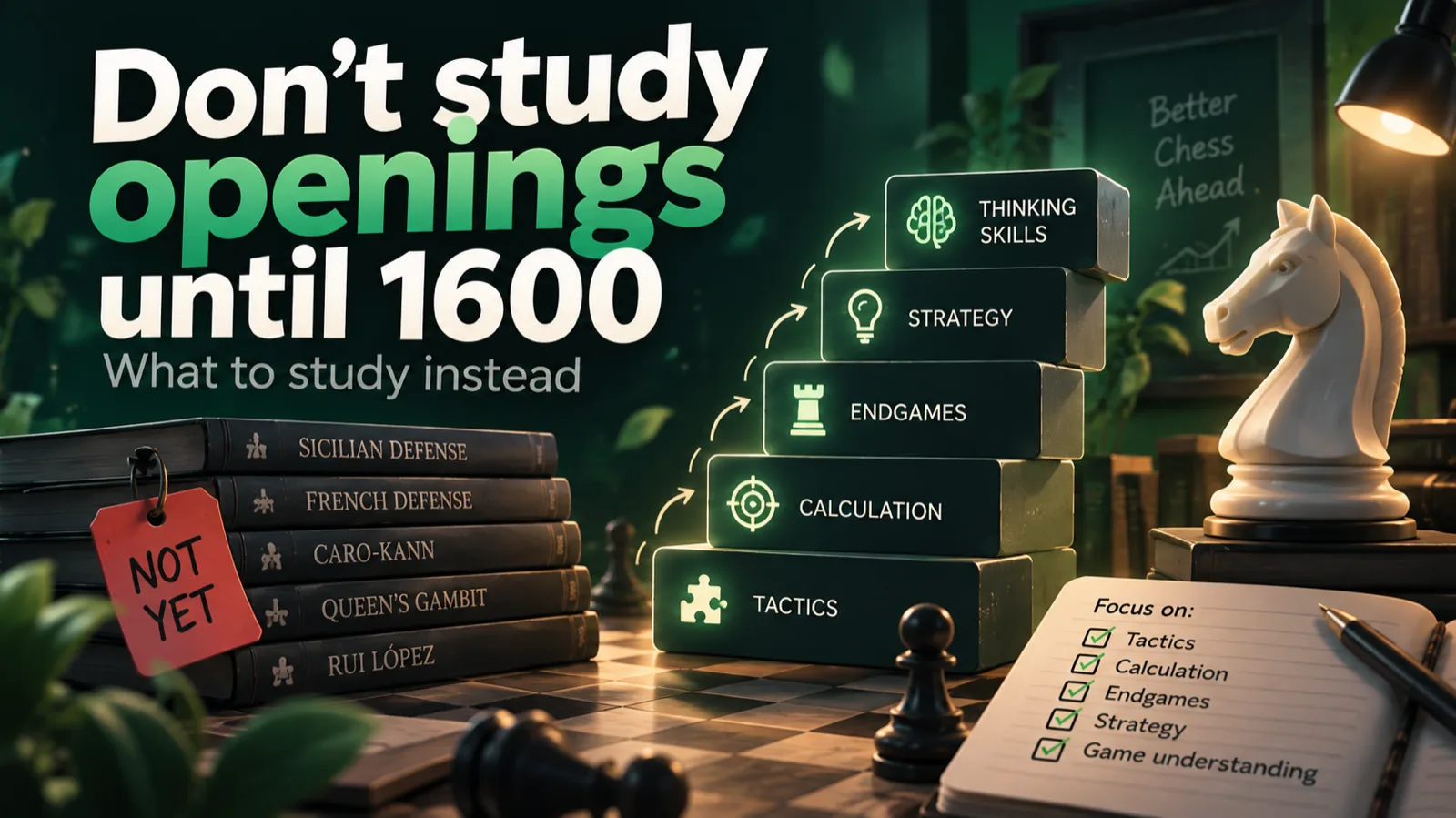
You memorized twelve moves of the Sicilian. Friday night you sit down to play, your opponent develops the knight to the wrong square on move three — and that's it: theory is over, and now the two of you are just playing chess. Sixteen moves later you leave a bishop hanging, and the game ends the way most games below 1600 end — not with an elegant opening trap, but with a blunder.
When should you study chess openings? The chess internet answers this with surprising unanimity: coaches converge on spending five percent or less of your study time on openings until you're rated around 1700. But "win with White in ten moves" courses sell far better than the truth — so the truth needs repeating.
Openings don't lose games. Move 19 loses games
We run engine analysis on thousands of amateur games, and the phase breakdown tells the same story every time: between 800 and 1500, the overwhelming majority of decisive mistakes happen in the middlegame and endgame. A piece left en prise. A fork nobody saw. A trade into a lost pawn ending. The opening phase, meanwhile, usually goes tolerably — not because you know it, but because your opponent doesn't know it either.
That's the core trick: a memorized line only works if your opponent plays along with the book. At your level, they don't play along — they bring the queen out on move four and go after f7. Memory doesn't help against that. Looking at the board and counting does.
Why it still feels like the opening's fault
The opening illusion is simple machinery. By move fifteen the position has turned unpleasant, you no longer know what the fight is about — and your brain helpfully offers a comfortable conclusion: "I don't know this variation." It's comfortable because it comes with an easy fix: learn the variation. Buy the course. Watch the video.
The uncomfortable truth reads differently: the position turned unpleasant because three moves ago you moved without asking what it changed for your opponent. That's fixed by a habit, not by memory — and one fixed habit moves your rating further than forty catalogued mistakes.
Five moves of principles beat twenty moves of theory
Everything you actually need from the opening below 1600 fits in a few lines. A pawn in the center. Knights and bishops before the queen. Castle by move ten. Don't move the same piece twice without a reason. Don't grab a pawn at the cost of three tempi.
That's enough to reach a playable middlegame against anyone at your level. Notice there isn't a single variation in there. Principles work against any move order your opponent chooses; a variation works against exactly one.
What to study instead: three things that move your rating
- Tactics built from your own blind spots. Not random puzzles — the motifs you actually missed in your own games. If you've overlooked three forks this month, you need forks until they jump off the board at you. Spaced repetition turns that into a vocabulary of positions you recognize on sight.
- The habit of checking every opponent move. One question — "what did his last move change?" — catches nearly every blunder. It's duller than the Catalan, but it pays out in every game, not one in twenty.
- An endgame minimum. Promoting a pawn, opposition, an active king. Half a point in every long endgame — knowledge that never expires and doesn't depend on opening fashion.
When openings finally earn their keep
Past 1600–1700 the picture honestly changes: games start surviving into positions where structure and plans matter, opponents stop handing you pieces — and that's when a repertoire begins to pay for itself. Even then it looks modest: one opening as White, one answer to 1.e4, one to 1.d4 — ideas first, moves second. Understanding what the fight is about in the resulting position survives any surprise move.
Our trainer shows you this in your own games: the analysis breaks your mistakes down by phase and by motif, and one look at the dashboard is usually enough to see the points are not leaking in the opening. The training program then feeds you puzzles on your weakest theme until it stops being weak.
Theory begins where blunders end. Until then, your best opening preparation is reaching the middlegame with all your pieces — and counting one move further than your opponent.