
An evening of blitz: minus forty points. Did you get forty points worse at chess in three hours? Of course not. But the number next to your name is different now, and so is your mood.
So here's the uncomfortable question: if your rating can drop forty points while your strength hasn't moved at all — what exactly does it measure?
Ratings measure a queue of results, not a player
Elo is honest math, but it measures something other than what we think. The formula answers one question: how often you score against a specific pool of opponents. That's excellent for pairing players and for tracking trends across hundreds of games. It's a poor answer to "how strong am I right now".
Look at what goes into the number. The pool: the same play earns a rating 200–400 points higher on lichess than on chess.com — same strength, different neighbours. Variance: everyone loses five games in a row sometimes, and it means nothing. State: fatigue and tilt eat dozens of points in one evening without a single new gap appearing in your knowledge.
A rating is a street thermometer that ten passers-by have breathed on. It does reflect the air temperature. On average. Over a month.
Strength is decision quality, not points scored
Coaches have always known this: to gauge a student's level, a master doesn't ask for their rating — they look at three or four games. What does this person do with a hanging piece? Do they see a fork two moves out? Do they panic in a worse position, or dig in?
In other words, strength is the quality of your decisions at the board, not the sum of your results. And decision quality has a lovely property: it can be measured in a single game — if you set up the right conditions. Like a lab: remove the noise, calibrate the load.
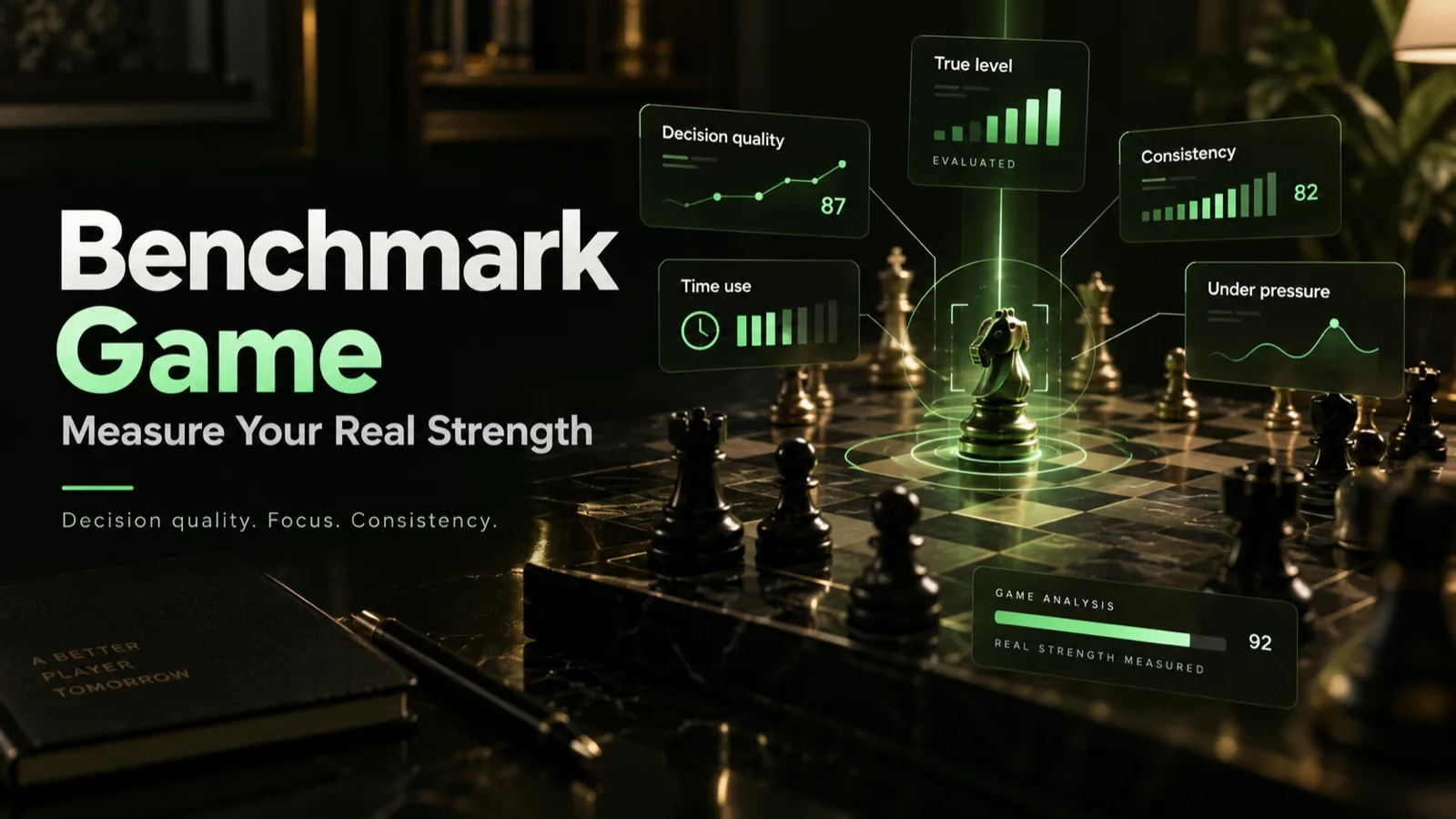
That is exactly what the benchmark game in our trainer does.
What a benchmark game is
It's an exam game, and it differs from a regular training game in two ways.
First: every hint is off. No highlighted threats, no plan card, no coach at your shoulder. In regular games the safety net is useful — it teaches. But you can't measure with it on, just as you can't grade a dictation written with spell-check enabled.
Second: the opponent is calibrated to you. Not the "easy" or "strong" preset — a bot tuned to the middle of your current strength band: search depth, move variety, error rate, all matched to one specific level. A game against such an opponent is informative: both a win and a loss tell you something. A 1400 player crushing an 800-level bot tells you nothing.
Where the trainer gets your band
From work, not from guessing. If you've brought your games over from chess.com or lichess, the band is built from the median of your ratings in recent games — your actual strength on the platform, give or take a hundred. No games? Then a cautious conversion from your puzzle rating, with an offset (solving puzzles is easier than playing) and a wide margin. Neither? The trainer honestly says "don't know yet" and refuses to invent a number.
Every benchmark narrows the band. And it works in both directions — which is the key difference from a rating: a lost benchmark game is exactly as useful as a won one. It doesn't take points away. It refines the measurement. You can't fail this exam — you can only learn the result.
Why the benchmark doesn't come weekly
The trainer offers a benchmark game not "once a week" but after a block of work: once you've solved 25 puzzles and played 8 games on your current theme. The logic is simple: measurement makes sense when something could have changed. Weighing yourself after every meal is a neurosis; weighing yourself after a month of training is data.
That's why the benchmark sits at the end of the cycle: review your weak spots, drill the theme, play — now let's see if anything moved. If it did, the band shifts up, and the next cycle builds from the new mark: slightly harder puzzles, a slightly stronger opponent.
What to do with this today
Stop checking your rating after every session — it's noise, and we've already written how playing in long streaks only makes it worse. Watch the thing that measures honestly: decision quality under identical conditions against an equally calibrated opponent, once per cycle.
The rating will catch up. It's always late — but it always arrives.