
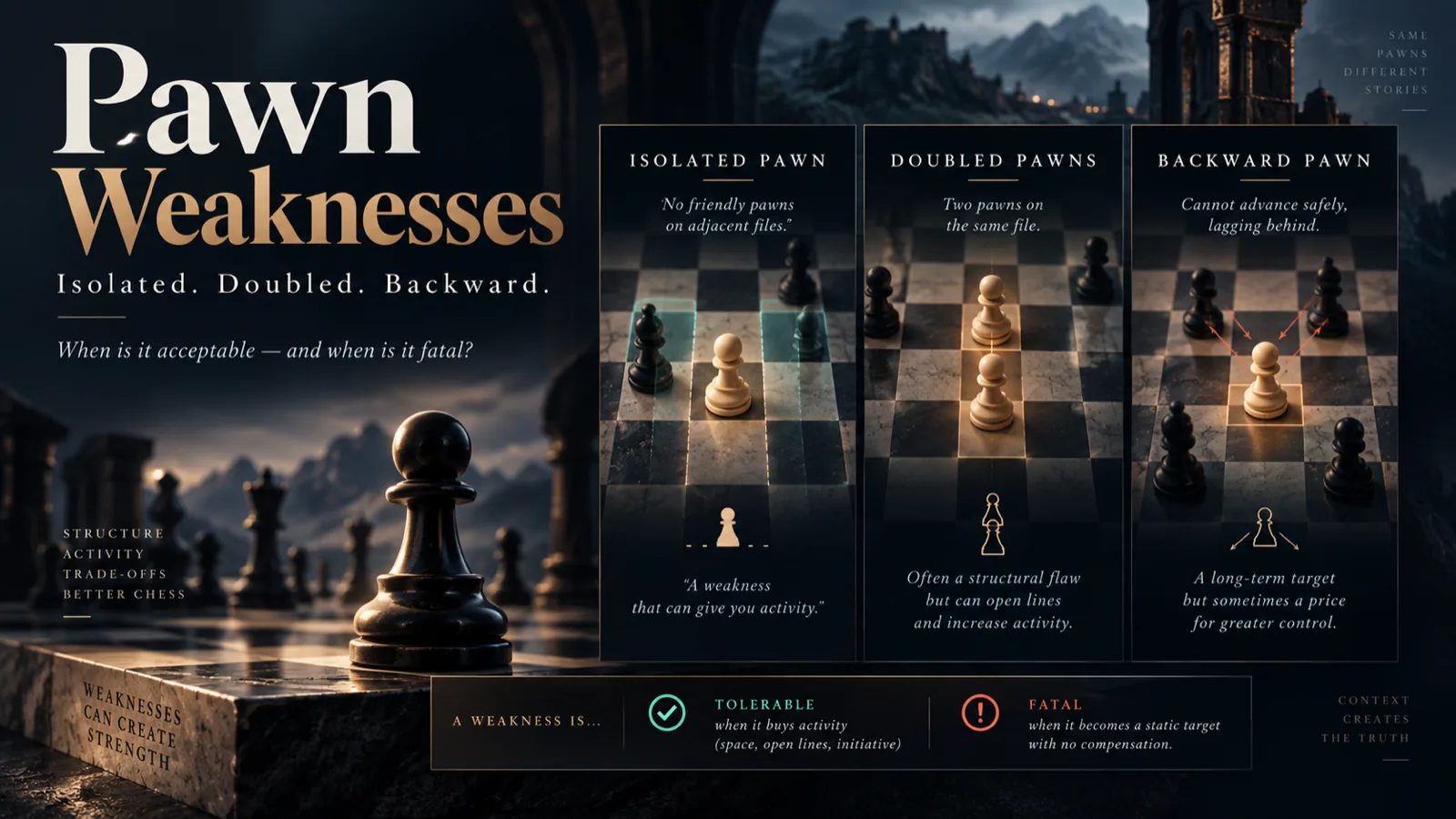
You trade a bishop for a knight, saddle your opponent with doubled pawns, and quietly award yourself half a point — their structure is ruined, after all. Twenty moves later their rook owns the newly opened b-file, their knight is parked on d4 in a hole your own “healthy” pawns left behind, and you are the one losing.
“Is an isolated pawn bad?”, “how bad are doubled pawns really?” — thousands of people ask this, and almost everyone answers with a list of definitions. But below 1600, weak pawns do not lose games. What loses games is the belief that a weakness is a verdict: you either avoid every structural defect in a panic, or celebrate your opponent’s and forget to keep playing.
A weakness is a price, not a diagnosis
Nimzowitsch already described the isolani as static weakness fused with dynamic strength, and nothing has changed since: a weakness costs exactly as much as what you got for it. Traded structure for a tempo, an open file, a square for your knight? Fair deal. Accepted it because “that is how you recapture in this opening”? Bad deal.
The isolated d-pawn is the perfect illustration. In return you get two half-open files, the e5 square for a knight, space and fast piece play. While the board is full, that position is dangerous — for your opponent. The catch is that the weakness is permanent and the compensation is not: pieces come off, and what remains is a pawn no pawn can cover.
Three questions decide the fate of any weakness
Before you panic about a defect in your own camp — or gloat over your opponent’s — answer three questions.
- Can it be attacked? A pawn no pawn can defend has to be babysat by pieces. If your opponent has a half-open file pointing straight at it, you lose a piece from the game — not for a move, but for the rest of the game.
- Who owns the square in front of it? This is the real question. A pawn only becomes a target when it cannot advance and something permanent sits in front of it.
- How many pieces are left? Dynamics live only while you have something to attack with. Every trade makes the static weakness heavier — which is why the decision to trade queens in such positions costs more than it looks.
Tolerable or fatal
| Weakness | Tolerable when | Fatal when |
|---|---|---|
| Isolated | pieces are on, half-open files work, a knight eyes e5 | queens are off, a solid blockader sits in front, rooks pile up on the file |
| Doubled | you got an open file and extra control of central squares | they are also isolated and on a wing: three pawns against two make no passer |
| Backward | you can genuinely push it, or you own the square ahead | the square ahead became a permanent knight outpost and the file is half-open |
Doubled pawns are the most slandered defect in chess
Straight answer: doubled pawns by themselves almost never lose a game. In exchange you nearly always get an open file for a rook, and the pair often holds key central squares — a pawn on c3 nails down d4, and no knight will ever land there.
The genuinely bad combination is a different one: doubled AND isolated AND on a wing. That is where the arithmetic that decides endgames kicks in — three pawns against two on one flank cannot produce a passed pawn, so you are effectively a pawn down. You just find out about it thirty moves later.
A backward pawn is dangerous because of the hole in front of it
A backward pawn is one that has fallen behind its neighbours and cannot catch up. People pity it for the wrong reason: the trouble is not the pawn, it is the square in front of it that lost pawn control forever. A knight there cannot be evicted by anything and presses on the whole position while enemy rooks calmly double on the half-open file.
Hence the cure: do not defend it forever, look for the moment to push it — one advance turns a permanent weakness into an ordinary trade. If pushing is impossible, trade off the piece that sits in front of it, even at the cost of some passivity.
What to do about it over the board
If the weakness is yours, play ahead of the clock. Compensation has a shelf life, so your pieces must work now: grab files, plant the knight on its outpost, start something on a wing. The worst plan is limp defence plus cheerful trades, drifting into an endgame where only static factors speak.
If the weakness is your opponent’s, do not rush to eat it. The old sequence still works: fix it first (take away the advance), then blockade the square in front with a piece, then trade off its defenders, and only then collect. Ninety percent of such positions are won by step two, not step three.
The easiest way to see what your structure actually bought you is the game review: the coach on 99chess explains in words what you received for those pawns and whether it was enough, while the evaluation graph shows the exact moment your compensation ran out and the weakness stayed. How a plan grows out of that, we covered separately.
No pawn is weak on its own. It is made weak by the piece staring at it, and by the square that piece cannot be chased from.