
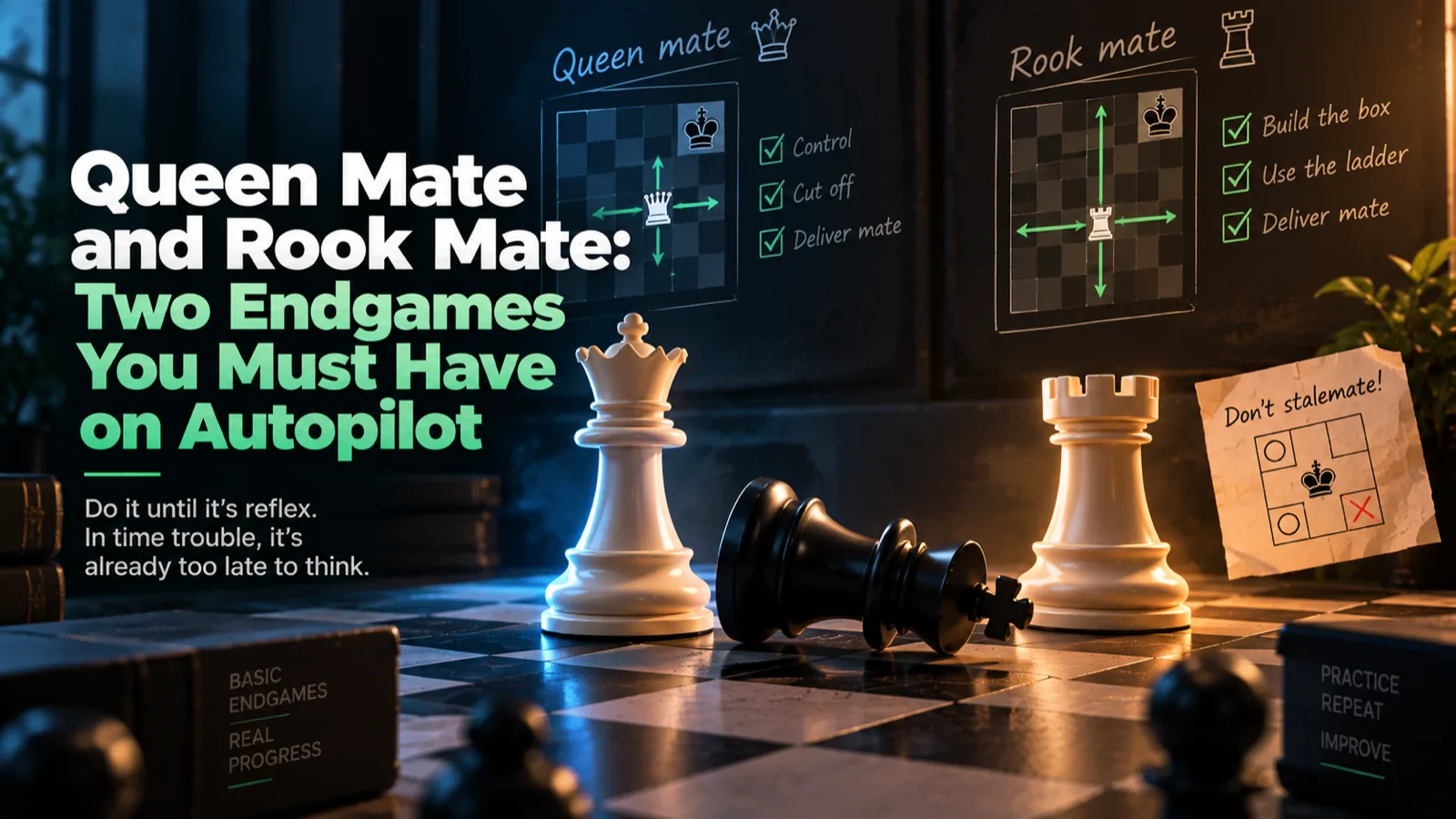
Thirty seconds on the clock. You are up a full queen, your opponent has a bare king. Six moves later the game is drawn: stalemate. We see this scene in game reviews below 1200 with depressing regularity — completely won positions where the player either stalemated the defender or chased the king around the board with checks until the flag fell.
Knowing how to checkmate with a queen — or with a rook — is not knowledge. It is motor skill. And it gets tested not in a calm position with a full clock, but on the last minute, when thinking is no longer an option.
Knowing the mate and delivering it are different skills
Ask anyone and they will answer correctly: drive the king to the edge, bring your own king over. The problem is that in time trouble you do not reason — you play with your hands. If your hands do not know the route, improvisation begins: check, another check, the enemy king strolls around the centre, your clock melts.
That is why the basic mates deserve to be drilled like scales on a piano: from any position, without thought, with time to spare. The honest benchmarks come from tablebases: the queen mates in at most 10 moves, the rook in at most 16. If it takes you thirty, the route is not in your hands yet.
The queen mate: knight distance, no checks
The most reliable method is to keep your queen a knight's move away from the enemy king. The king steps — the queen mirrors the step, keeping the same distance. You need no checks at all: the queen simply herds the king, and it backs into the edge on its own, losing squares with every move.
Once the king is pinned to the last rank, phase two begins: the queen freezes, and your king walks over. When it reaches the neighbouring file — mate in one or two: the queen lands next to the enemy king under your king's protection, or strikes along the back rank.
The one-line rule worth memorising: the queen shadows like a knight, the king arrives, the queen delivers.
Stalemate is why you don't win won games
The knight-distance method has one trap, and it is exactly the one that turns +9 into a draw. When the enemy king is already cornered, "one more tidy queen move" can take away its last square. The classic: king on a8, queen arrives on c7 — no check, no legal move. Stalemate, handshake, half a point gone.
Hence the stop rule: the moment the defending king reaches the edge, the queen stops approaching. Entirely. Every remaining move belongs to your king. And before any "finishing" move, one question: does his king still have a move? No check and no move is a stalemate, not a win.
The rook mate: a shrinking box, not a ladder
With a single rook, checks work even worse: the king simply walks up and chases it away. The working method is the box. The rook cuts off part of the board along a rank or file, and the box gradually shrinks. It is not the rook that shrinks it — it is your king, walking up and taking squares away shoulder to shoulder.
The key moment is the opposition. When the kings stand directly opposite each other, a rook check shoves the enemy king one rank closer to the edge. If the defender refuses to step into opposition, make a waiting move with the rook along the same line: the box stays intact, and now he must move — sooner or later straight into opposition.
Stalemate lurks near the corner here too: a rook cutting off the second-to-last rank plus your king hugging the corner can leave the defender with nothing. Same question before every quiet move: does he have a move left?
Making it automatic
The test is simple. Set up king and queen versus king from a random position and mate within thirty seconds. Then the rook — within a minute. Three times in a row, no stalemate, no repeated positions — the skill is there. If you stumble, drill ten endings a day; it costs five minutes and pays for itself in your very first time scramble.
These two mates are the foundation the rest of your endgame stands on: the opposition, the square of the pawn and the rook behind the passer only matter when you can finish the final stage without thinking.
In the trainer this shows up as numbers: the review counts endgame mistakes separately — the “Endgame” row on your statistics page shows how many points leak exactly there, and the coach marks both the missed mate and the stalemate that was one move away. You can replay the ending against the bot right on the site — as many times as your hands need.
A won position is not a won game. The game goes to the player who has the mate in their hands, not in their head.