
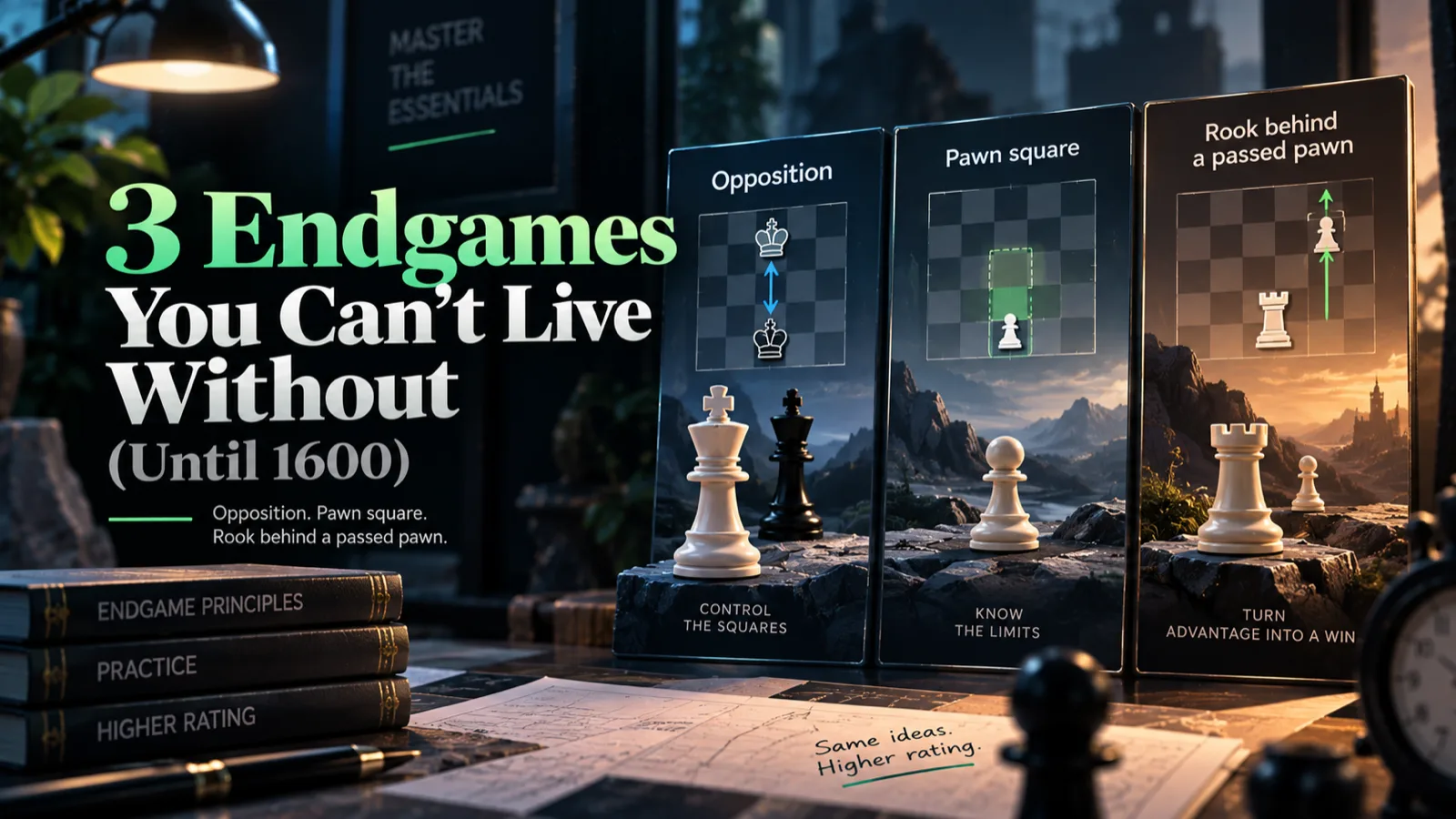
You won a piece in the middlegame, traded queens carefully, reached king and pawn versus king — and drew. Sound familiar? In our game reviews this is the most painful way to lose points below 1600: not a blunder, an unconverted win. And it is almost always one of the same three stones everyone trips over.
The good news: you don't need a four-hundred-page endgame manual to stop tripping. You need three ideas, each fitting in one sentence, and one evening of moving pieces by hand.
Opposition: the player who does NOT have to move wins
King and pawn versus king is how every second long game ends. One standoff decides it: kings face to face with one square between them. Whoever must move has to step aside — so the opposition belongs to the player who stands in it when it is NOT their turn.
The typical mistake looks identical game after game: the side with the pawn happily pushes it forward, the king trailing behind — and at the critical moment it turns out you are the one who has to give way. A draw in a perfectly won position. The rule that cures it: the king walks in front of the pawn, not behind it, and before every king move you ask who will hold the opposition after it. There is nothing to calculate — you understand it once and remember the feeling: “my move means I step aside.”
The bonus that doubles the value: defending a pawn down, you use the very same knowledge in reverse — take the opposition on the opponent's turn and hold it, and half of your “lost” pawn endings become draws.
The square: whether the king catches the pawn — no counting required
Your opponent launches a passed pawn on the far side, your king is far away, and the painful count begins: “the pawn needs four moves, I need five… or four?” That count is the first thing to break in time trouble — and time trouble is exactly when these positions happen; we've written about why.
The rule of the square removes counting entirely: mentally draw a square whose side runs from the pawn to its promotion square. If your king can step inside the square, the pawn is caught; if not — run your own pawn. One footnote people forget: if the pawn is still on its starting square, draw the square as if it had already made its double step — otherwise a “caught” pawn suddenly escapes.
This rule saves more than half-points — it saves clock time: “chase or push” becomes a two-second glance instead of a two-minute calculation.
The rook goes BEHIND the passed pawn — yours and theirs
Rook endgames are the most common of all, and one habit there replaces half a book of theory: the rook belongs behind a passed pawn. Any passed pawn — yours or your opponent's.
The logic in one line: behind your own passer the rook pushes it from the back — every step the pawn takes makes the rook stronger. Behind the enemy passer the rook breathes down its neck — the pawn cannot move unattended while your rook stays free. The typical mistake is parking the rook “beautifully” in front of the enemy passer: with every pawn step the rook has fewer squares, until it must give itself up for the pawn.
Check your own recent rook endings: if your rook ended up in front of a passer — that is exactly where the half-points leaked.
One evening instead of four hundred pages
Learn it the same way as an opening setup: by doing, not reading. Half an hour on the opposition (king and pawn vs king from both sides until you stop thinking), fifteen minutes on the square (a handful of “catches it / doesn't” positions by eye), half an hour on the rook behind the passer. That volume genuinely covers you up to 1600; beyond it come refinements like the Lucena bridge — built on these same three stones.
Why these three and why they're enough is visible in the 800→1600 ladder of mistakes: endgame losses there are strikingly repetitive. In 99chess reviews these episodes are easy to spot — a flat evaluation graph until the last fifteen moves, then a cliff — and the What-to-improve tab shows your error rate by game phase: if the endgame row is redder than the rest, start with these three ideas.
The endgame is the only phase where a few rules honestly substitute for talent. These three sentences are the cheapest rating you will ever buy.