
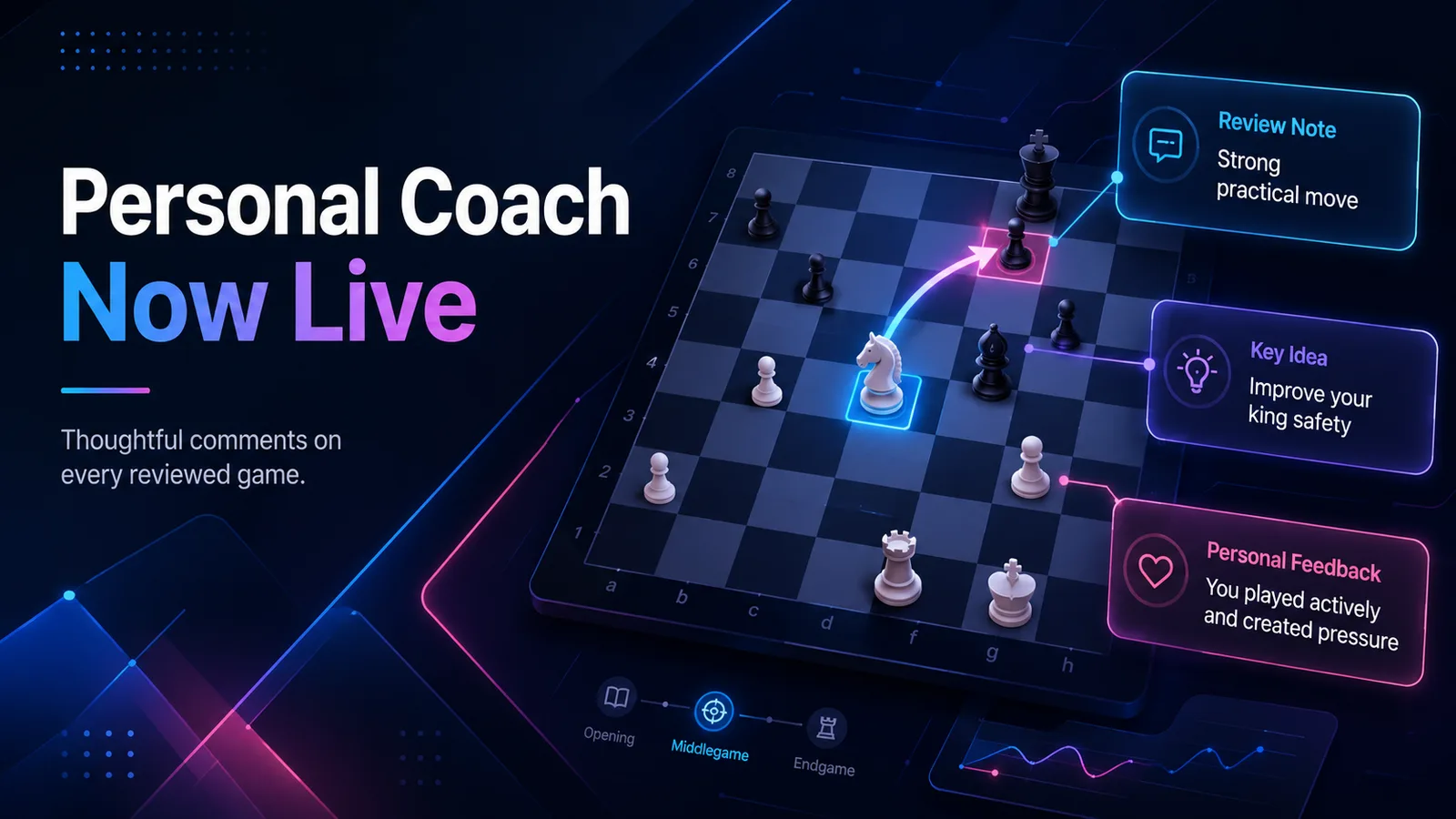
Yesterday we described what a real coach should be: on your side, quick to praise a good defence, always explaining why — and never making things up. Today that coach is live. Open any of your games and it will walk through it with you, move by move.
What it looks like
You step through the game and a story runs alongside — the way it happens at the board with a living coach. Your move: what it did and how it could be punished. The opponent's move: not "he played the knight", but what it changes for you — what became possible, what became dangerous.
The game reads like a duel, not a protocol: "you attacked the pawn — he covered it with the knight at once", "you saw the threat and moved the rook away", "he ignored your threat — the prey is still there". The coach praises a defence as readily as it calls a blunder a blunder. And it mentions what you never even noticed: "an undefended pawn was standing there — you walked past it".
"Take it boldly" — our favourite part
This happened in a real game on our board. Playing White, a player did not dare capture a pawn with the knight: the knight uncovered the queen, and the queen looked lost. The caution felt reasonable — and cost the game.
The truth is the queen could not be taken: the greedy capture led to mate in two — the three-hundred-year-old Légal trap. The engine always knew. Now the coach says it out loud, right on the move card: "don't worry about the queen — taking it costs him the game". Next to it there is a button: press it and the board itself plays out the greedy line with ghost pieces, all the way to mate.
That is the difference between a report and a coach. A report shows the best move. A coach removes the fear that stopped you from playing it.
Not a word invented
Every sentence of the review is checked against the position. If the coach says "the knight on e5" — a knight stands on e5. If it says "you captured the bishop" — a bishop was really taken by that move. Where there is nothing to say, it speaks briefly — or stays honestly silent. Confident prose about pieces that do not exist is the classic disease of AI coaches, and we guard against it hard.
How to try it
Play a game here, or import your games from chess.com or lichess — one click brings the whole archive. Open a game, press "Build the review", switch the coach on. While it writes you can see how many moves are ready — and the cards fill up before your eyes. The games list now shows what is already reviewed: those rows carry a check mark.
What comes next
The coach will keep getting sharper. It will learn to talk about the opening in the language of tempo and development — "the knight moved three times while the rooks never said a word". It will match its speech to your level: "he attacks your knight" for a beginner, "your d5 square is weak" for a stronger player. And moments from your games will become puzzles: the trap you did not believe in will come back to your board — as an exercise.
The board is open: 99chess.com. No install, no card — your first review is ready a couple of minutes after your first game.