
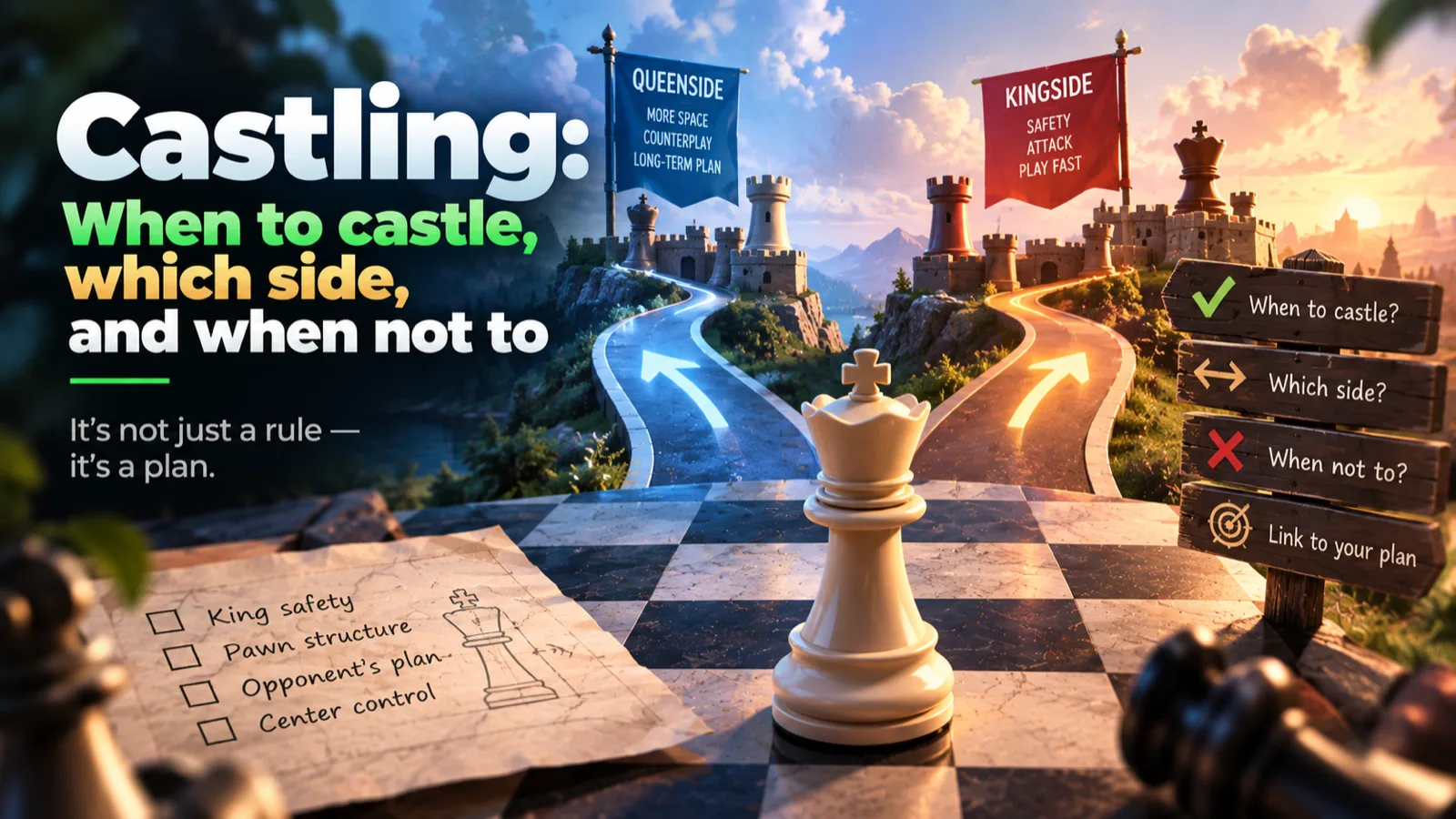
Move fourteen. Your pieces are developed, your queen eyes the centre, your opponent just left a pawn hanging — and you grab it, because castling can wait one more move. Three moves later the e-file rips open, a rook lands across from your king, and a level game is over in five moves. "When to castle" sounds like a beginner's question; the players losing to it are usually well past knowing how the king jumps.
Castling is a plan, not table manners
Beginner courses teach castling as hygiene: develop, castle, that's how it's done. That framing quietly plants two bad habits. One — "castling is always good", so you castle on autopilot, sometimes straight into a ready-made attack. Two — "I'll get to it", and the king never leaves the centre at all.
A more useful frame: castling decides where your king lives and which pawns you're allowed to attack with. It's the first genuinely strategic move of the game. Pawns shielding your king don't get to storm anywhere; the pawns on the other wing are free labour. Decide where the king goes and you've half-decided your plan — the other half is covered in how to make a plan in plain words.
When to castle: watch the centre, not the move number
The old rule "castle by move ten" mostly works, but the move number isn't the reason. A king in the centre is in danger exactly when the centre can open: pawn trades on the d- and e-files uncork lines, and rooks and queens hit e1 or e8 directly.
The practical test has three cases:
- The centre is locked shut, pawn chains leaning on each other — you may postpone castling for a genuinely better move.
- Trades in the centre are possible, or pressure is building on the e-file — castle at the first legal opportunity; it is the better move.
- Not sure whether the centre will open? Assume it will. The price of caution is a tempo; the price of optimism is the king.
Kingside or queenside: ask which pawns you want to push
Kingside castling is the default for a reason: it's faster (two pieces to clear, not three), and the king lands behind untouched f-, g- and h-pawns.
Queenside castling isn't an exotic flourish — it's a declaration: my attack will be carried by the kingside pawns. That's the whole story of opposite-side castling: you go long, they go short, and both sides launch pawn storms without undressing their own king. Whoever's avalanche arrives a tempo sooner wins, which is why you castle long when the attack is already in the air — not for variety.
It has a price tag, too: after long castling the a-pawn sits outside the king's cover, and the king usually needs an extra move to b1 or b8. Budget that tempo into the plan.
When you can't castle — and when you can but shouldn't
The legal part takes one line: no castling if the king or that rook has moved, if the king is in check, or if it passes through or lands on an attacked square. The interesting cases are the legal castles that lose:
- The shelter is gone. If the pawns in front of your castling spot have already advanced, or the fianchetto bishop got traded off, the king isn't moving into a fortress — it's moving into ruins. Sometimes the centre genuinely is safer.
- Their attack is faster. Before committing to opposite-side castling, count whose pawn storm lands first. If it's theirs, don't sign up for the race.
- Queens are off and the endgame is near. In the endgame the king is a fighting piece that belongs in the centre. Castling out of habit after a queen trade walks your best endgame piece away from the action.
The stuck-in-the-centre king is a pattern, not bad luck
In game reviews this story repeats across the 800–1400 range with remarkable consistency, and the mechanics never change. You meant to castle next move, but a pawn was hanging and it felt wasteful not to take. Then a threat needed answering. Then one more developing move. By move fifteen the centre is open — and castling turns out to be impossible: if not by the rules, then by the position, because every square on the way is covered.
The rest plays itself: a check down the open file, the king walks, the rooks never connect, and you finish the game a rook short in practice. The fix is not a sticky note — it's a habit: while your king is in the centre, ask on every move what is stopping you from castling right now. If the answer is "nothing, but that pawn looks tasty" — castle.
Spotting the pattern in your own games is the easy part now: the 99chess coach reviews your game in plain words and will say "this was the moment to tuck the king away", and the What to improve tab shows which phase of the game bleeds the most points — a stuck king shows up there as an opening-phase dip.
Castling costs one move. Games that put it off for later rarely live to see later.