
You've solved a thousand puzzles. The puzzle rating grows, the streak burns, the progress ring closes every day. And in your games — same old story: the same piece left undefended, the same fork landing on the same squares. Sound familiar?
It's not that puzzles are useless. It's that you are solving other people's puzzles. Positions from other people's games, with other people's mistakes, from situations you may never reach. Your brain dutifully learns to recognise them — and keeps failing to recognise yours.
The best exercise has already been played — by you
Recall a moment from your last lost game: right here you thought, you moved — and two moves later things fell apart. That moment is a perfect puzzle. Better than any of the million puzzles in the databases, and here is why.
First, you remember it with your body. "I sat right here" — your own position is recognised instantly, with all its context: the opening, the opponent, the feel of the game. New knowledge holds onto that hook far better than onto an abstract diagram.
Second, it is by definition your weakness. Database puzzles train "chess in general". Your own miss trains exactly the spot where your game breaks. We wrote about this last time: one fixed habit beats forty found mistakes — and the habit lives precisely in these recurring moments.
There was only one problem: collecting such exercises by hand is a coach's job, and it costs like a coach.
Now it happens by itself
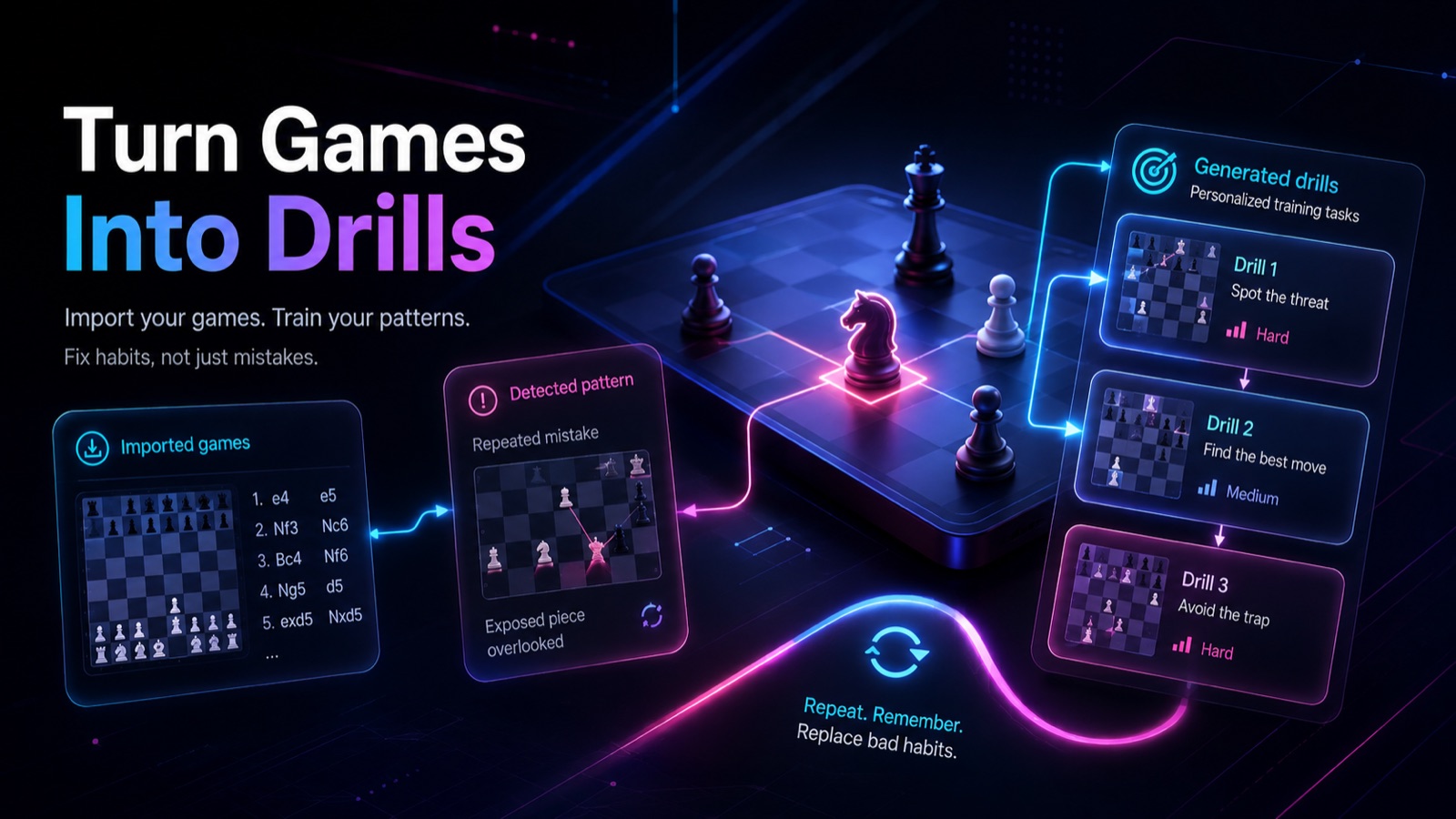
On 99chess this is now automatic. You play — or import your games from chess.com and lichess by username, your whole archive if you like. The coach reviews every game, finds the mistakes — and turns the ones with a concrete tactic into puzzles:
- The position starts one move before your slip — the opponent moves as in the game, and you are back at that exact point. Only now without the clock and without the panic.
- The puzzle tells you why it exists. Not a faceless "find the best move", but "you could win the e5 knight here — in the game you walked past it", or "there was a mate here and you missed it". Answering "why" is half the teaching.
- The card shows where the moment is from: the opening, the opponent, the date. It is not a diagram out of nowhere — it is your game.
- A solved puzzle comes back. Tomorrow, in three days, in a week — on a spaced-repetition schedule, the way you learn words of a language. Miss it, and it returns sooner. The goal is not to answer once, but to recognise the position instantly.
And one honest detail: only moments with a concrete blow become puzzles — a capture, a check, a mate, a free piece you missed. Quiet positional subtleties don't make the cut: an exercise that leaves you asking "what was that about?" teaches nothing.
How to try it
Go to 99chess.com, import your games (a chess.com or lichess username is enough — signup is free) and open Puzzles. The first puzzles from your own mistakes will build themselves, and the queue starts with them — marked with a violet "a puzzle from your own game". The theme filter has a "From my games" mode if you want only those.
A thousand of other people's puzzles make you better at other people's games. Twenty of your own — at yours. The choice seems obvious.