
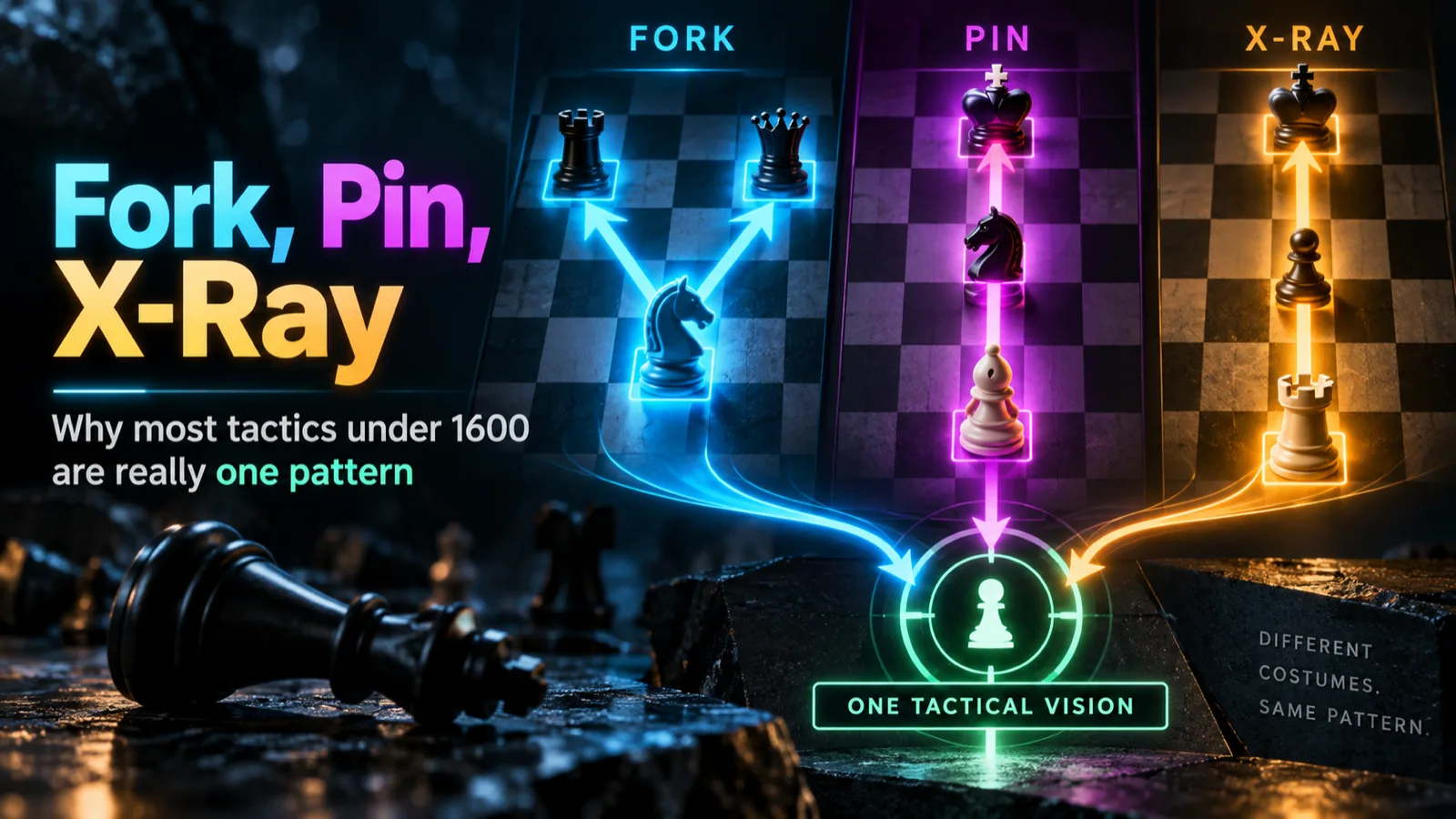
Open any tactics book and you get twenty-five named motifs: fork, pin, skewer, discovered attack, overloading, deflection, decoy, windmill. Now open the review of your last ten games. How many different motifs are actually in there? Below 1600 the answer is almost always the same one: a piece attacked two things at once, and only one of them could be saved.
The chess fork, the pin and the skewer look like three separate chapters only in the table of contents. On the board they are one trick in three costumes — the double attack. And what you need to train is not the list of names, but the eye for the trick.
All of it is one attack on two targets
A fork is the double attack in its naked form: one piece lands where it hits two enemy pieces. Knights do it most often for a boring reason — their attack cannot be blocked.
Pins and skewers are the same double attack, except the targets stand in a queue on one line instead of side by side. The rook hits both pieces down the file; the front one simply stands in the way. If the more valuable piece is behind, it is a pin and the front piece may not move. If the more valuable piece is in front, it is a skewer and it must move, handing you the one behind. Same trick — only the order of the queue changed.
A discovered attack is a double attack assembled from two pieces: one moves away and attacks something itself, and by leaving it opens the line of the piece behind it. Two hits, one move — the same idea again.
The difference between these “motifs” matters to whoever writes the table of contents. What matters to you at the board is one thing: is there a move after which your opponent has two problems and only one move to fix them?
Twenty templates versus one question
When tactics live in your head as a list, you have to run through it: “is there a fork here? a pin? maybe a windmill?” There is no time and no attention for that, and in blitz the checklist is the first thing to go.
When tactics live as one skill, the question is one too: where are two of his targets that one move can hit? That question fits into three seconds, even on the last minute of the clock.
The double attack needs two conditions
For the trick to exist at all, two things must coincide on the board, and both are checked with your eyes, not with calculation.
One: there is a vulnerable target. Usually that means an undefended piece — we wrote separately about why tactics never create weaknesses, they only find ones that are already there. The king counts as a target too, and he is the most convenient one: he cannot be left under attack, so a double attack with check wins the second piece every single time.
Two: the targets stand in the right geometry. For a knight that means two pieces on squares of the same colour with a square between them that hits both. For rook, bishop and queen it means two pieces on one line or diagonal. This is exactly why strong players get twitchy when their own king and queen end up on the same diagonal, even when nothing is currently aiming down it.
Search from the targets, not from your pieces
The classic way to fail the search is to stare at your own knight and wonder where it could jump. Forks found that way are found by accident.
Do it backwards. First name the targets: the enemy king plus everything of his that stands undefended. Then look for a square that hits two of them at once. Only then ask whether you can get there and whether your piece survives on that square.
Three steps instead of twenty templates — and the best part is that the same scan works on defence. The same two questions, asked about your own pieces, catch his fork one move before it happens.
Themed puzzle sets lie to you
There is an awkward truth about trainers with neat sections called “fork”, “pin”, “deflection”. When you already know the theme, the puzzle is half solved before you look at the board. You are training calculation inside a known motif, but not the thing the game actually asks for: recognising the motif from scratch.
Nobody at the board announces “heads up, pin incoming”. That is why mixed positions beat themed blocks, and puzzles built from your own mistakes beat everything: they combine an unfamiliar position with your personal blind spot.
Finding out which attack you actually miss
In a 99chess game review every blunder gets tagged with its pattern: fork, check fork, hanging piece, discovered attack, pin. The tags pile up across games — and after a dozen reviews you see something sharper than “my tactics are weak”: you spot knight forks fine, and you walk into a discovered attack every second game.
You will not recall twenty-five textbook motifs in time trouble. You will recall one question.