
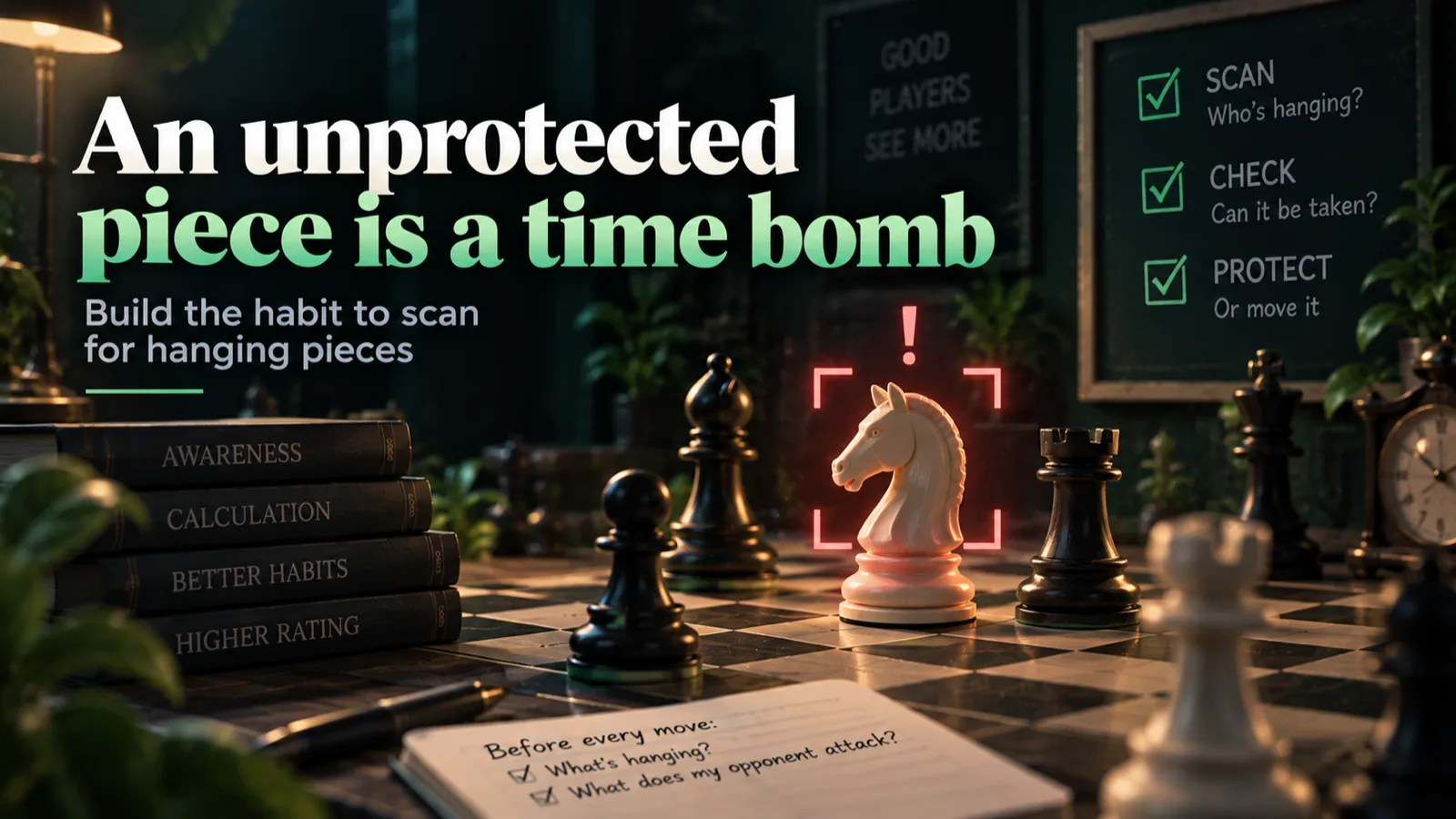
Your bishop came out to g5, poked a knight and stayed. Nobody attacks it — for eight straight moves it looks perfectly safe. Then your opponent plays the queen to d5: a fork on the bishop and b7, and you lose one of them. The review will flag the queen move as the moment things went wrong — but the bomb was planted eight moves earlier, when the bishop was left without a single defender.
We have already written about missing your opponent's shots: a blunder is an attention failure. This is the other angle — how to make sure there is nothing to miss. Loose pieces are not about being alert at the moment you move. They are about prevention.
The dangerous piece is the undefended one, not the attacked one
Grandmaster John Nunn popularised the phrase every English-speaking coach repeats: LPDO — loose pieces drop off. An undefended piece is not dangerous from the moment it gets attacked; it is dangerous the whole time. The bill just has not arrived yet.
The mechanics are simple. A double attack wins material only when both targets cannot simply be covered — one of them is usually a bare piece. A pin turns deadly when the piece behind it is loose. Skewers, discovered attacks, in-between checks — almost all of your opponent's tactics do not create your weakness, they exploit one that already exists. Remove the loose pieces and most of his combinations have nothing to be built from.
There is a pleasant side effect: calculation gets easier. When nothing of yours hangs, the answer to "what if he goes here?" is usually a boring "nothing". A covered position forgives even sloppy calculation.
This is prevention, not vigilance
The difference matters. Vigilance means checking whether your move hangs something RIGHT NOW; it fires at the moment of decision and switches off with fatigue, time trouble and excitement. Prevention works earlier: a piece that has a defender needs no attention at all — not this move, not five moves from now.
It is the gas-leak principle: you can train your nose, or you can close the valve. In blitz, where there is physically no time to check every reply, the valve is the only thing that works.
The three-second scan
The habit worth installing: before every move, two questions, three seconds.
- "What of mine is undefended?" Run across your pieces — not "who is attacked" but "who has no defender". Mark them as hot spots: any new lunge by your opponent will probe them first.
- "What of his is undefended?" His loose pieces are your future forks and pins. Half the tactics you "don't see" start with a bare enemy piece you never registered.
Scanning is not calculating. You are just tagging pieces the way a sapper tags suspicious ground; calculation starts only when two hot spots line up on one file or diagonal. And one hard rule: rescan after every exchange and every opened line. That trade on e5 may have just removed your d3-knight's only defender — yesterday's scan is void.
Where the bomb usually sits
In our game reviews the hanging piece is the most frequent error pattern from 800 to 1600, and it is usually the same pieces hanging:
- The developed-and-forgotten bishop — g5/b5 (g4/b4 for Black): did its opening job and stayed behind enemy lines with no support.
- A rook on an open file with no backup — looks proud, but any knight with tempo, or a queen down the file, turns it into a skewer target.
- A knight on the rim — a5/h5 and beyond: few defenders, fewer retreats.
- Queen and a loose piece on one line or diagonal — a ready-made pin or skewer; same for king and piece sharing a diagonal.
A special case: a piece defended exactly once, by a defender that has other duties. Formally covered, practically loose — one deflection and the defender is gone.
The coach in 99chess reviews tags these episodes as "hanging piece" — a distinct error type that feeds puzzles built from your own games, and the What-to-improve tab shows the number falling week by week — in your real games, not on the trainer. Why shots still get missed at the moment of the move is its own article.
Your opponent does not create your weaknesses — he finds them. Leave him nothing to find.