
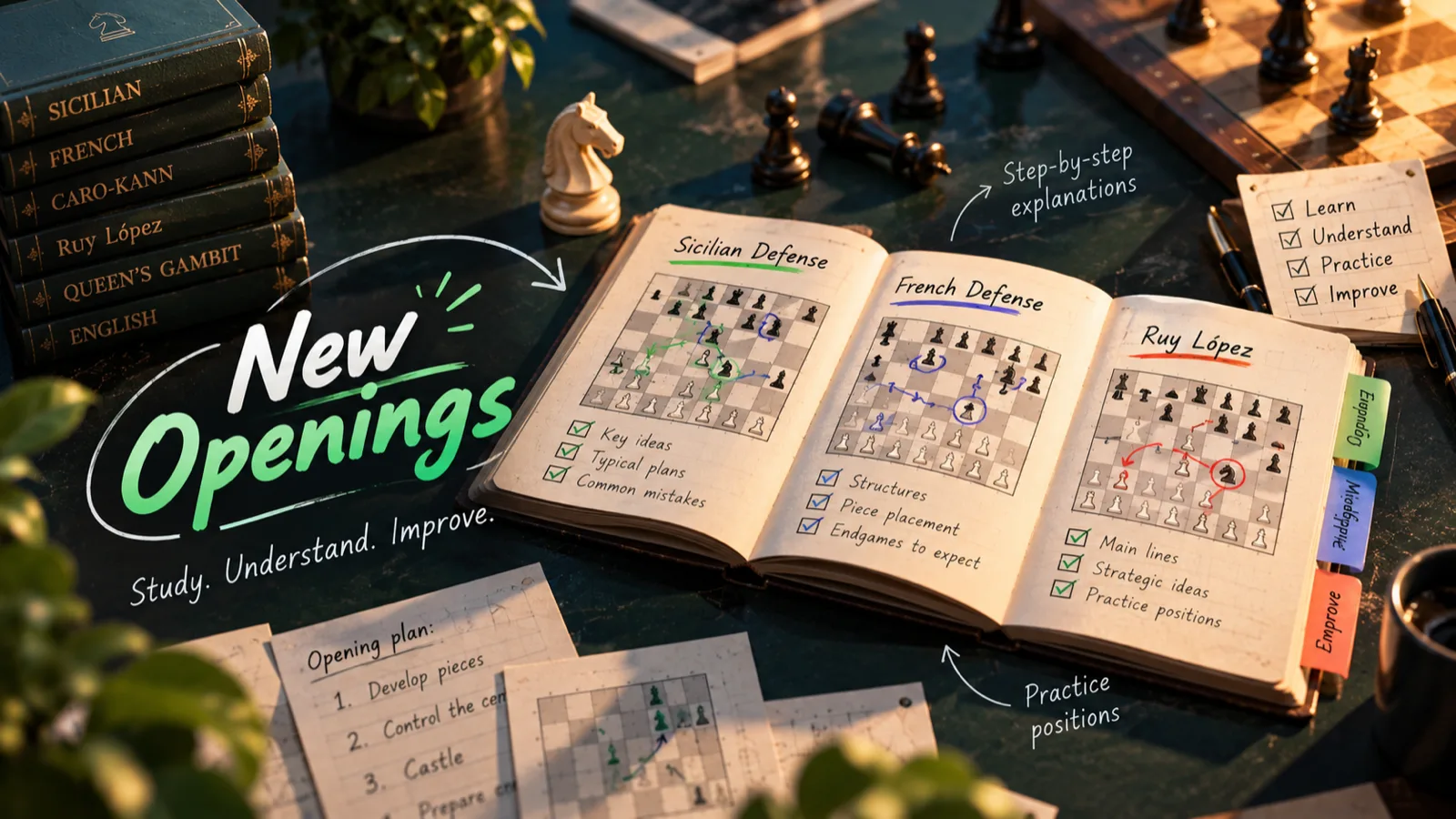
An average opening book runs four hundred pages of lines. The first move by your opponent that is not in the book arrives on move four. From then on it is you and the board, and none of the four hundred pages help. That is why we did not build an openings section for a long time: we wrote that below 1600 you should not study openings, and we still think so. Lines, no. Setups, yes.
Now the dashboard has an Openings tab. Ten schemes in it, and not one asks you to memorise variations. Here is what is inside and why it is built this way.
Ten schemes, five per colour
For White: the London System, the Italian Game, the Queen's Gambit, the Ruy Lopez and Bird's Opening. For Black: the Indian setup, the Scandinavian, the Caro-Kann, the Accelerated Dragon in the Sicilian and the French. Candidates were picked not by taste but by what people rated 1200–1800 actually play: after 1.e4 e5 2.Nf3 Nc6 forty-five percent put the bishop on c4, so the Italian went first in line.
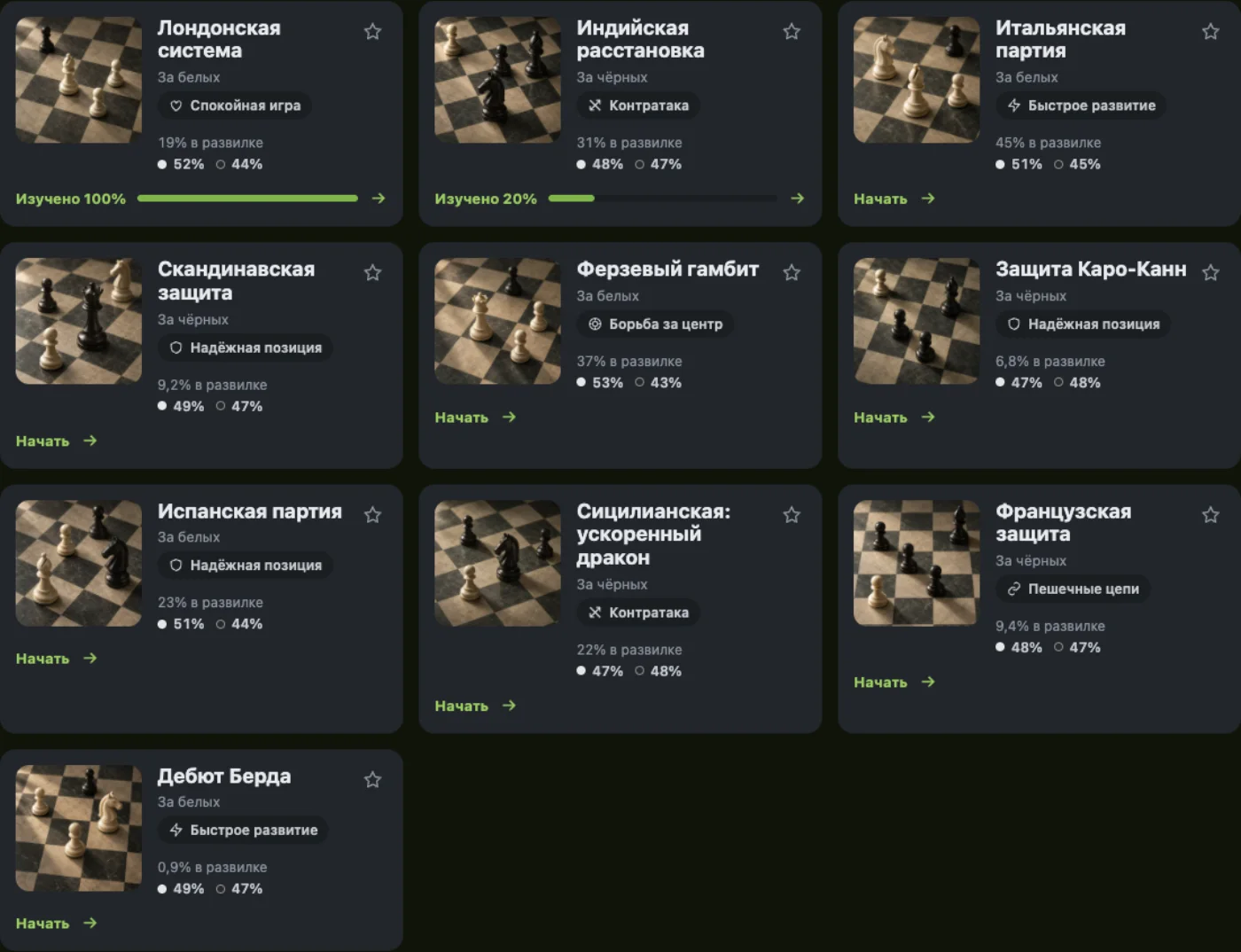
Each scheme is twelve or thirteen moves with a "why" under every one of them. Not "theory recommends", but concrete: the bishop goes to f4 before e3, because after e3 it stays locked in. Every square name in the text is clickable: tap "f4" and the square lights up. A beginner does not need to know the coordinates by heart to follow the idea.
The bot replies differently, and that is the point
The most common complaint about opening trainers: they teach one line, the opponent plays another. Each of our schemes has at least two lines of opponent replies, and the bot picks one at random every time. In the Caro-Kann today White plays the classical line with a knight on e4, tomorrow they exchange on d5. Your setup is the same; the road to it changes. That is exactly what happens in a real game.
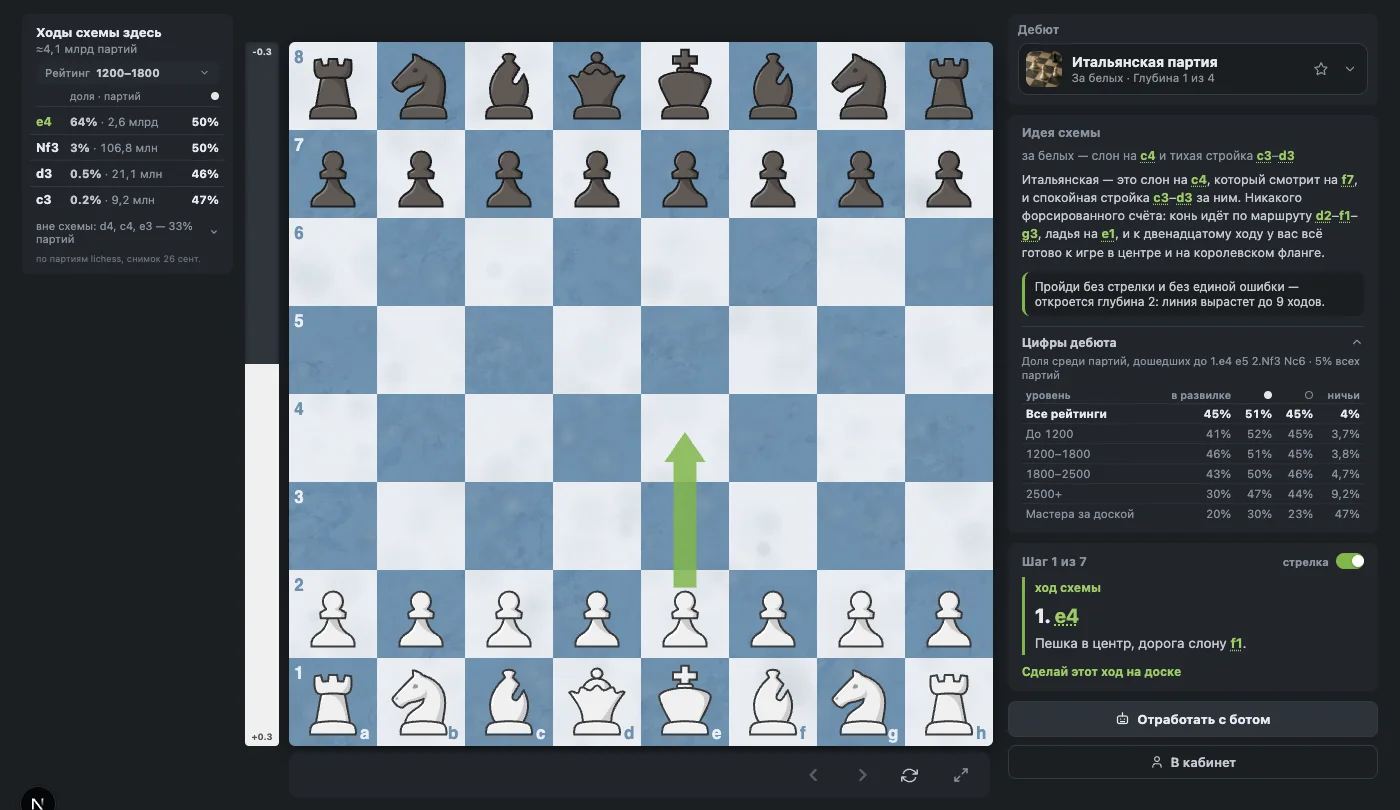
There are two modes. Study: a green arrow shows the scheme move, you play it and read why. Drill against the bot: no arrow, you build the setup yourself, and the trainer checks the result, not the move order: are the pieces on their squares, and did you castle in time. The verdict is one of three: clean, rough, not assembled. A streak of clean runs is counted separately, and that streak is what moves a scheme to "mastered".
Depth opens gradually. The line starts short, seven moves. Run it with no arrow and no misses and it grows to nine, then eleven. You cannot scroll to the end: the next chunk goes only to someone who already holds the previous one.
Numbers instead of "that is how it is done"
Next to the board lives the "What people play here" widget. For every position it shows which moves people make on lichess, how many games each has and with what win rate. The scheme move is always first, next to it the human moves that reach the same setup in a different order. You can switch the sample: under 1200, 1200–1800, 1800–2500, 2500+ or masters over the board. Different levels play differently, and you should prepare for the opponents you will meet tomorrow, not for grandmasters.
Each opening also has its own numbers as a whole. The Italian is 45% of games after 1.e4 e5 2.Nf3 Nc6 among club players and only 20% among masters, where almost half of those games end in a draw. The Scandinavian is every eleventh beginner game after 1.e4. Those tables sit on every card and inside every scheme. The source is billions of games from the lichess database; we do not make them up.
How to use it
Pick one scheme for White and one for Black, no more. Star them so they live in "My repertoire" and the Continue button at the top always takes you to where you stopped. Go through the study once, then only drill: three clean runs in a row mean more than ten walkthroughs with the arrow. If you are unsure where to start as Black, we have covered that choice: one answer to 1.e4 instead of a menu. And the idea of a scheme instead of memorising is told on the example of the London System.
Starting a study and every drill cost credits, like a game against the bot: three for a study, five for a drill, and they refill every day. You can try without an account for free too, but progress is not saved and the move statistics open only with an account.
What comes next
Gambits are the next batch: they fit the same "setup plus plan" format, only the plan is more aggressive. For now, ten schemes and not a single page of lines to memorise.
Your opening is not the one you learned but the one you assembled on the board when the opponent left the book.