
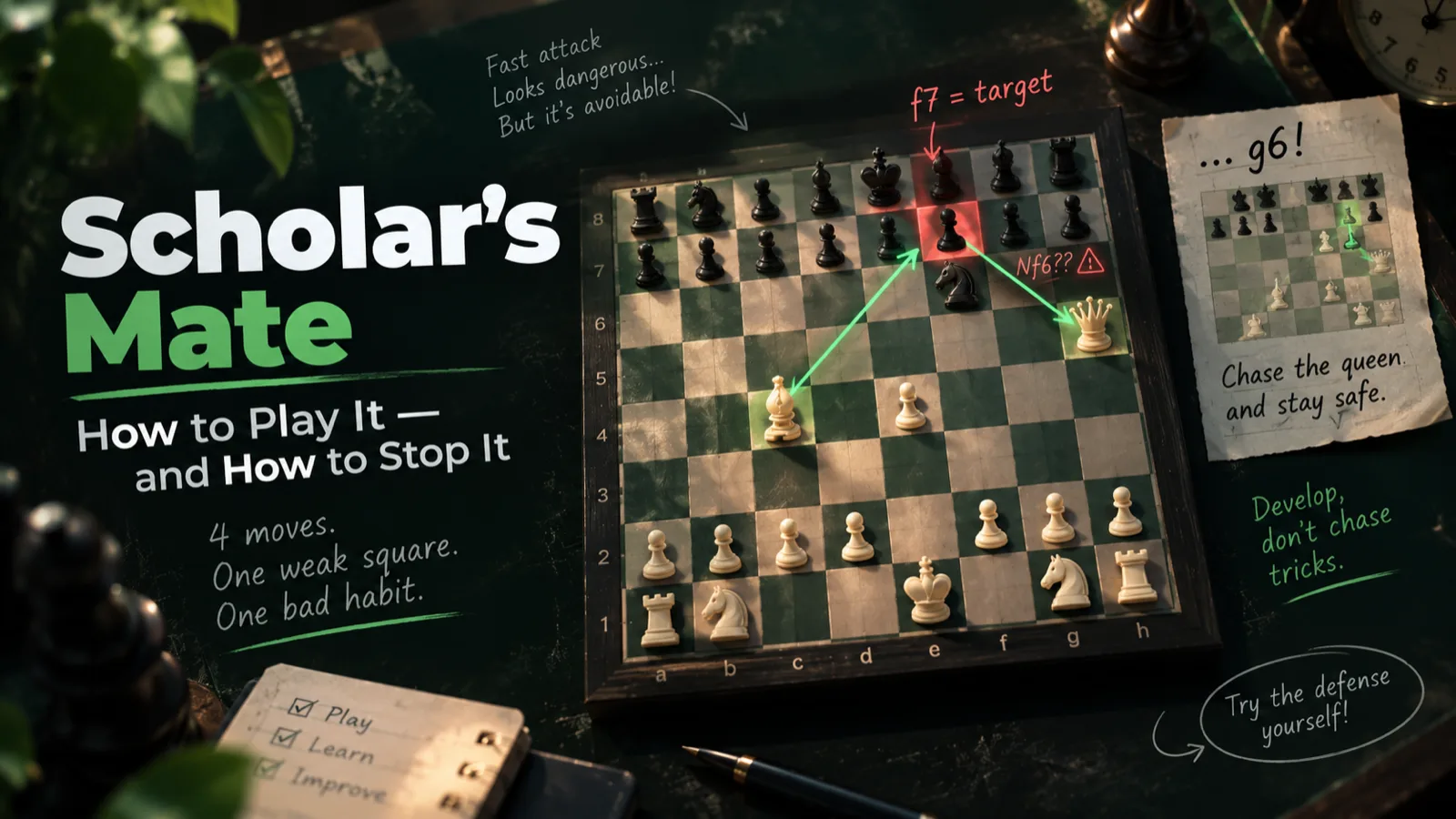
Four moves in, you develop your knight to f6. The most normal, most textbook move on the board. Your opponent takes the f7 pawn with the queen, says «mate», and leaves. You are sitting in front of a position where you still have all sixteen pieces, wondering what just happened.
That is Scholar's Mate. It is about five hundred years old, it still catches every other beginner, and it is easier to stop than it looks — once you know what the fight is actually about.
The whole attack rests on one pawn
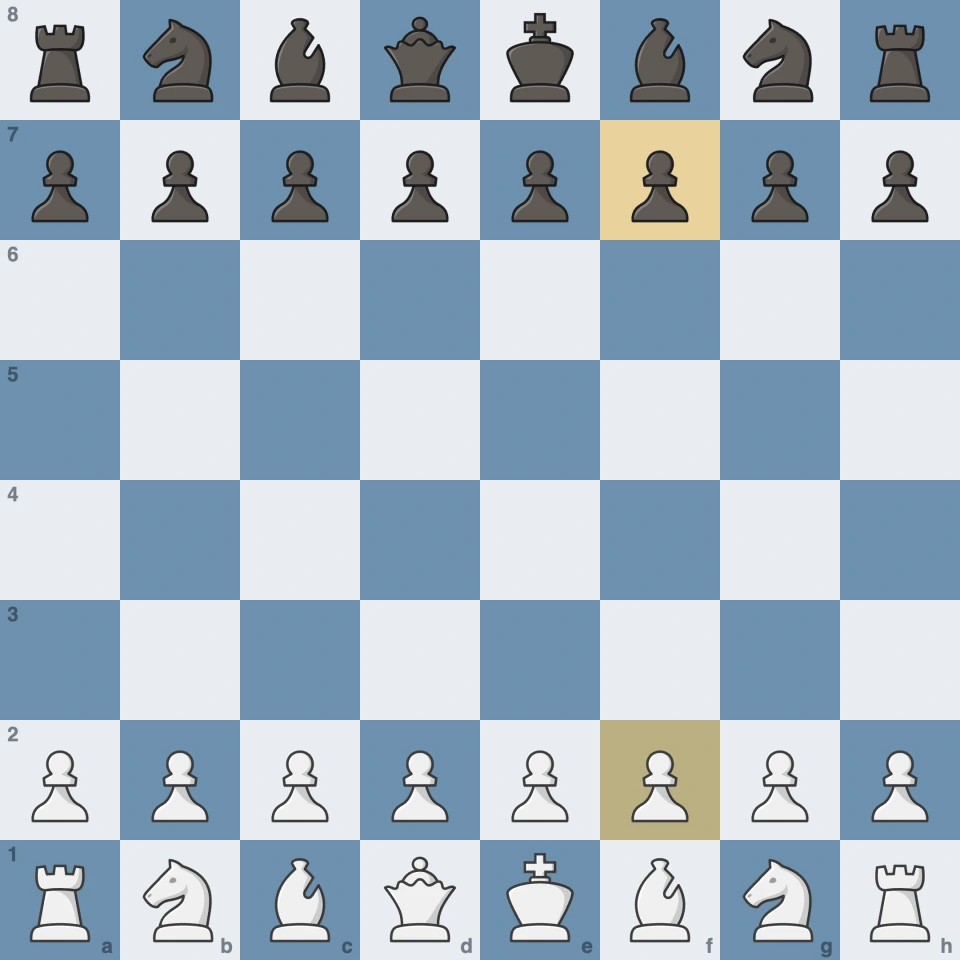
Look at the starting position. Every pawn has a guardian — a neighbour, a knight, a rook. Every pawn except f7 and f2. Those are protected by the king and nobody else, which makes them the weakest points on the board before a single move is played.
White simply does the arithmetic: bring two attackers to f7 while Black has one defender there. The bishop goes to c4 and stares at f7 across the board. The queen goes to h5 and stares at f7 down the diagonal. Two against one, and the pawn is gone.
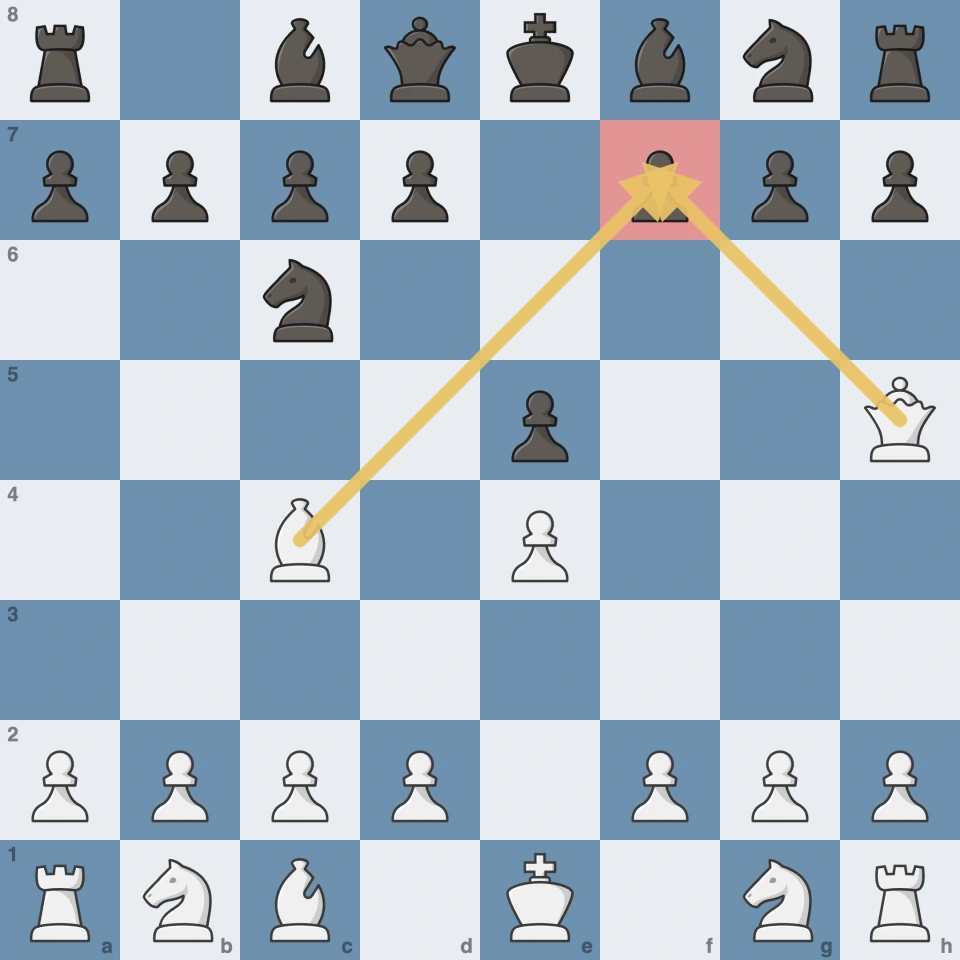
1.e4 e5 2.Bc4 Nc6 3.Qh5 Nf6?? 4.Qxf7#
That is the entire scheme. Black's first three moves look flawless: take the centre, develop a knight, keep developing. The fourth one, Nf6, is straight out of the book too — knights before bishops, pieces off the back rank.
Except the knight on f6 does not defend f7. It has nothing to do with that square. The queen takes, the bishop on c4 protects her, the king cannot capture, cannot run, cannot block. Mate.
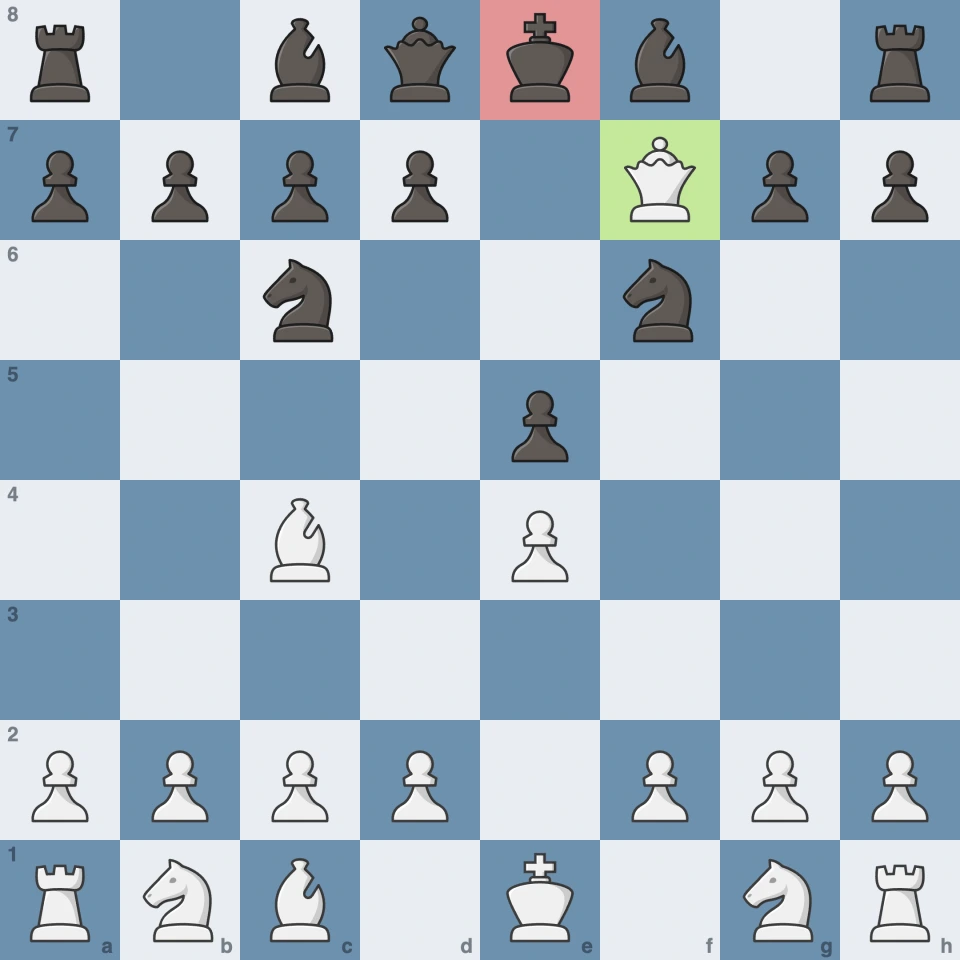
The galling part is that it isn't a mistake that loses — it's a habit. Nf6 was played from memory, not from the position.
The defence takes two moves, not one
Most guides tell you: play g6, the queen is attacked, done. That is half true. 3…g6 is genuinely good — it hits the queen and wins a tempo, and White has to move her.
But she moves to f3 — and looks at f7 all over again. The threat is still live: if Black now plays anything unrelated, Qxf7 is mate once more. We ran the position through an engine rather than repeat a common claim: after 3…g6 4.Qf3, mate is still on the board.
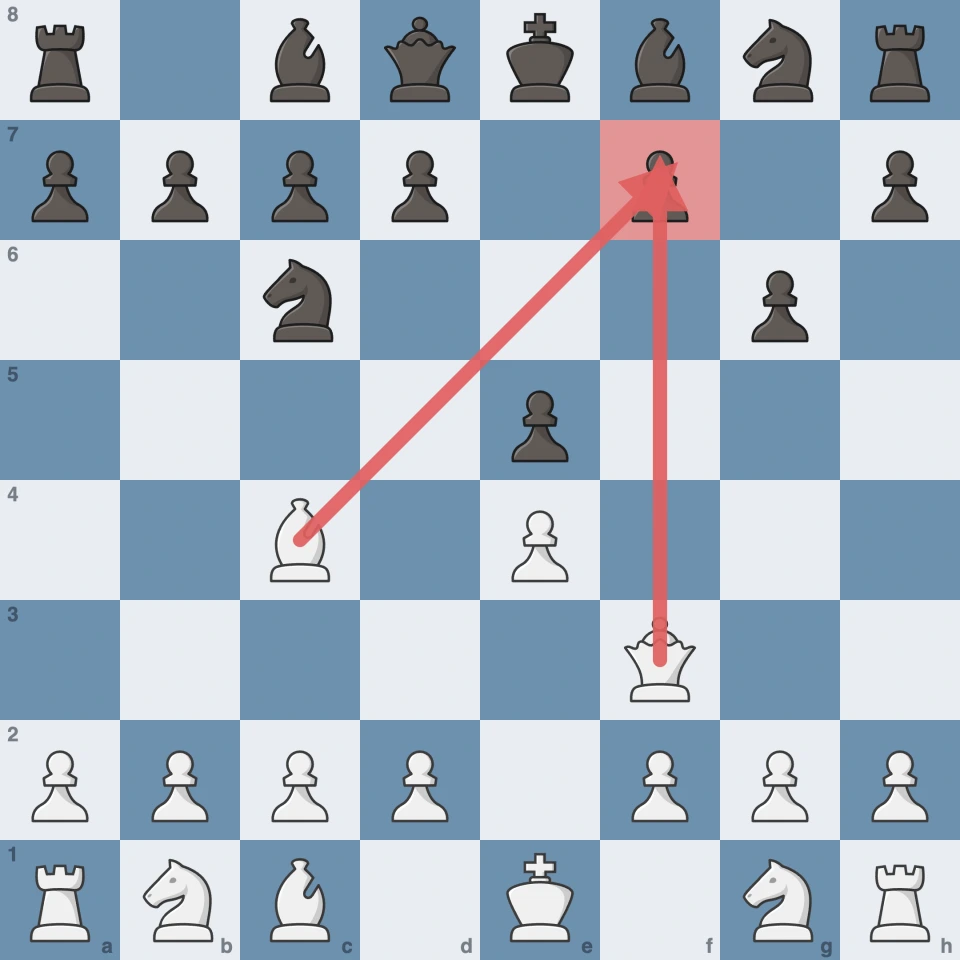
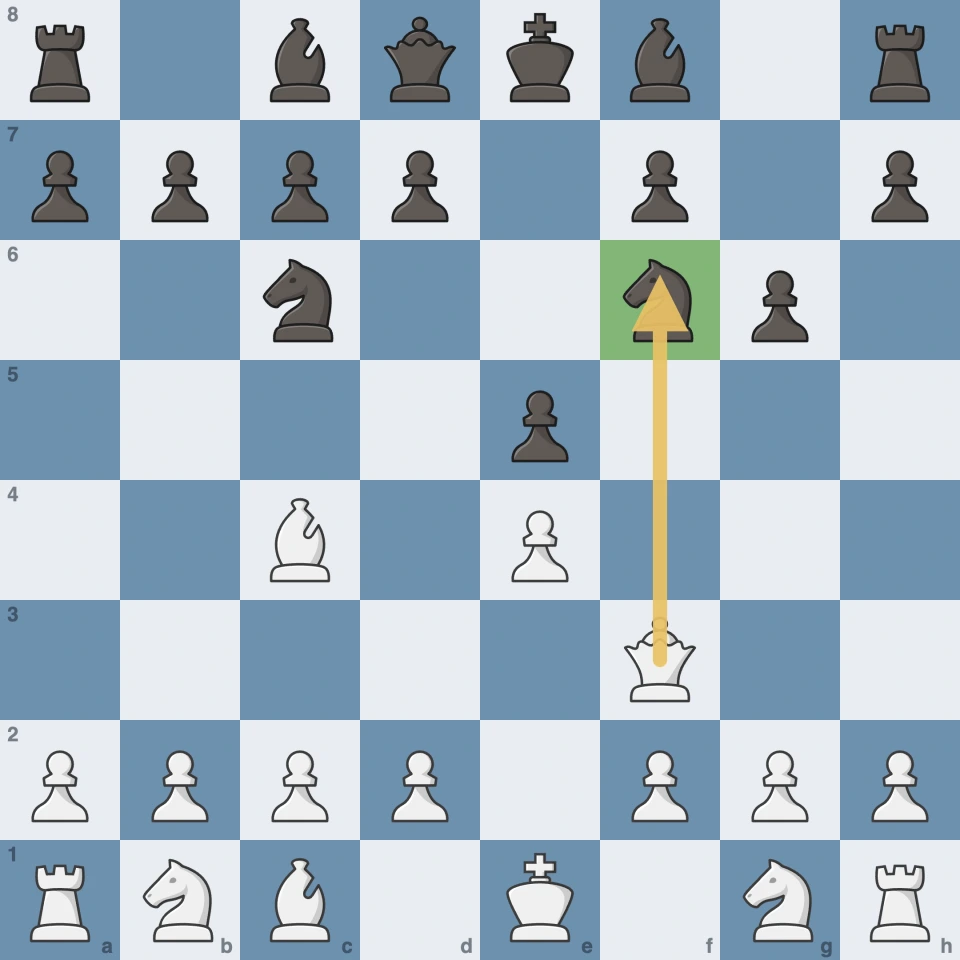
And this is where 4…Nf6 works. The very same knight move that lost on the spot two moves earlier. The difference is that the knight now sits on the f-file between the queen and the pawn — it does not defend f7, it blocks the road. One move: mistimed, it's mate; timed right, the attack is over.
If you'd rather not memorise the order, there is a simpler answer: 3…Qe7. The queen tucks in behind the e-pawn and guards f7 directly, no subtleties required.
After the defence, the attacker is the one who is worse
Count what White has after 3…g6 4.Qf3 Nf6. The queen has moved twice and stands where a knight or a bishop is about to chase her. There is no development to speak of: one bishop and a wandering lady. Black has a knight out, a solid pawn chain and a ready-made square for the bishop on g7.
That is the real price of the fast attack. An early queen doesn't create threats — it creates a target. Every time your opponent attacks her with a minor piece, they develop and you run.
Playing it past your first thousand rating points is a bad deal
Scholar's Mate is a beautiful illustration of what a weak square is, and the worst opening plan you can own. It beats people who don't know the defence and loses time against everyone else. The more points it wins you, the later you learn to play a position where nobody hangs anything.
We wrote at length about why a trap wins the game and ruins the player: fast growth, hard ceiling. Scholar's Mate is the first rung of that ladder.
It is far more useful the other way round: keep the habit, not the attack. Glance at f7 and f2 in every early position and ask the same question — how many attackers, how many defenders. That question kills Scholar's Mate and half the other opening tricks with it.
Try the defence right now
If you are just starting out, begin with the rules and your first three games, then go and meet this pattern on a board.
You can play without an account: on 99chess the coach highlights threats right on the board, so you'll see two attackers converging on f7 before it turns into mate. See that picture once and you stop missing it.
Scholar's Mate takes four moves. Unlearning it takes one game.