
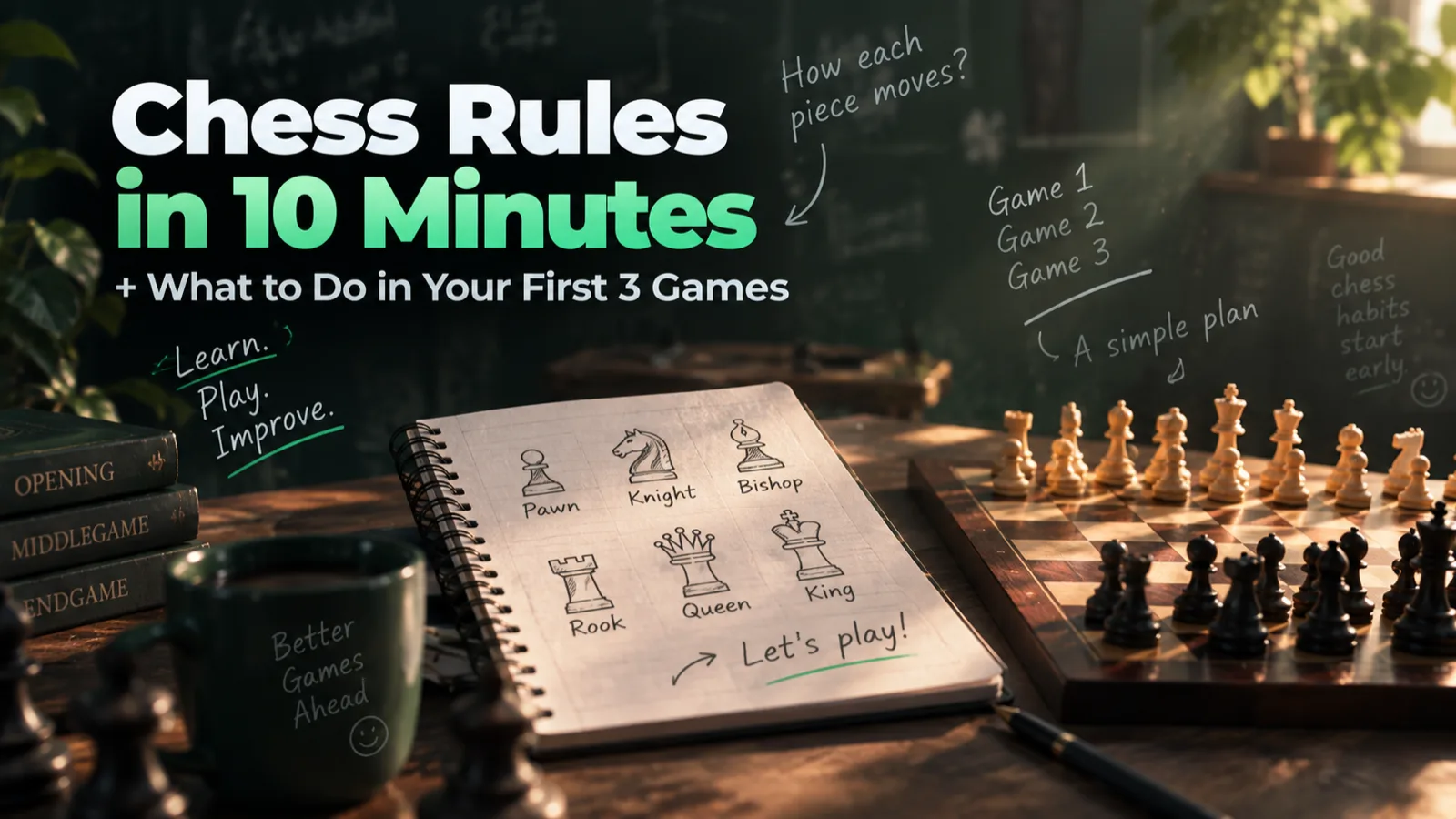
The rules of chess fit into ten minutes. Six pieces, two special moves, two ways a game can end — that's the whole thing. The trouble starts in minute eleven: you sit down, push the e-pawn two squares, your opponent replies, and your hand freezes over the board. You can move anywhere. Where you should move is a mystery.
This is where people quit. Not because chess is hard, but because what follows the rules is never concrete: "develop your pieces, control the centre." That's a slogan, not an instruction. Below are the rules in short form, and then the part these articles usually skip: what to actually do in game one, game two and game three.
The rules really do take ten minutes
Set the board so each player has a light square in the right-hand corner. The queen goes on her own colour — white queen on a light square, black queen on a dark one. White moves first, then you alternate, and passing isn't allowed.
Here's how the pieces move.
- Pawn — one square forward, or two from its starting square. It captures differently from how it moves: diagonally. Reach the far end of the board and it becomes any piece you like, almost always a queen.
- Knight — two squares one way, one square sideways. The only piece that jumps over others, yours and theirs alike.
- Bishop — any distance diagonally. It spends the entire game on squares of one colour.
- Rook — any distance in a straight line, along a rank or a file.
- Queen — rook and bishop in one: any straight line, any diagonal.
- King — one square in any direction. He may never step onto a square that's under attack.
Two special moves. Castling: the king steps two squares towards a rook and the rook hops over him to the other side. Neither piece may have moved yet, the squares between them must be empty, and the king can't be in check, pass through an attacked square or land on one. En passant: if an enemy pawn uses its two-square jump to land right beside yours, you may capture it as though it had only moved one — but only immediately, on your very next move.
Endings are just as short. Check means the king is attacked and you must deal with it. Checkmate means he's attacked and there's nothing you can do: game over. Stalemate means you have no legal move but aren't in check — that's a draw, not a win, and it burns winning positions every single day.
That's it. Those are the rules.
Minute eleven is where the real problem starts
White has twenty legal first moves and not one of them looks obviously better than the rest. Three moves in, there are thousands of positions. So the beginner plays something at random, loses the queen ten moves later, and closes the tab thinking chess isn't for them.
The usual advice at this point is to study openings. That's the worst possible first move: you memorise ten moves, your opponent leaves the book on move four, and you're right back where you started, only more annoyed.
What works instead is one job per game, for three games. One. Not three at once.
Game one: just finish it
The only goal is not to quit. You'll lose, and that's fine — you have no habits yet and your opponent does. Game one isn't about the result; it's about watching, with your own hands, how pieces get in each other's way and what a capture actually feels like.
One rule: don't resign and don't close the tab. Even down to a bare king against a queen, play it out. It takes thirty seconds and you get to see a checkmate delivered. Half of all beginners have never seen one, because they always quit first.
Game two: get your pieces out and tuck the king away
A knight or bishop still sitting on its starting square isn't playing — it's furniture. So game two has one job: while any minor piece is still at home, don't move the same piece twice without a reason.
The order is simple: a centre pawn, knights, bishops, castle. Four or five moves and you have a sane position against almost anything. Not a perfect one — a sane one. At this stage that's plenty.
Game three: before every move, look at what your opponent can take
The most valuable habit in chess and the cheapest one to build. Your opponent moves — before you think about your own plan, answer one question: what can they capture now? Look, find it, defend it or move it. Then think about your plan.
It sounds insultingly basic. But below 1000, games aren't decided by combinations — they're decided by who left a piece hanging first. A player who runs that check beats a player who knows twice as much and doesn't.
What this plan deliberately leaves out
Notation, opening names, words like "fork" and "pin", endgame theory, evaluating a position. You'll need all of it — just not in your first three games. A beginner's head holds one new job at a time; hand it three and none of them stick.
Once those three are automatic — a week or two of unhurried play — you'll feel what's missing on your own. That's when tactics earn their turn.
Where to play these three games
Right now, no account needed: open the board on 99chess and play. Your opponent is a bot, and on the easy setting it plays like a human on purpose — it hangs a piece now and then. A flawless engine is useless to a beginner; it simply wipes you out in twenty moves and teaches you nothing.
Later, if you want your games saved and reviewed in plain words by a coach, you'll need an account. For the first three games you won't.
The rules take ten minutes. What makes you a player is three games you actually finished.