
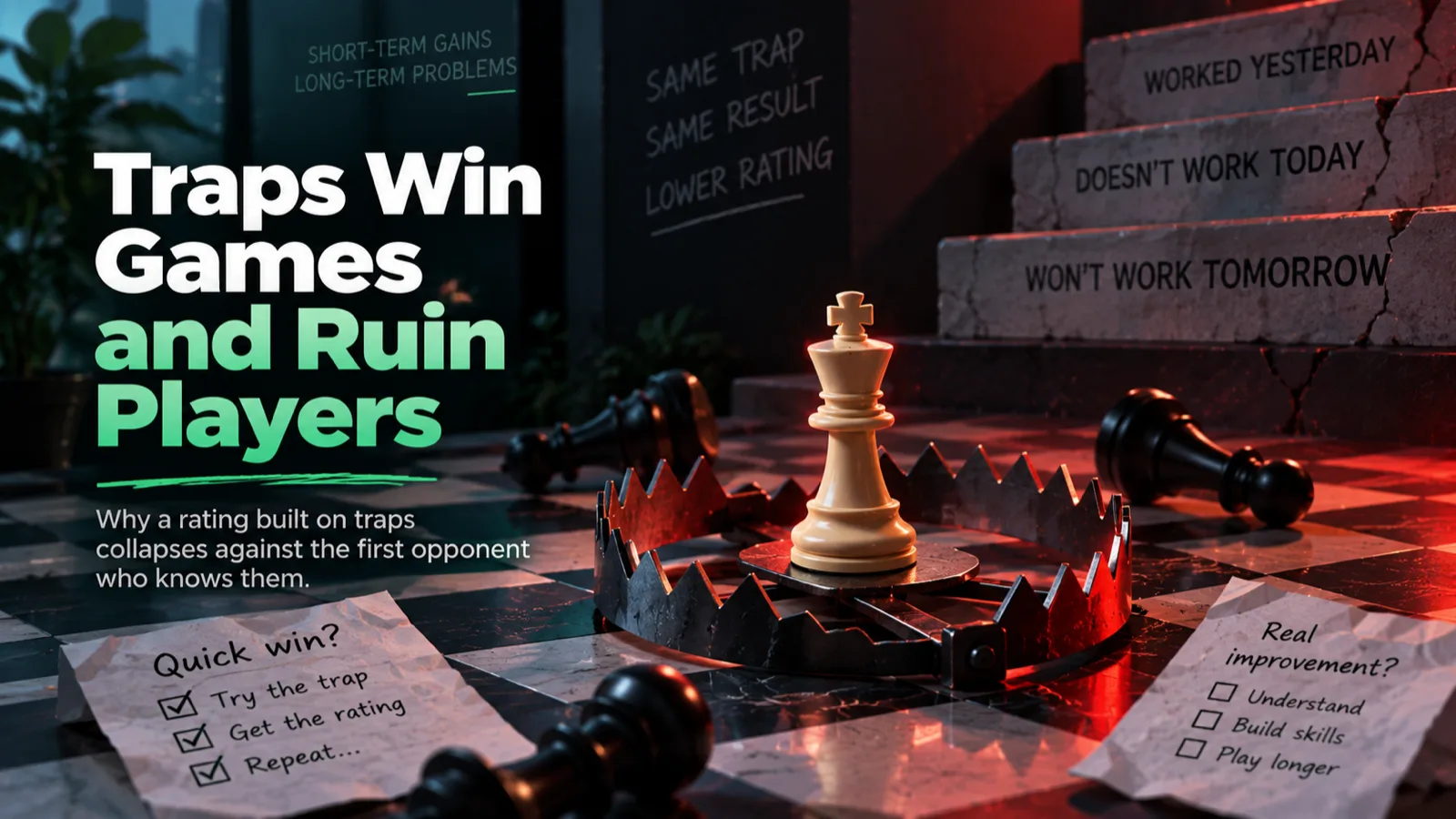
Over one evening of blitz, the queen comes to h5 twelve times. Eight games end before move ten: mate on f7, the opponent "didn't see it." Sixty rating points in a night. Two months later the same player posts on a forum: "Stuck at 900. I play every day and nothing works." Those aren't two stories. They're one story, told from both ends.
Rating on credit
Chess opening traps all run on the same engine — from Scholar's Mate to the Qxb2 trick in the Englund Gambit. You play an objectively dubious move and collect payment up front: points from everyone who doesn't know the refutation. From everyone who does, you collect a worse position and a handful of lost tempi.
The problem isn't that traps are "cheap." The problem is that they're a loan. A trap-built rating is borrowed rating: it grows faster than your actual chess, and the difference eventually comes due. For most players that happens somewhere around 900–1000 — the level where nearly everyone has already met Scholar's Mate, and the easy points dry up overnight. That's the wall people write about.
The lost points aren't the worst part
Open any of your games where the trap didn't land and look at it honestly. It's always the same picture. The queen that came out on move three trudges home, tempo gone. The pieces that were supposed to develop are still in their beds. The eval already reads −0.8 before the real fight has even started: you paid your advantage for a mistake your opponent declined to make.
And then the real bill arrives: you have no plan. A trap opening never taught you what the middlegame is about, because it never expected a middlegame to happen. From there the game runs on vibes, and against an even opponent, vibes lose slowly and painfully. One habit damages two things at once: your position today, and your thinking long-term. Every trap game is a rep of hoping for a blunder instead of looking for a strong move.
A trap and a problem are different professions
Don't throw the baby out, though. Strong players set traps constantly — theirs are just built backwards. An honest trap is a strong move that happens to ask a question: answer wrong and you're worse, answer right and I've lost nothing — my position stands on its own. A rotten trap is a weak move wearing a scary mask: if you bite, I got lucky; if you don't, I'm simply worse.
The test takes three seconds: ask "what if they see it?" If the answer is "I still have a sound position and a plan," that's a problem for your opponent — set it with pleasure. If the answer is "well, I'll figure something out," that's a lottery ticket paid for with the quality of your position.
How to quit
- Move first, poison second. Pick the move that's good against the best reply. If two candidates are equal and one also asks a question — take that one. The trap is a bonus, never the plan.
- Openings by principles, not by YouTube. Center, development, king safety. Boring — right up until your opponent has nothing to punish. Why memorizing lines below 1600 is a bad investment in the first place: "Don't study openings before 1600."
- Review the ones that failed. Games where the trap worked teach nothing — your opponent just blundered. The lessons live in the games where it didn't: look at the eval at the moment they declined, and ask yourself whether you'd ever choose that position on purpose.
One more thing: if your rating was built on traps, it's better to find out your real strength yourself — before your first serious opponent does it for you. We wrote about why ratings measure players so poorly in "Measure your real chess strength."
What the game review shows
A game review tells this story without words: on the eval graph, a trap player's game either ends in the opening or starts from below zero — there's rarely a third option. In 99Chess the coach walks through such a game with you move by move and points at the exact moment the advantage left — long before any middlegame.
A trap is seasoning, not food. What wins games is the chess that's left after your opponent has seen everything.