

On move two your opponent shoves the f-pawn into a capture. Free pawn, so you take it. For the next ten moves you’re bailing water: your knight runs from pawns, a bishop stares at f7, the queen swings in from h5. After the game the engine says you were better. You still lost.
That’s a gambit: a pawn, sometimes a piece, handed over for time. The usual answer to “should I accept or decline a gambit” is a list: take this one, not that one, take here and give it back on move five. Nobody remembers the list. Here is one rule that works against any gambit, and the three gambits you’ll meet most below 1600.
The engine can hold the position. You can’t.
Stockfish almost always votes for taking. In the King’s Gambit after 1.e4 e5 2.f4 exf4 it gives Black around +0.6: an extra pawn, not enough compensation. Now open the lichess database for players rated 1200–1800. After 2…exf4 (roughly every second player takes, 22 million games) Black wins 43% and White wins 54%.
Extra pawn, better evaluation, worse results. The difference has a name: panic. White gets the open f-file, fast development and pressure on f7, while Black spends moves hanging on to the extra material. Below 1600 a gambit isn’t won by the position. It’s won by ten moves under pressure in which you only need to slip once.
The rule: two developing moves in a row
Before you capture, ask: if I take, can I make two developing moves in a row without any piece getting kicked with tempo? A developing move takes a knight or bishop from its home square to a useful one. Moving the same piece twice, a pawn move to hold material, a retreat: none of those count.
If the answer is yes, take and develop; the extra pawn is yours. If it’s no, don’t take, or give the pawn back yourself while it still costs nothing, and play a normal position. Below 1600 an equal position with no debts scores more than an extra pawn under fire. Let’s run the rule on the three gambits you’ll see most.
King’s Gambit: take it, but not with the knight on f6
1.e4 e5 2.f4 exf4 3.Nf3. The most natural move, 3…Nf6, fails the rule: 4.e5 and the knight moves a second time without developing anything.
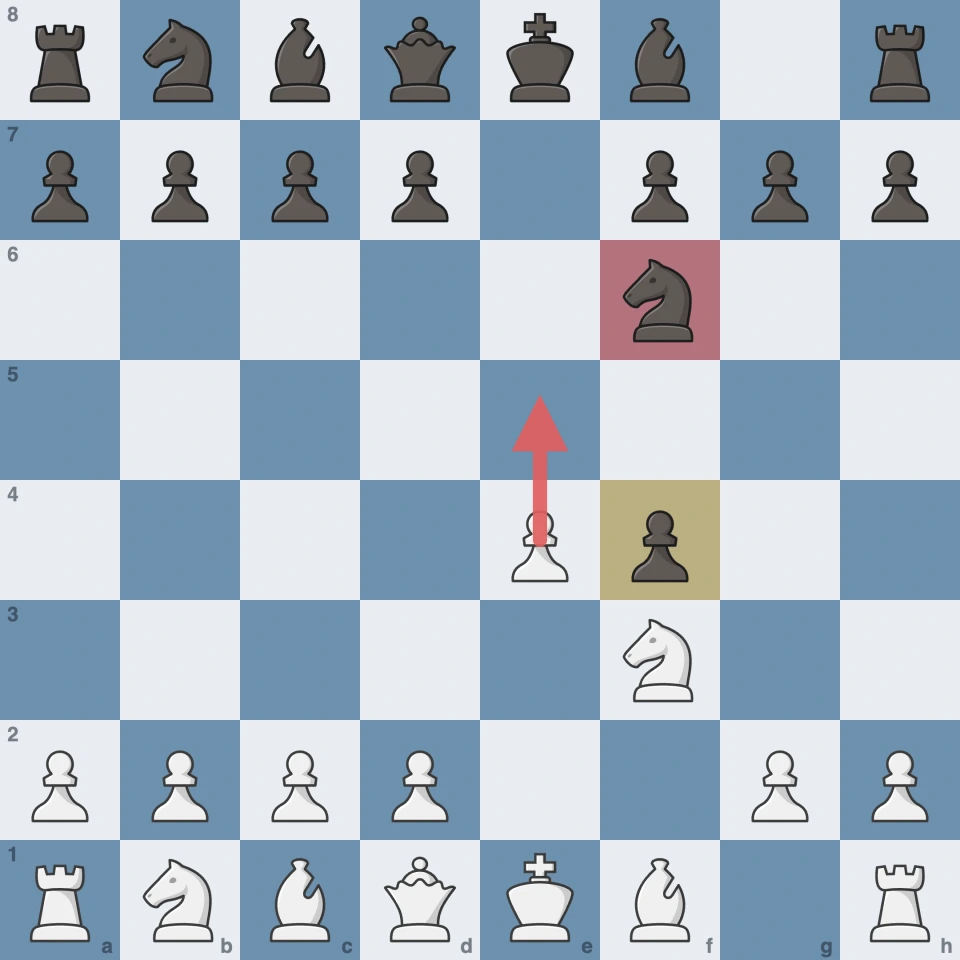
3…Be7 passes: the bishop is out, Nf6 follows, and there’s nothing left to kick it with. Ten percentage points from the order of two moves. The King’s Gambit in one line: after taking on f4, bring the bishop out before the knight; don’t feel like thinking, answer 2…d5 and leave the pawn alone. After 2…d5 the score at this level is dead even: Black 49%, White 48%.
Evans Gambit: don’t take
1.e4 e5 2.Nf3 Nc6 3.Bc4 Bc5 4.b4. Seventy percent of players grab the b4 pawn. Check the rule: after 4…Bxb4 5.c3 the bishop is attacked and moves a second time, and once it retreats 6.d4 arrives, another tempo for White.
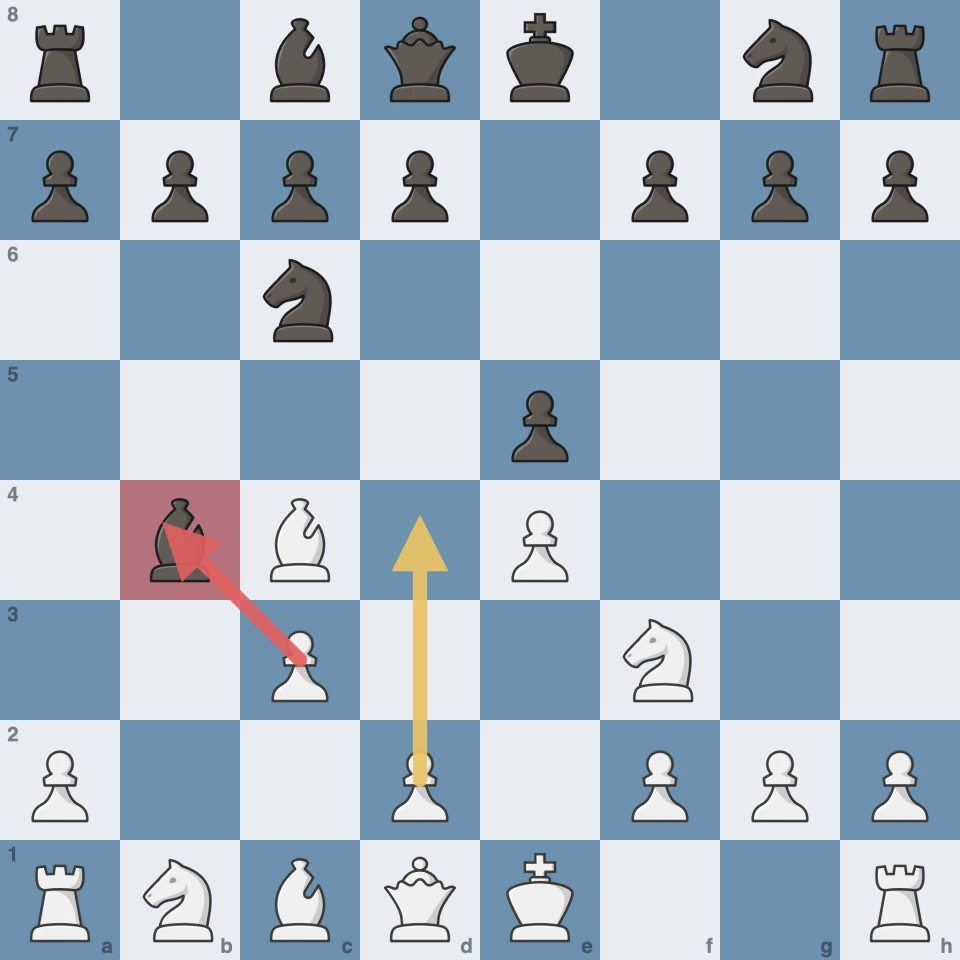
The numbers agree with the rule: players who take win 43%, players who decline with 4…Bb6 win 50%. If you do take, retreat to a5 or e7, never c5: from there d4 kicks the bishop again and the score drops to 40%. The Evans in one line: meet 4.b4 with 4…Bb6 and keep developing.
Morra Gambit: decline with one move
1.e4 c5 2.d4 cxd4 3.c3. Seventy-two percent take: 3…dxc3 4.Nxc3. The knight comes to c6 easily, but there’s nowhere for a second developing move: the f8 bishop needs a pawn move first, and that isn’t development. The rule says no.
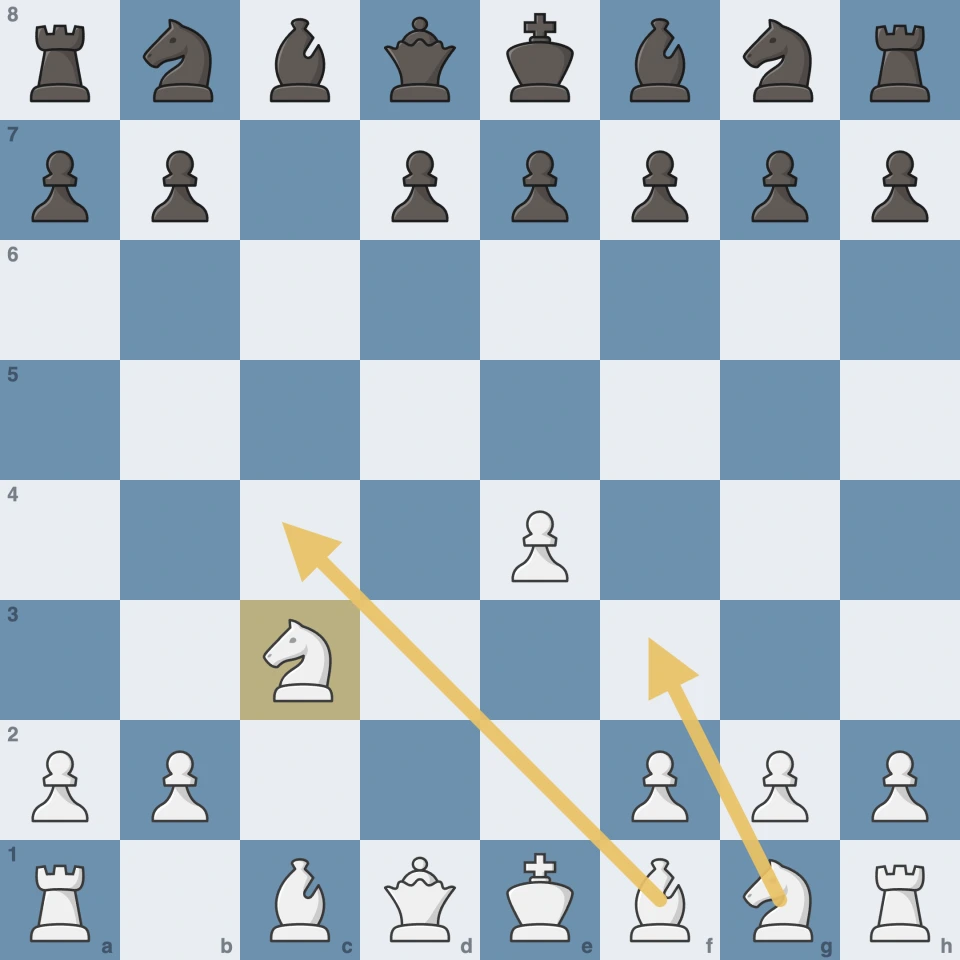
After taking, Black wins 45% at this level, and active tries like 4…e5 or 4…d6 drag it down to 41–43%. Easier not to go in at all: 3…Nf6 or 3…d5, and you’re in a normal c3 Sicilian with no debt. There Black scores 49–51%. The Morra in one line: answer 3.c3 with 3…Nf6 and leave the pawn alone.
A gambit is a question, not a present
Plenty of gambits are just opening traps in a nicer suit: a pawn offered so you’ll waste moves keeping it. That’s no reason to study theory for each one. Below 1600, memorised lines barely pay off, and the two-move rule works against a gambit you’ve never seen before. If the gambits reach you as Black after 1.e4, it’s simpler to settle the matter with one answer to 1.e4 than to learn them one by one.
One last thing: if you took and the rule said yes, spend the next two moves developing pieces, not propping up the pawn with pawns. Moves like g5 or b5 to keep the extra material are the most common way to hand back the initiative your opponent was paying for.
The numbers in this article come from the same source as the “This is what people play here” panel on the trainer’s game screen. Walk into a gambit and you’ll see under the board how players at your rating handle the position and how it ends for them.
A gambit isn’t an insult and it isn’t a gift. It’s a question — can you get developed? — and you want to answer it before you take, not on move ten.