
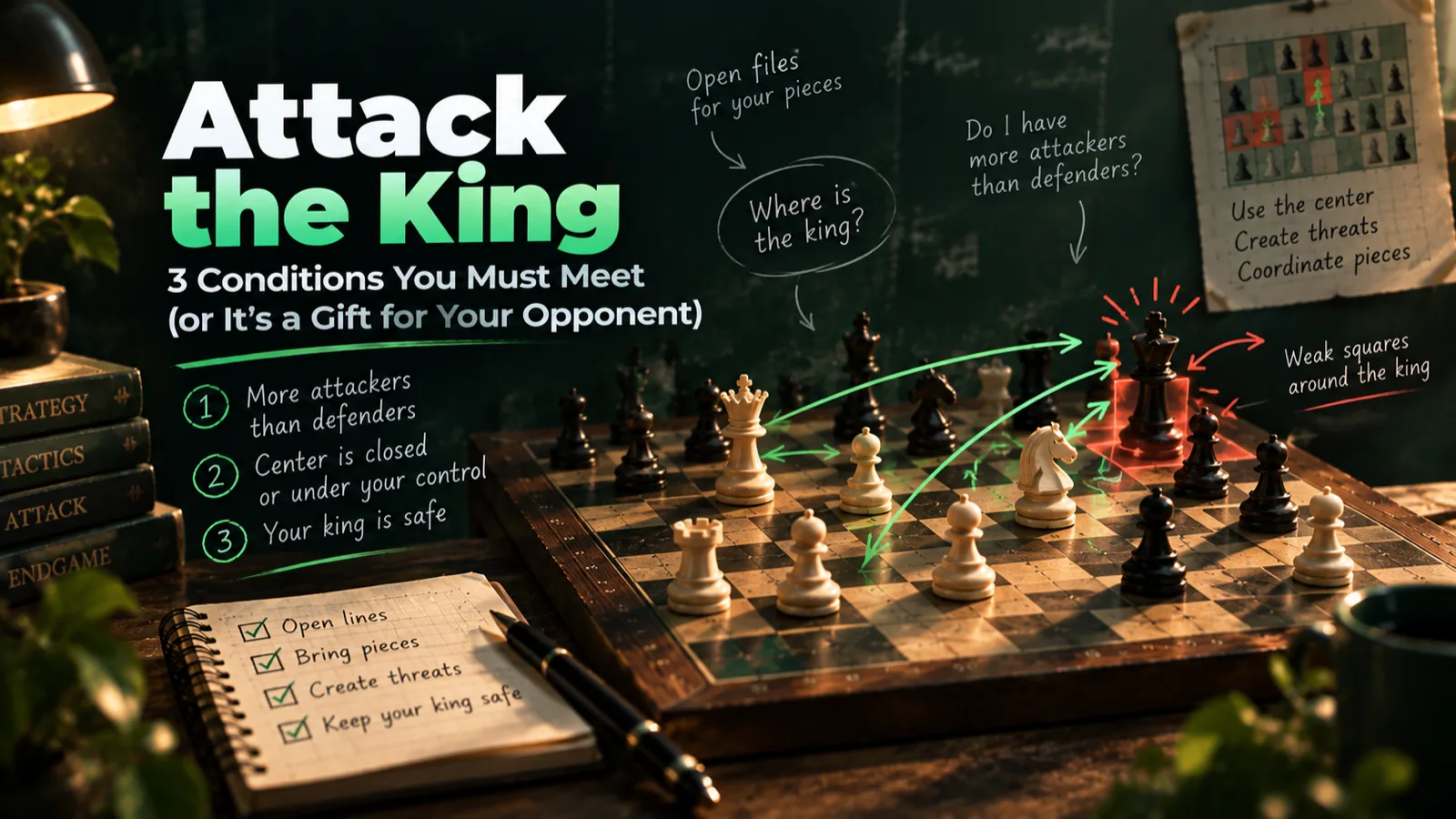
You pushed h4–h5, sacrificed a bishop on h7, got checked back, and lost down the e-file — to the king you never castled. Sound familiar? The problem isn't that you attack badly. The problem is there was no attack. There was hope.
Attacking the king is arithmetic, not bravery. It has entry conditions, and you check them before the first pawn moves, not after everything collapses.
There are three. All three yes — go. One no — what you're about to do isn't an attack, it's a donation.
One: more attackers than defenders
Count pieces that look at the four squares around the enemy king — g7, h7, f7, h6 — not pieces on the board. Your rook on a1 doesn't count, however beautiful it is.
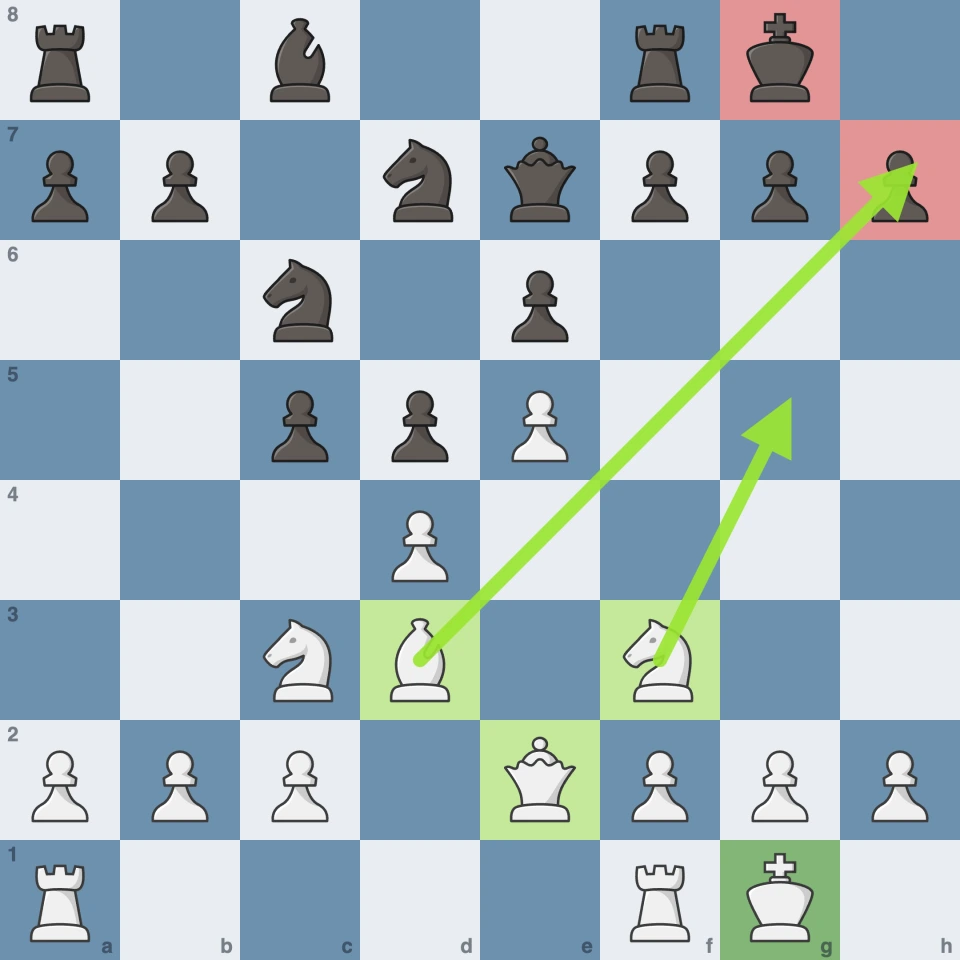
This is where most attacks under 1600 die: the advantage gets counted across the whole board, but the blow lands in one corner. Three pieces against one is an attack. Two against two is a trade — after which you own the holes and your opponent owns the tempo.
The practical consequence stings: if you're one attacker short, don't strike. Bring it. Rook f1–f3–h3, knight to e5, queen to the third rank. An attack launched one move before the last piece arrives gets refuted on exactly that move.
Two: the centre is closed, or it's yours
The old rule says meet a flank attack with a strike in the centre. While the centre is open, every pawn move you make on the edge is a gift to your opponent in the middle — and the middle is closer to both kings than your wing is.
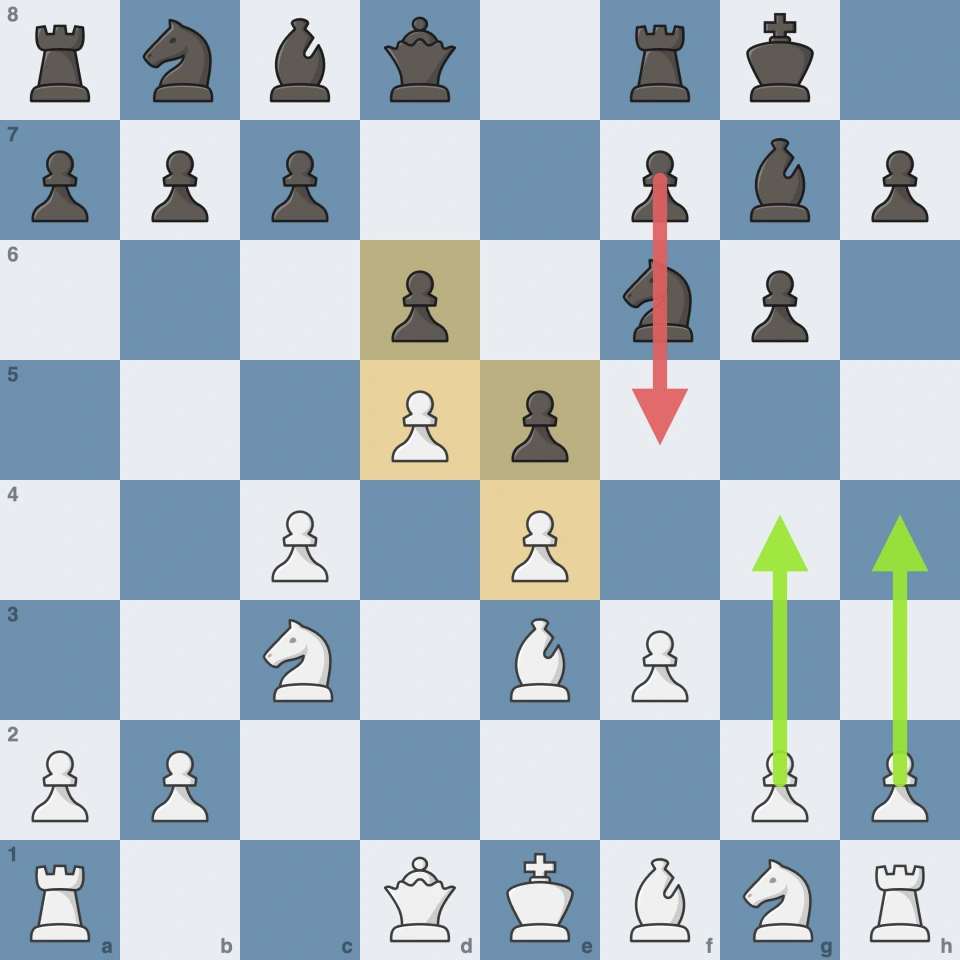
That's how a pawn storm actually works. Not because pawns are frightening, but because your opponent has no reply in the middle: he has to play on your wing, by your rules, a move behind.
If the centre is open or fluid, you don't get a slow attack. You get a fast one — pieces, tempo, no pawn moves. Different job, different arithmetic.
Three: your own king is already home
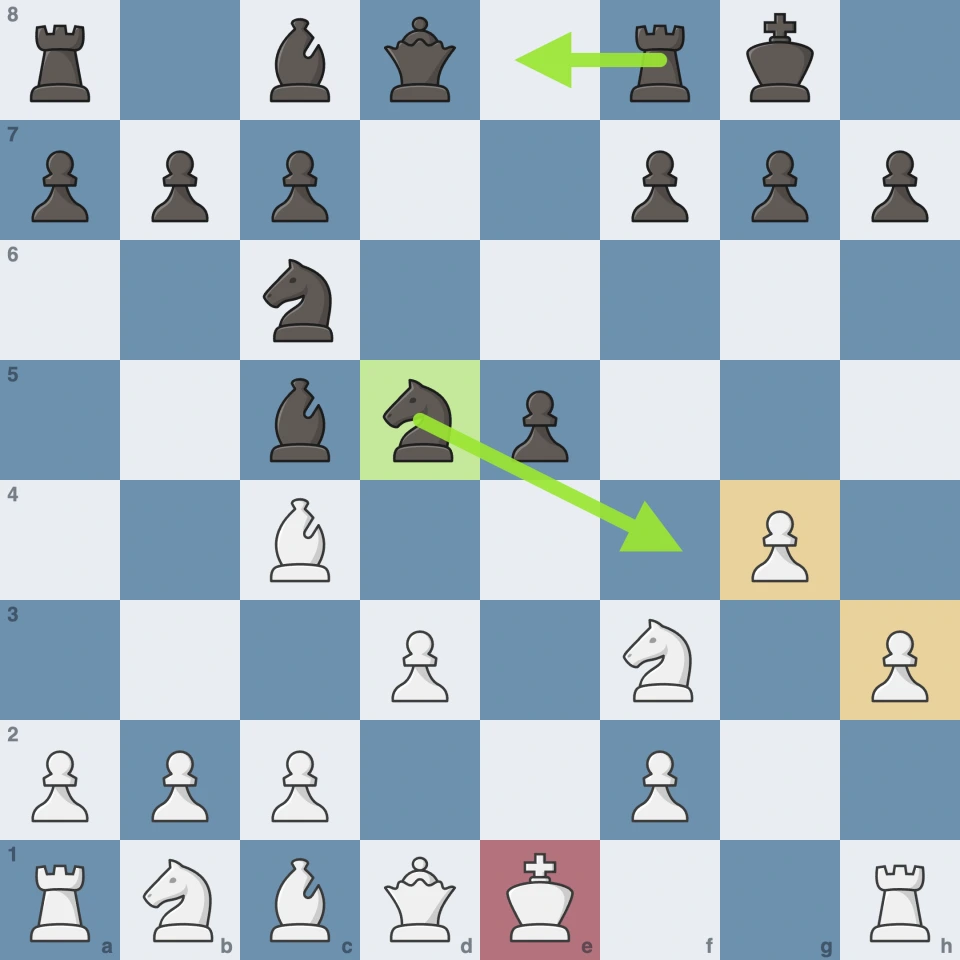
Every pawn that leaves your king is a line opened towards him. While the king sits in the centre you aren't attacking: you're digging a trench in your own direction and inviting your opponent to climb in.
Which is why the first condition of an attack is usually spelled castling. And why flank pawn moves come last: they're irreversible, and the weaknesses they leave outlive the attack.
Why this is one rule, not three tips
Wilhelm Steinitz put it more harshly than it's usually quoted: the right to attack belongs to the side that already has the advantage — and that side must attack, or the advantage evaporates. An attack without an advantage loses by definition: you pay in moves and weaknesses and receive nothing.
The three conditions are how you check for that advantage by eye, without an engine. More force in the sector — one. More time, because your opponent can't hit back in the centre — two. No counter-advantage on his side — three. With all three present, attacking isn't a risk; it's conversion.
What to do when the answer is no
Nothing dramatic: the attack is postponed, not cancelled. Short of attackers — spend moves bringing them, not checking. Centre open — fix it or win it first. King in the centre — castle and forget the wing for two moves.
The funny part is that this "preparation" is usually the whole game. An attack in a ready position takes three minutes to calculate and six moves to execute; getting the position to the point where it calculates takes thirty.
The mistake your review points at in the wrong place
The engine drops a minus on move twenty-four, when the attack finally fell apart. The real mistake was move eighteen, when you started it without counting. So in review, rewind to the moment you decided to attack and ask the three questions there.
This is one of those places where a coach beats an engine: it says not "−1.5" but "you had two against three here". The 99chess review looks for the decision, not the punishment, and explains what the position was missing. What a workable plan looks like we covered separately.
Attacking isn't courage. It's arithmetic you did before you touched the pawn.