
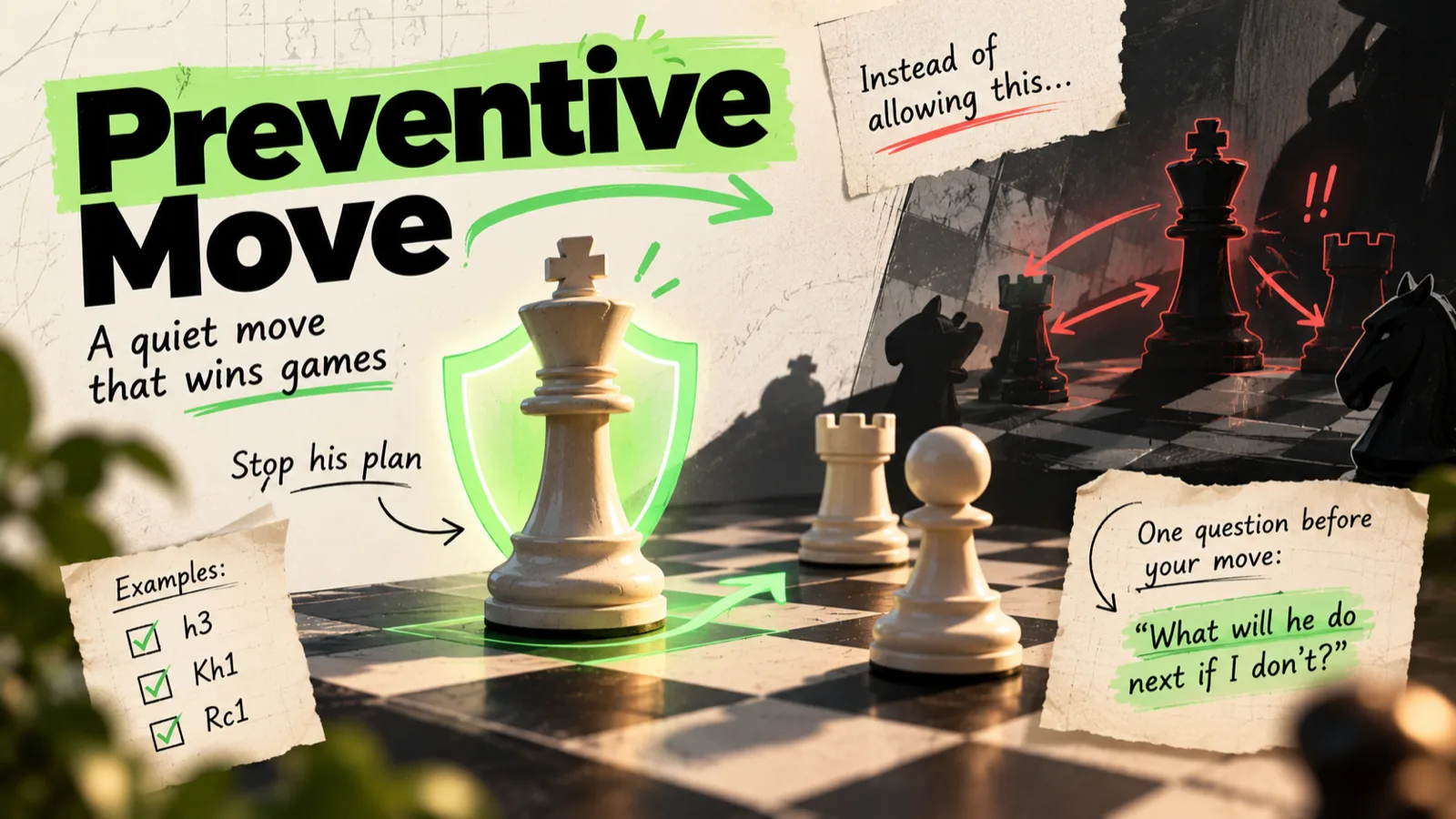
You've been building an attack for five moves. Rook lifted, knight rerouted, one more move and it's go time. Then your opponent plays the move you never thought about: bishop to g4, a pin, and two moves later your attack is a memory. They weren't a genius. You just never once asked what they wanted.
That's prophylaxis in chess: a move that creates nothing on its own but takes away your opponent's next idea. Sounds dull. In practice it's one of the cheapest ways to stop losing games that were "going fine."
Below 1600, people play half the board
Look at your losses. Almost every one has a stretch where you were busy with your own stuff — developing, attacking, "improving" — while your opponent calmly loaded the gun. You didn't miss some deep combination. You missed an ordinary move that was obvious from their side of the board.
We covered the root of this in why you hang pieces: a blunder is usually not a lack of knowledge but a lack of attention to the reply. Prophylaxis is the same question, asked one move earlier. Not "what are they threatening?" but "what will they threaten if I don't stop it?"
One question before every move: "what would they do if I passed?"
Imagine your move is a blank. You skip your turn and your opponent gets two moves in a row. Where does their piece go? Which move do they want most? You'll find the answer in about ten seconds — because for once you're looking at their plan, not yours.
Then there are two cases. If their best move is harmless, play your own plan; no prophylaxis needed. If it hurts, look for a quiet move after which that plan simply doesn't work. Not a defence against a threat that doesn't exist yet — just denying it the square.
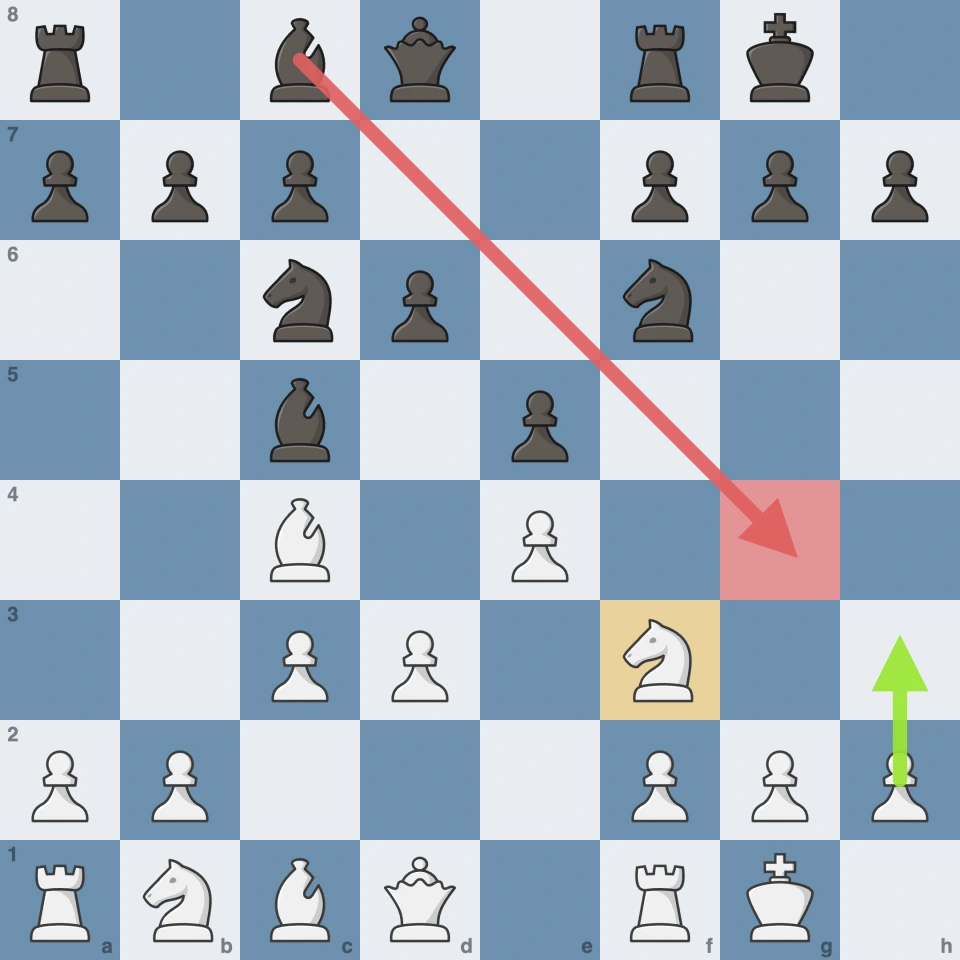
The classic case is the Italian Game. Both sides have castled, the position is calm, and your hands itch for something active. But "what would they do if I passed?" answers itself: ...Bg4, pinning the knight and playing against the center. h3 looks like a wasted move, yet it takes Black's best bishop square away for the rest of the game.
Three quiet moves worth recognizing on sight
Prophylaxis can get subtle, but below 1600 three standard cases cover most of it:
- h3 (or ...h6 for Black) — takes g4 away from the bishop and knight, and gives your king a window against back-rank mates.
- Kh1 — steps the king off the diagonal your opponent's bishop is eyeing before you play f4 or open the center. Skip it, and your own pawn break hands them a check.
- Rc1 — puts the rook on the file your opponent is about to open with ...c5. They open it, and the file is already yours.
What they share: all three are played before the opponent's idea turns into a threat. Afterwards it's called defending, and defending usually costs more.
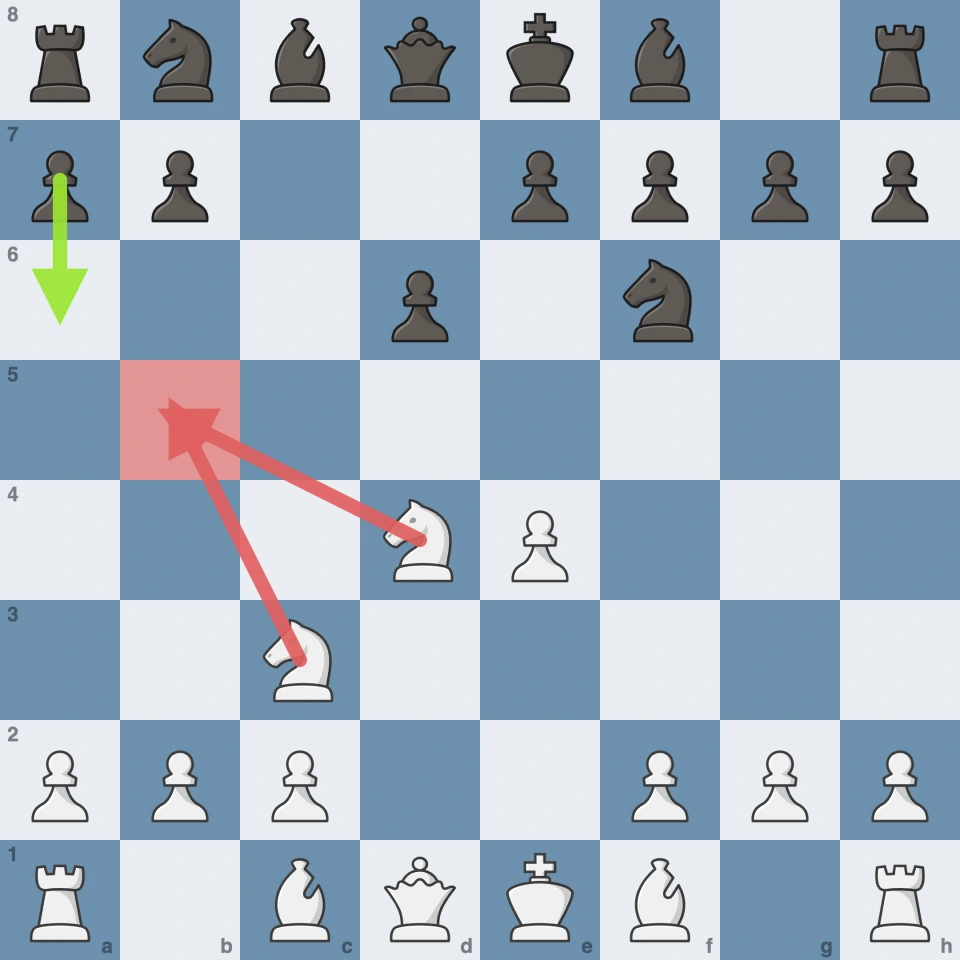
And here's one everyone who has opened an opening book knows: the Najdorf Sicilian starts with ...a6. It doesn't develop a piece or fight for the center. It just shuts the b5 square — and one of the most popular openings in history is built around that "nothing" move.
Prophylaxis is not passivity
Here's the trap. After reading about quiet moves, it's easy to start playing them all the time: nudge a pawn, tuck the king away, "just in case." That's no longer prophylaxis, it's passivity — and the difference is simple.
Prophylaxis takes away their plan. Passivity gives up yours. h3 after asking "what do they want?" is prophylaxis: it answers a concrete idea. h3 "because everyone plays it," in a position where your opponent threatens nothing, is a lost tempo — and in open positions you pay for those.
The on-the-spot test: can you name the opponent's move that your quiet move cancels? If yes, play it. If the answer is "well, no reason really," play your own plan. Same logic applies to attacking: an attack on the king works only when the opponent has no fast counterplay — and a prophylactic move often removes that counterplay in advance.
How to turn the question into a habit
You build the habit in calm positions, not sharp ones. It's exactly when "nothing is happening" that your opponent prepares their best move. So the rule is simple: before every move in a quiet position, one look from their side of the board. Not five moves of calculation — one sentence: "if it were their move, they'd play…"
This isn't about calculation depth — that's covered in how many moves ahead to calculate. It's about looking in the right direction. Two or three moves from their side beat ten from yours.
Training wheels help at first. In 99Chess, when you play the bot, there's a "Threats" toggle: it highlights your pieces your opponent is already aiming at — yellow, orange or red, depending on how much you stand to lose. Turn it on for a week and, before each move, check yourself first, then the highlight: "what do they want?" Once your answer keeps matching the colors on the board, switch it off.
The best moves in a game often do nothing on the board. They make sure nothing works for your opponent.