
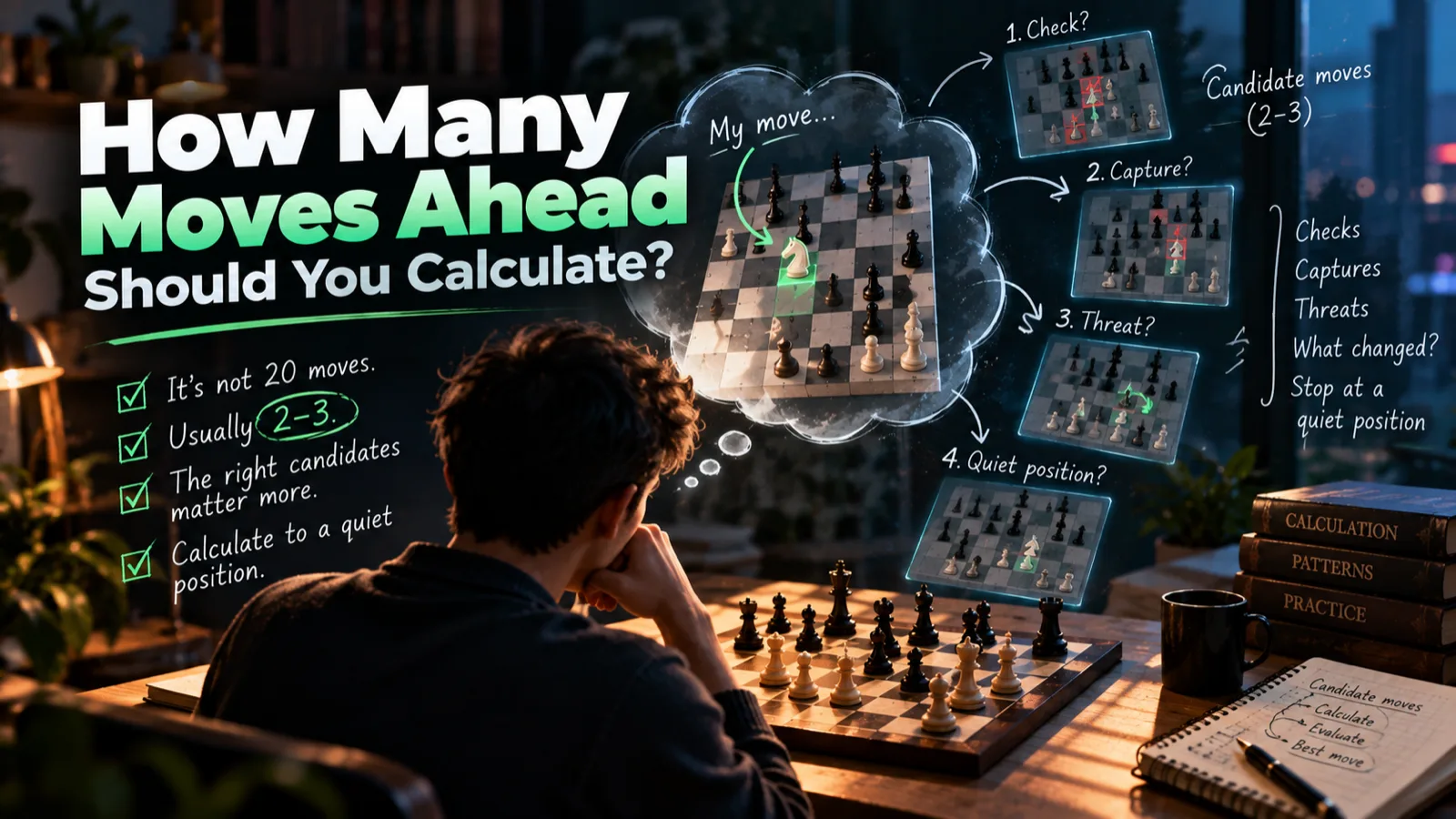
Ask a beginner how many moves ahead chess players think and you will get a confident answer: "Grandmasters see twenty moves." Ask a grandmaster and you will get a smile. Capablanca is credited with the line: "I see only one move ahead, but it is always the correct one." That is closer to the truth than the legend.
We review players' games every day and keep seeing the same thing. Games are not lost because somebody failed to calculate ten moves. They are lost on move two of a line nobody calculated at all. So an honest answer to "how to calculate variations in chess" does not begin with depth.
Twenty moves is a myth, two or three is the job
Long forced lines do exist: a mating combination, a pawn endgame decided by a single tempo. But those are rare islands. In an ordinary middlegame position the decision is made two or three moves deep, and then evaluation takes over: "my pieces are more active here, his king is exposed there."
Why? Because by move three the tree already branches into dozens of continuations, and no brain holds them all. A strong player does not calculate more. They calculate less, but the right things: nine moves out of ten are discarded before the counting even starts.
Calculate to a quiet position, not to a depth
Here is the rule that replaces the question "how many moves". A line is calculated until the position goes quiet: no checks, no captures, no direct threats. Reached the quiet, stop and evaluate. If the quiet came after two moves, two moves was the right depth. If it took seven, then seven, but such lines are almost always forced, and forced lines are easier to calculate than they look.
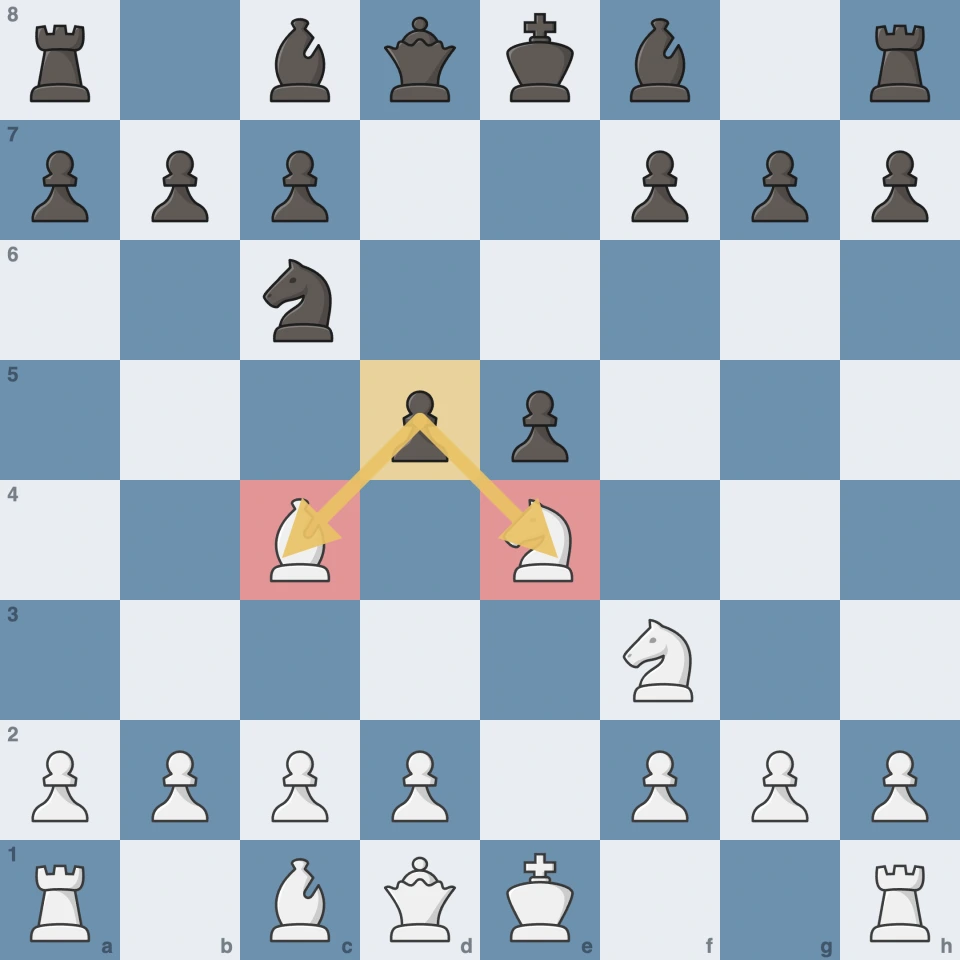
Look at the diagram. Black has just played d5 and two white pieces are attacked. White has essentially two candidates. First: 6.Bxd5 Qxd5, and suddenly there is no quiet: the queen on d5 attacks the e4 knight again, the knight has to move, and Black gets the centre plus a queen in play. Second: 6.Bd3 dxe4 7.Bxe4, and there is the quiet position: material is level, nobody attacks anybody. Two moves in one branch, two and a half in the other. No twenty anywhere.
Candidates first, calculation second
Half a century ago Alexander Kotov described the main calculation mistake: a player grabs the first move, calculates it, finds a flaw, grabs a second, then drifts back to the first "just in case". The clock runs, no tree gets built. His cure is simple: list the candidate moves first, all of them, then calculate each one to the end without hopping between branches.
Where do candidates come from? There is an order worth learning like the multiplication table: checks, captures, threats. All checks first, yours and the opponent's. Then all captures. Then moves that create a threat next move. Everything else is a "quiet" move, and quiet moves rarely need calculating deeper than one move; they need evaluating.
The same order works in defence. Before your move, scan the opponent's checks and captures. Three seconds. Those three seconds, not the ability to see five moves further, separate a 1200 player from a 1500 one.
What did the opponent's last move change?
The most common calculation failure happens before any calculation. The opponent moves, and you keep counting the plan you invented two moves ago. Meanwhile one move changed the position: a file opened, a piece left its defensive post, a new threat appeared.
So the first question after every opponent move is not "what do I want" but "what changed". Where does that piece hit now? What did it stop defending? Which line did it open? We have written that almost every blunder is born from this blindness: why you hang pieces gives three questions that catch most of them. And separately, about the targets an opponent looks for first: loose pieces drop off.
Four ways to calculate wrong
In reviews of games below 1600 the calculation errors repeat so precisely that they can be numbered.
- Counting only your own moves. "I go here, then here, then I take." In that line the opponent moves the way that suits you. One rule fixes it: for the opponent, look for their best reply, and the best reply is almost always among checks and captures.
- Stopping on a capture. "I take the knight" and the verdict is "a piece up". But a capture is not quiet: a recapture or a check follows. Count until there is nothing left to take.
- Hopping between branches. Starting the same line five times and never finishing it once. That is where time trouble and "but I saw it" come from.
- Calculating the pretty line instead of the necessary one. A bishop sacrifice on h7 gets eight moves of loving attention, while the opponent's modest reply that simply wins a pawn gets none.
Notice that none of the four is about depth. All of them are about order, and about honesty towards the opponent's replies.
How to train it
Calculation is trained not by "mate in five" puzzles but by a habit: on every move, scan checks, captures and threats, name the candidates (silently is fine), calculate each to the quiet. The first weeks are slow and annoying. Then it becomes automatic, and that is when the feeling of "seeing further" appears, although you are still calculating two or three moves.
The 99Chess trainer helps by not letting you hide: in the game review, every blunder shows with a green arrow the opponent's reply you did not calculate, and your puzzles are built from exactly those unseen replies, so the same trick stops working on you.
A grandmaster does not see further than you. They see the right two moves and spend not a second on the other eighteen.