
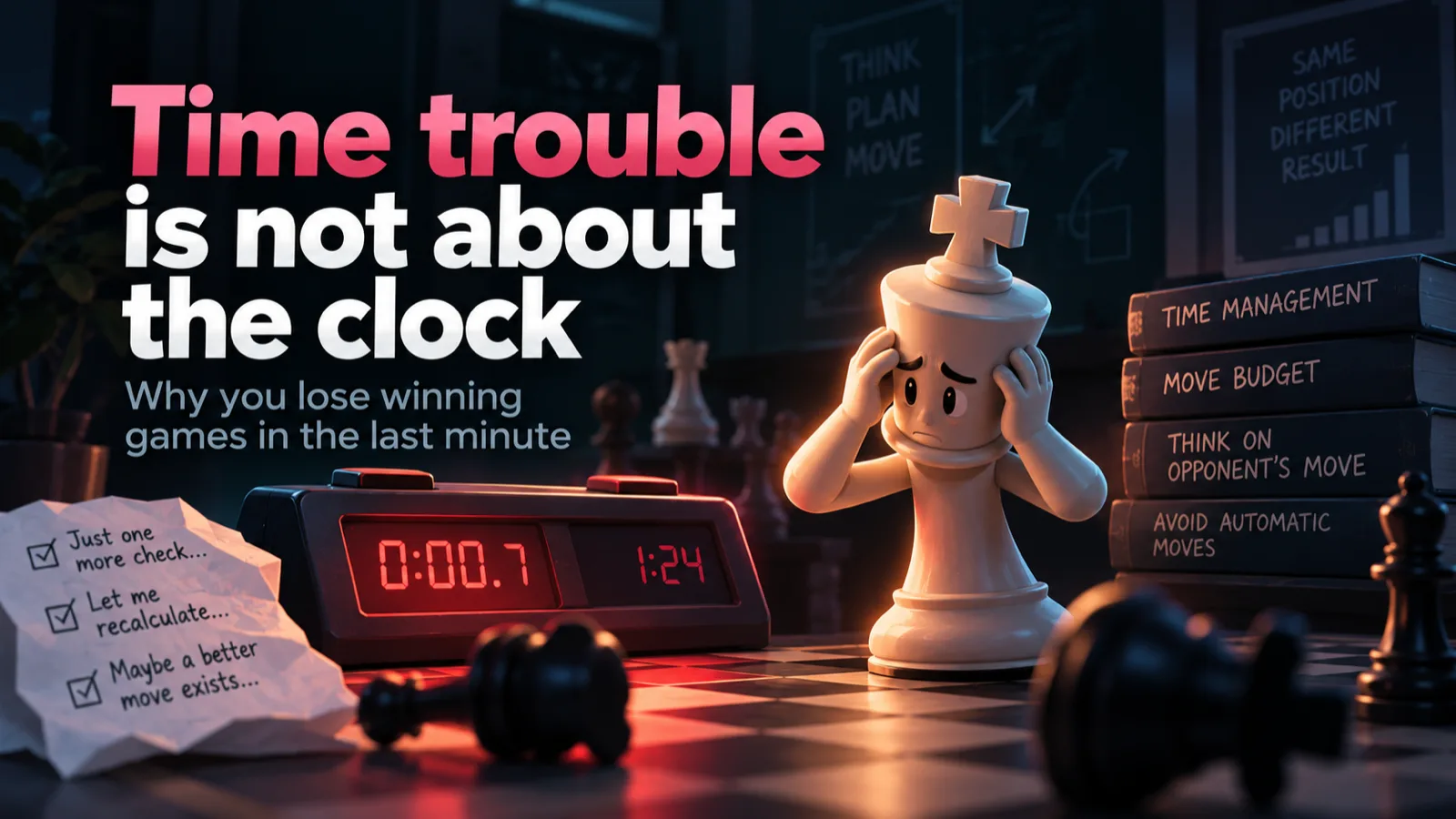
You're plus seven on the board: an extra rook, the opponent's king is bare. The clock shows forty seconds. Six moves later your flag falls, and the scoresheet says zero. You didn't lose this game on the board — you lost it on move fifteen, when you spent four minutes on a position where three different moves were all fine.
Chess time management is usually treated with speed: play faster, drill your mouse hand, buy premoves. That's treating the symptom. The clock isn't the cause — it's a counter: it shows how many decisions you made twice.
Your time doesn't leak into hard positions
Look at where the minutes actually go in your games. Not into the critical moment with a sacrifice — time spent there is spent honestly. The minutes are eaten by three familiar thoughts: "just one more check", "let me recalculate to be safe" and "maybe a better move exists".
That's perfectionism, and it's expensive. You already calculated the line — and you calculate it again, because pressing the button is scary. The move you found is sufficient — but you keep hunting for the perfect one. Every re-check is thirty seconds gone, and you arrive at the endgame — where precision finally matters — broke.
A move budget, like a monthly budget
Coaches converge on one number: the opening should cost you no more than a fifth of your total time. The logic is simple: the first ten moves follow principles — center, development, castling — and you don't need memorized lines for that. Every minute spent on move three is stolen from move thirty-three.
From there, the rule is selective depth: don't think equally — think selectively. Routine moves — the only recapture, obvious development, a move that follows your plan — take seconds. Save the deep dives for critical moments: structure-changing captures, sacrifices, transitions into the endgame. A game has three to five of those, not forty.
Think on your opponent's clock
Half the game is your opponent's move, and that half is working time, not a break. While they think, you settle the strategic questions: what the fight is about, where your worst piece belongs, which trade favors you. Then your own move carries one quick job: check what their move changed — and execute the decision you already made.
A player who only starts thinking after the opponent moves plays at half speed for the same quality. Literally half: they use fifty percent of the available time.
An automatic move is not the same as a fast move
One important caveat. Forced moves — the only reply to a check, a mandatory recapture — play them instantly; those are honestly earned seconds. But an "obvious" move is not a forced one: it still deserves the one-second check, "what did their last move change?". Autopilot is exactly where pieces get hung — followed by thirty seconds of panic that costs more than any check ever would.
In a winning position, find a sufficient move, not the best one
With an extra rook, stop playing chess for aesthetes. Your job isn't to find the strongest continuation — it's to allow no counterplay: offer trades every move, simplify into technique. A sufficient move in five seconds beats a perfect move in forty — because after ten of those "perfect" moves you won't have time left even for sufficient ones.
And if the flag does fall — don't immediately queue up the next game. Game after game without a pause after a painful zero is tilt, and it will take more rating than the time trouble did.
Our trainer attacks the same problem from the other side: puzzles and bot games without a clock build the habit of asking "what did their move change?" on every single move. Drilled without pressure, that check takes one second in blitz — and it's precisely what turns forty remaining seconds from a death sentence into a reserve.
The flag doesn't fall suddenly. It falls twenty moves earlier — the moment you recalculate, for the third time, what you had already calculated.