
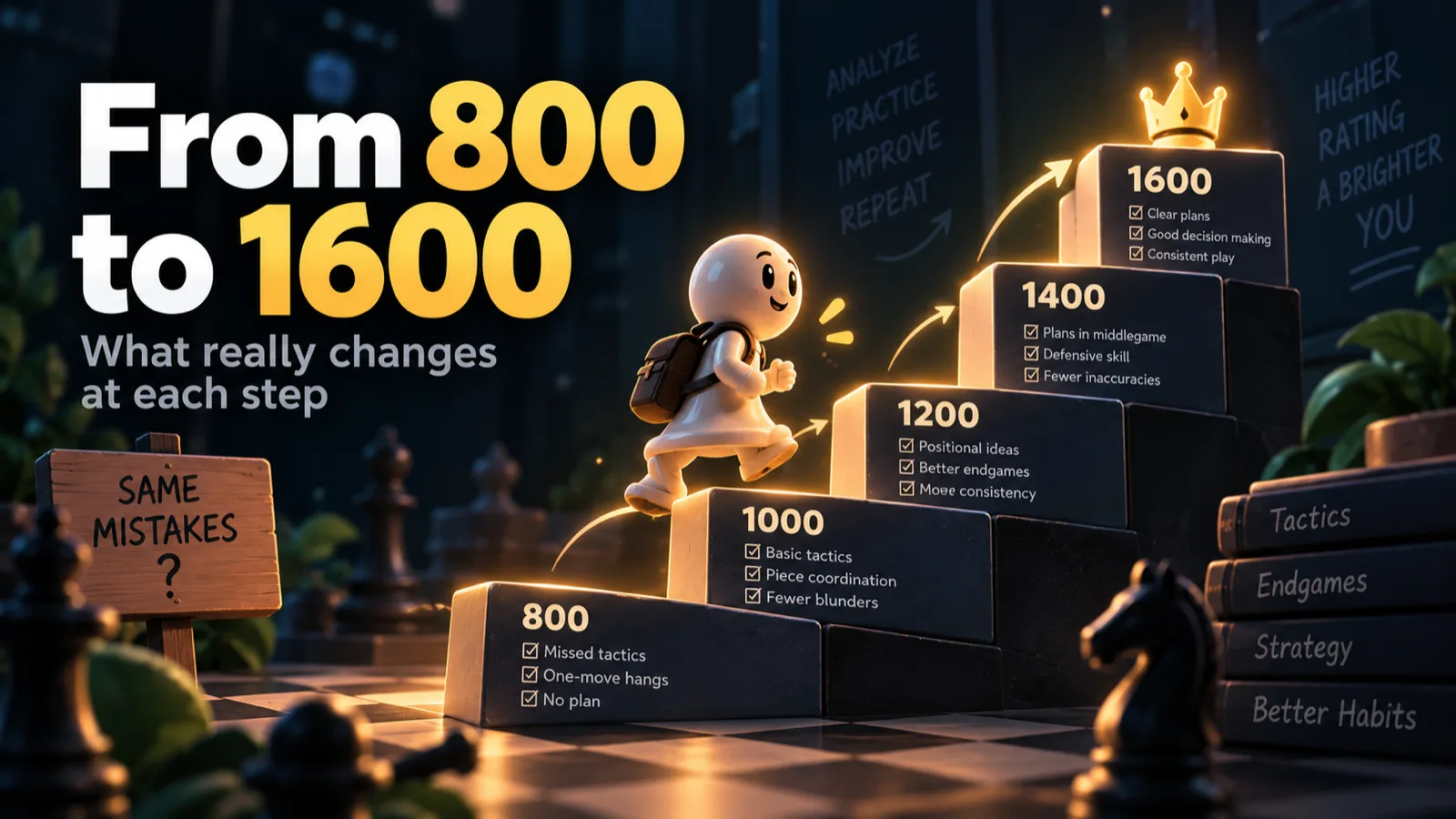
Ask a 1600 player what changed since they were rated 800. They won't say "I calculate deeper now" or "I understand strategy". They'll say something boring: "I stopped hanging pieces". Then they'll think a moment and add: "and I stopped throwing away won positions".
Chess rating levels don't grow like knowledge, in even layers — they climb like a staircase, and every step up is one specific class of mistakes going extinct. We run engine analysis on thousands of amateur games, and the steps show up clearly in the mistake types. Here they are.
800 → 1000: pieces stop vanishing for free
In our analysis of the 800 zone, one pattern dominates by a wide margin: a piece left en prise. Not a sacrifice, not a miscalculated combination — the bishop was just standing there, something could take it, and something did. Half of the decisive mistakes in this zone look exactly like that.
This step isn't climbed with opening study or mate-in-three puzzles. It's climbed with one habit: one second before every move for the question "what did their last move change?". Boring. Works. Why pieces get hung — we covered it separately: it's an attention failure, not a knowledge gap.
1000 → 1200: other people's tactics become visible
At 1000, a player already sees THEIR OWN forks — and happily plays them. But not the opponent's. In this zone the decisive mistakes change color: fewer hanging pieces, more "didn't see the fork", "walked into a pin", "grabbed the poisoned pawn".
The difference is subtle but fundamental: you look for your own tactics when you feel like it — you must see your opponent's tactics always. This step is climbed with puzzles, but not just any: the motifs you actually missed in your own games hit your blind spot precisely.
1200 → 1400: won games stop being lost
The 1200 zone is the most painful one. The player already outplays opponents: wins a piece, dominates the center... and hands half the point back. The typical script from our analysis: +4 by move twenty-five — then a draw, or a zero on the scoresheet. The causes never vary: counterplay that was allowed to happen, an autopilot trade into a lost endgame, a burned clock.
This step is climbed with technique, not talent: simplify when ahead and allow no counterplay; an endgame minimum (pawn promotion, opposition); the sufficient move instead of the perfect one. "Delivering points to the scoresheet" is a distinct skill — and at 1400 it shows up far more often than at 1200.
1400 → 1600: the position starts talking
Only here does the thing beginners call "strategy" appear. In the 1400 zone decisive blunders are already rare — games are decided by accumulated small things: a passive bishop, a weak square, a file opened toward the wrong king. A 1600 differs from a 1400 not in calculation — both see two or three moves ahead — but in what happens between tactical storms: their quiet moves serve a plan instead of serving nothing.
This is also where opening preparation finally pays for itself — below this level it was your worst time investment: games now survive into positions where structure matters.
You can't skip a step
The most common training mistake is studying material from someone else's step. A 900 player watches lectures on pawn structures — and keeps losing games to a bishop hanging on move 19. The knowledge settles in; the rating doesn't move. What holds a rating down is not your most "sophisticated" gap but your most frequent mistake class. Until it's extinct, everything else is scaffolding over a hole. One fixed habit moves a rating further than forty catalogued mistakes — that's the staircase in one sentence.
Our trainer is built around exactly this: the analysis sorts your games by mistake type and shows which step is yours, and the training program then drills that step with puzzles made from your own games. Not "chess in general" — your next step specifically.
A rating doesn't grow when you learn something new. It grows when something old goes extinct — one mistake class per step.