
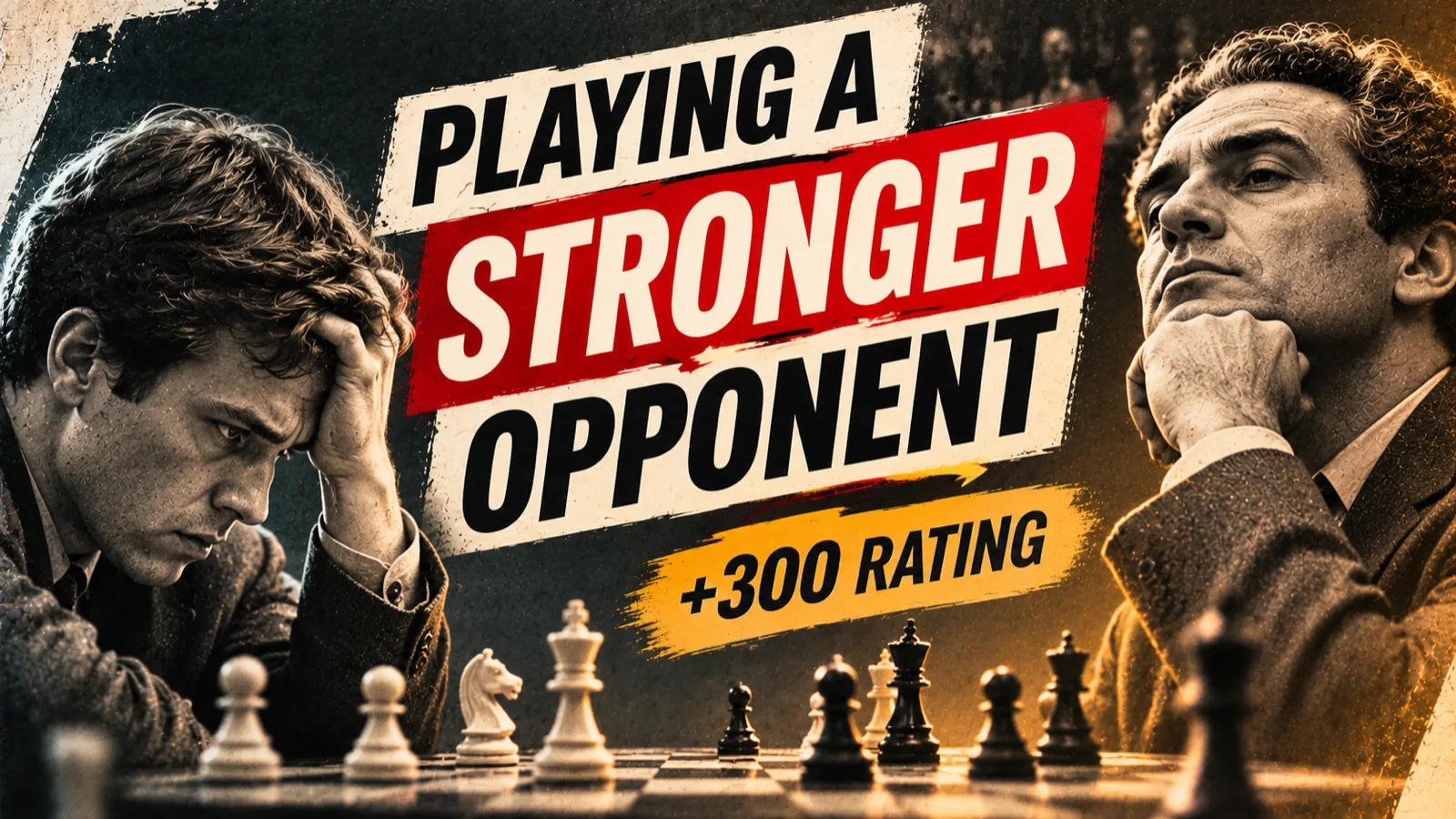
Across the board: 1850. You: 1550. You haven't made a move yet, but the game is already running in your head. "He sees everything." "Every move is a trap." "I have to do something or he'll crush me." By move 15 you have half his time on the clock, and you throw in a pawn sacrifice "to give myself a chance". By move 25 you resign.
That's how most games against a stronger opponent go. You lose your nerve long before you lose the position. Here's how to play a higher-rated player so that he actually has to work for the point.
300 points isn't a wall. It's 15%
The Elo formula is honest about what to expect: with a 300-point gap, the lower-rated player scores about 0.15 points per game on average. That's roughly one win and one draw in ten games. Not zero.
Where do those points come from? Not from brilliant combinations by the underdog. Almost always the stronger player goes wrong somewhere on his own, and the weaker one is in a position where the mistake can be collected. Your job isn't to outplay him. It's to survive until he slips — and not slip first.
Fear plays on his side
Against a stronger player, three habits switch on, and all three help him.
One: seeing a trap in every move. He put a rook on e1, so he must be planning something terrible. You spend ten minutes looking for a threat that isn't there, then rush past the one that is. Most of the time, a strong player's normal move is just a normal move.
Two: the clock. Every minute spent being scared is a minute you won't have in the endgame. We've written that time trouble starts twenty moves before the flag falls. Against a stronger player it starts on move one.
Three, the most expensive: going for complications. The logic is easy to follow — "in a quiet position he'll outplay me, so I have to stir things up." But sharp positions are won by whoever calculates better, and that's usually the one with 300 more points. Complicating against a stronger player means playing on his turf, by his rules.
Where strong players actually go wrong
Strong players rarely blunder in sharp positions — that's where they're focused and having fun. They go wrong in level, boring positions with no obvious plan, where they're "supposed" to win. A draw against you costs him rating. So he starts inventing: pushing pawns, loosening his king, dodging trades, anything to keep the position from drying up.
That's your chance. He should be the one taking risks, not you. Your job is to build a position where he has nothing to bite on — and wait.
How to play against a stronger opponent: three rules
Keep the position closed and level. Play your own setup — no gambits, no theory duels where he knows ten moves more than you. Pawn chains, a solid centre, pieces behind the pawns. The fewer direct blows on the board, the less his calculation edge matters. Prophylaxis is your friend here: before each move, ask what he wants to do, and take it away with a quiet move.
Trade pieces and don't fear a draw. Every trade removes part of his edge in understanding. Fewer pieces means fewer tactics, a simpler position, and a draw — which is a great result for you — gets closer. If he's the one attacking, trade the queens. And if the position is level and a repetition comes up, repeat. Let him be the one who deviates and takes the risk.
Don't play hope chess. A hope move only works if your opponent doesn't see it. Queen to h5 with a mate threat that one pawn move shuts down. A sacrifice that wins only if he recaptures with the wrong piece. Against an equal, that sometimes lands. Against someone 300 points stronger, almost never — and the position after it fails is usually worse than before. Simple test: if a move is only good when he blunders, it's a bad move.
And when he does go wrong
The most painful version: the stronger player really has overpressed, you're a pawn or the exchange up — and your hand starts shaking. "No way. It must be a trap." It's the same trap-hunting habit, except now it's giving the win away.
Check the capture exactly as you would against an equal: can he answer with a check, a capture or a threat? If not, take it. After that, the same rules apply from the other side: trade pieces, keep pawns, don't rush. A strong player in a worse position will try to muddy the water — don't leave him the pieces to do it with.
Losing to a stronger player is the most useful loss there is
It shows you exactly where those 300 points live. Usually it isn't some secret depth — it's two or three moments: ten minutes burned on fear, a hope sacrifice, a trade you turned down.
You don't need a tournament to practise this. 99chess has a ladder of nine bots from 400 to 2000+ that make human-like mistakes. Pick one a step or two above you, play by the three rules, and the review afterwards will show where you got scared sooner than you needed to.
A stronger opponent isn't all-seeing. He's just waiting for you to make the first mistake. Don't do him the favour.