
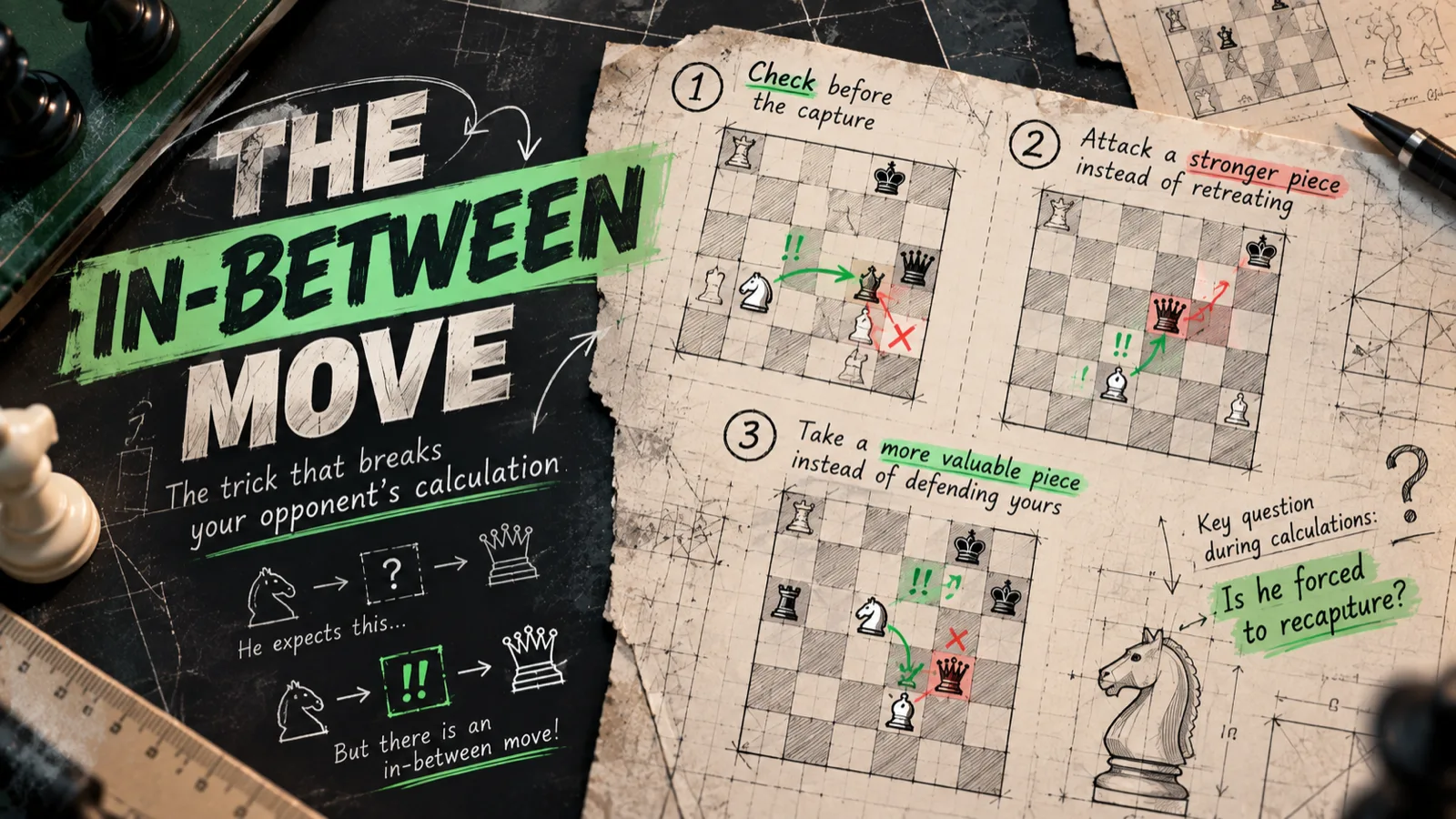
You worked it out: his bishop takes my knight, I take the bishop, an even trade. He captures the knight. You reach for the bishop, and instead of recapturing he gives check. The king steps aside, the bishop is still there, your knight is gone. That is a zwischenzug, German for “in-between move”: a move inserted between two moves that were supposed to be forced.
“He takes, I take back” rests on one unspoken assumption: after his capture I must recapture, and after mine he must. He mustn’t. The only player who must do anything is the one facing a check, a hit on the queen or a mate threat. Everything else is a wish.
An exchange does not have to be symmetrical
An intermediate move is a forcing move slipped into a sequence everybody expected: before a recapture, before a retreat, before a defence. It neither finishes the operation nor starts a new one. It changes the score before the exchange is over.
A good zwischenzug is almost always one of three things: a check, an attack on the queen, or a capture of a loose piece. Something the opponent has to answer right now. While he answers, your “hanging” piece just stands there: there is simply no time to take it.
Hence a one-question rule. Before any series of exchanges, ask: “Does he actually have to take back?” If, between his capture and yours, he has a check or a hit on the queen, start the calculation over. And the mirror image: do I have to? Maybe I have something stronger than a recapture as well.
Situation one: a check instead of the expected move
The Petroff, played thousands of times a day: 1.e4 e5 2.Nf3 Nf6 3.Nxe5 Nxe4 4.Qe2. Black reasons: my knight is attacked, I retreat with 4…Nf6, his knight retreats too, material is level. White has no intention of retreating.
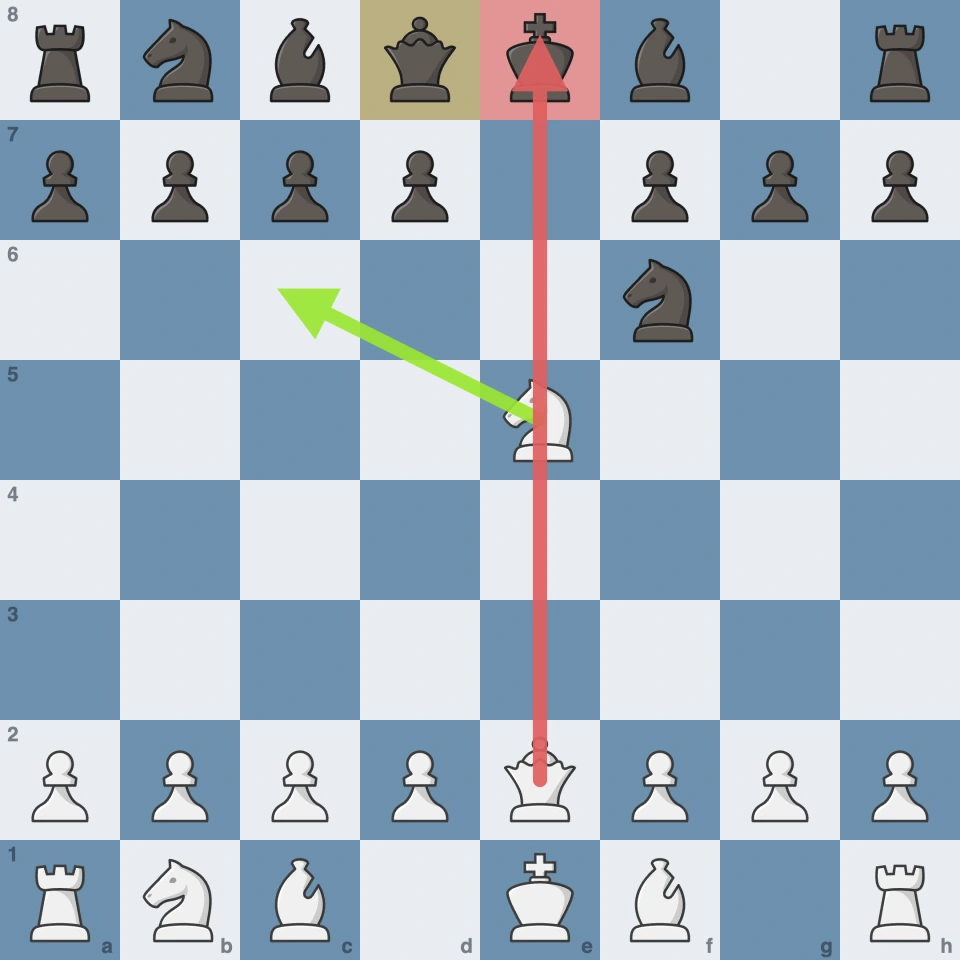
5.Nc6+ is a discovered check and an attack on the queen in one. Black’s retreat protected nothing, because the calculation stopped at the word “retreat”. The habit to build: after your own retreat, look for the check the opponent has just gained. Here there is none if the queen goes opposite the queen first: 4…Qe7.
Situation two: a hit on the rook instead of the recapture
Queen’s Gambit Accepted: 1.d4 d5 2.c4 dxc4 3.e3 b5 4.a4 c6 5.axb5. Black calculated “he takes on b5, I take back, the pawn is protected, I keep my extra pawn” and played 5…cxb5. White does not continue the exchange. White plays 6.Qf3.
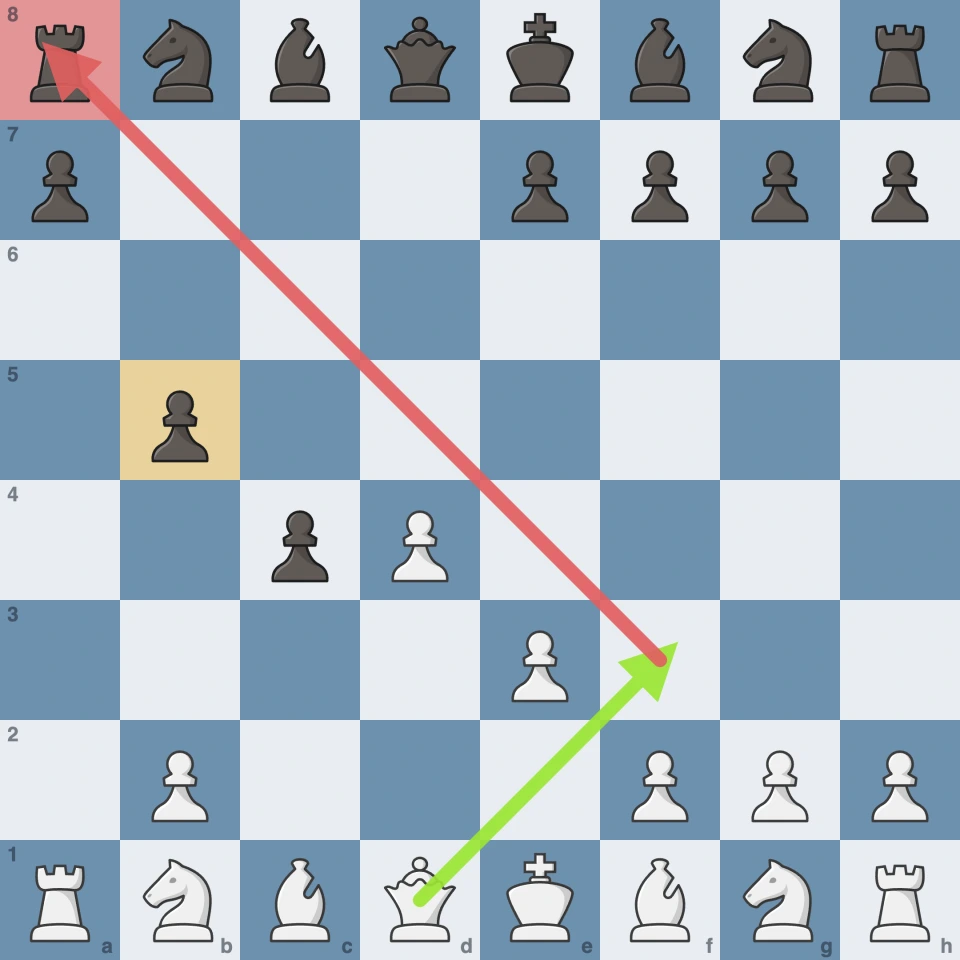
Nobody attacked the rook while the exchanges were going on. But every capture opened a line, and after the third one the a8–h1 diagonal was bare. The second question for any exchange: what has opened? Not only “what is left on the board”, but which lines have become highways.
Situation three: take his instead of saving yours
The Blackburne Shilling Gambit, a favourite trap under 1600: 1.e4 e5 2.Nf3 Nc6 3.Bc4 Nd4 4.Nxe5. White grabbed a pawn and expects Black to win the material back. Black is not counting material: 4…Qg5.
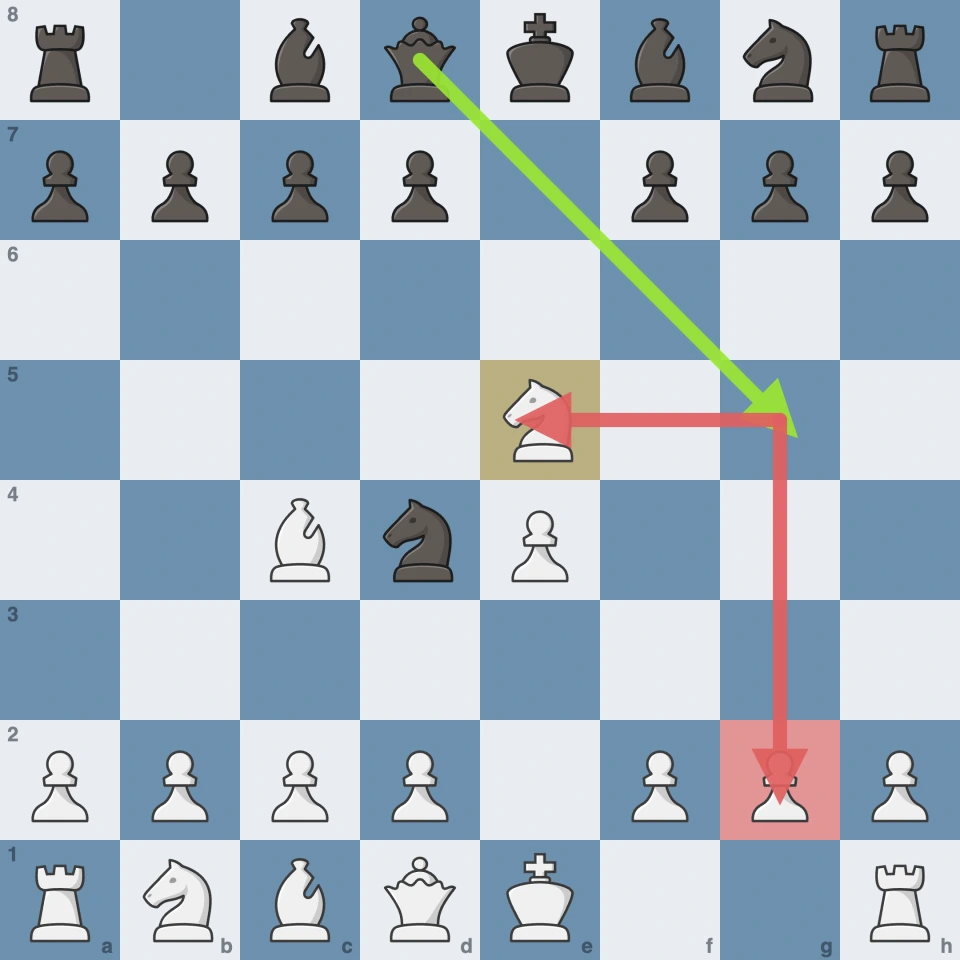
An attacked piece is under no obligation to save itself. Sometimes the best answer to a threat is a bigger threat. Textbooks call it a desperado: if the piece is lost anyway, let it take as much as it can with it. Under 1600 the “save my piece” reflex fires before the eye reaches the opponent’s pieces, and the in-between hit goes unnoticed.
How to calculate it at the board
The device itself needs no deep calculation. In the article on calculating variations we suggested scanning “checks, captures, threats” on every move. The zwischenzug hides exactly where that scan gets switched off: inside a “forced” sequence, because “it is all obvious there”.
Two habits settle it. Before his recapture: what can he do instead? Before mine: what can I do instead? Three quarters of intermediate hits land on a loose piece, and half of them are really a double attack in a different coat. Nothing new to calculate; just don’t stop calculating inside exchanges.
In the game review the coach shows these moments without commentary: the red arrow is your move, the green one is the move that was needed. The in-between move you missed becomes a puzzle from your own game and comes back on schedule until you start seeing it before the exchange rather than after.
An exchange is not a contract that both sides are bound to honour. It is a pause into which either of you may insert a move. The player who looks into that pause wins.