
Pull up your last loss and freeze it on move twenty. Where are your rooks? If the answer is a1 and h1, you played half the game without your two strongest pieces after the queen. Meanwhile your opponent parked a rook on an open file, and that is exactly the road the attack came down later.
Rooks below 1600 aren't bad pieces. They're unemployed. Knights and bishops develop themselves because they have squares to go to; a rook needs its square prepared. Preparing it is what playing on open files really means.
Open files in chess: where a rook has a job
An open file has no pawns on it at all. A semi-open file has none of your pawns, so your rook looks straight down it at an enemy pawn or piece. A rook behind its own pawn is staring at a wall. A rook on an open file sweeps the board from edge to edge and threatens to break into the enemy camp.
Most guides stop there: "put your rooks on open files." But by move twenty the open file is usually taken, and whoever got there first isn't giving it back. So the real question isn't "where is a file open?" It's "where is a file about to open?"
Put the rook where the file will open, not where it is open
Queen's Gambit Declined, Orthodox Defence: 1.d4 d5 2.c4 e6 3.Nc3 Nf6 4.Bg5 Be7 5.e3 O-O 6.Nf3 Nbd7 7.Rc1. Look at the c-file: a pawn on c4, a knight on c3, a pawn on c7. It's shut tight, and White puts a rook on it anyway.
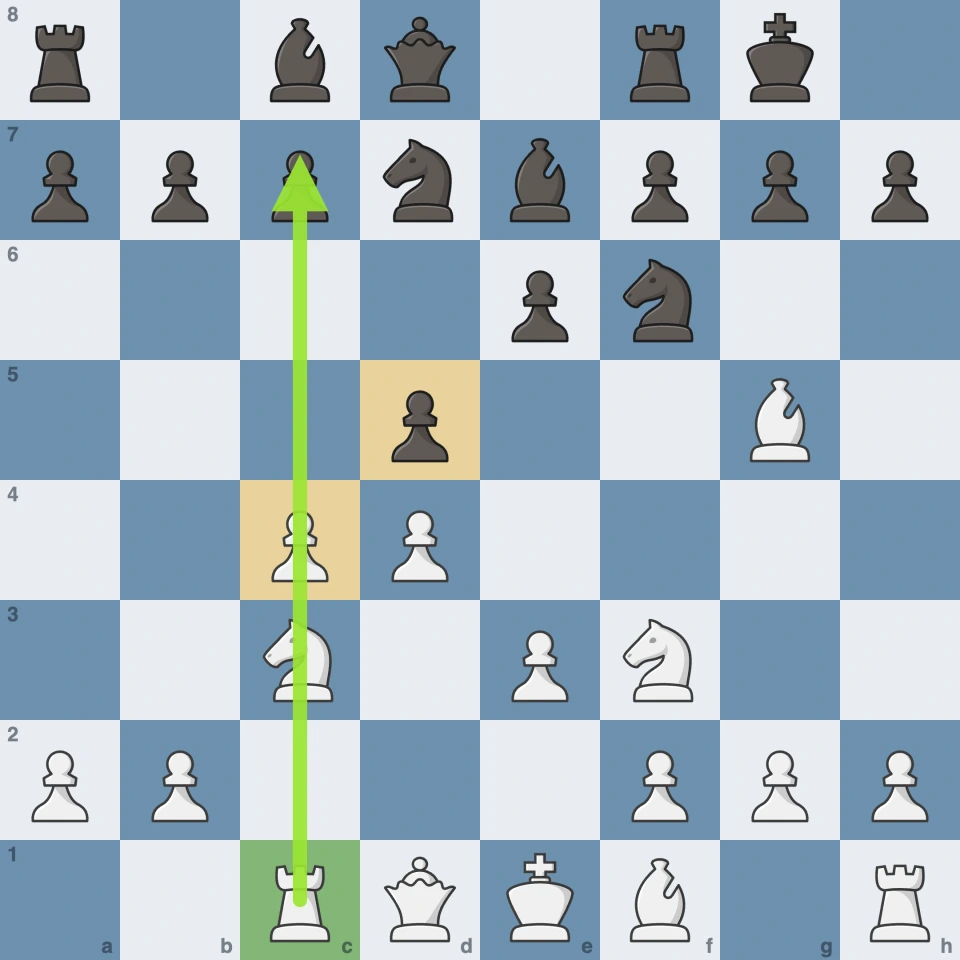
This isn't a quirk. In the lichess masters database, 7.Rc1 was played in 1,970 of 3,883 games from this position, more than any other move. Masters see what the gold squares show: c4 and d5 are nose to nose. One of them will capture, and the c-file will open.
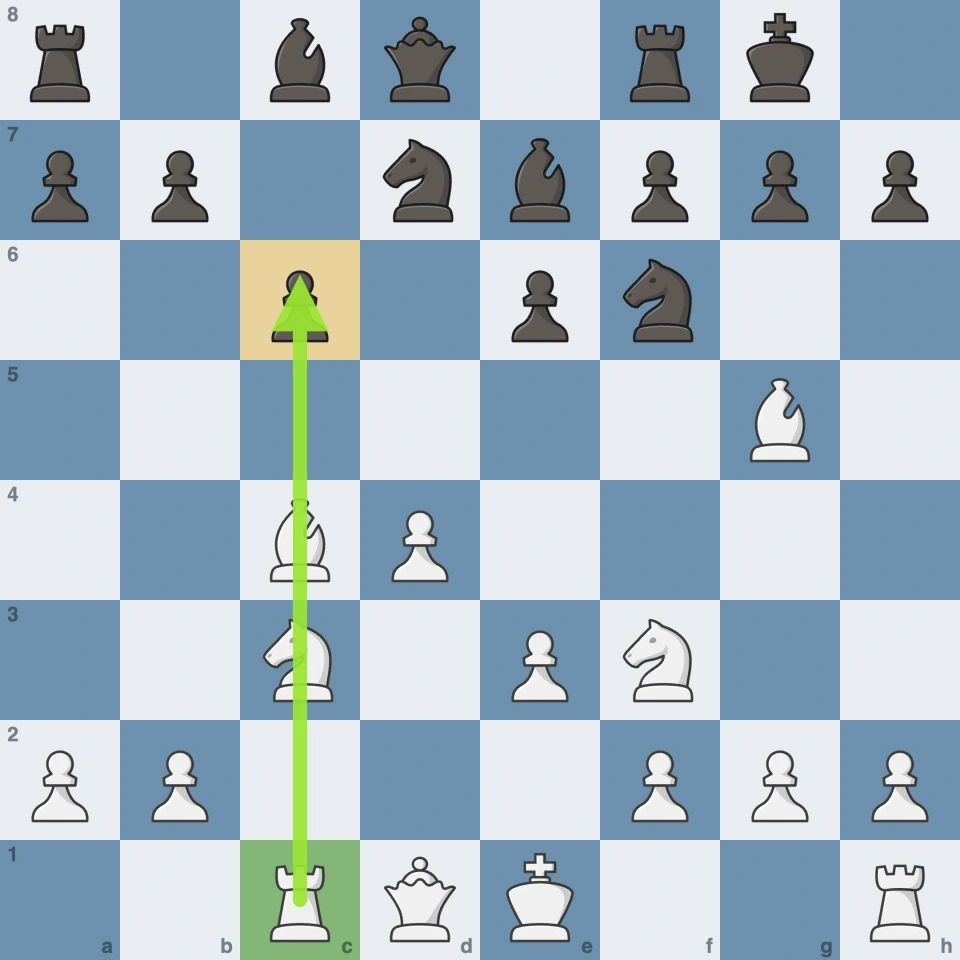
Two moves later the trade happened, and the c1-rook found itself on a semi-open file, aimed at c6. White spent no extra time on it; Black now has to reckon with pressure down the c-file. The rook goes in before the trade, not after: once the trade happens, both sides are looking at that file.
One sign it's time to grab a file: pawns have met on it
How do you know which file will open? You don't guess — you look for pawn contact. If one of your pawns and one of theirs can capture each other, at least one file is about to become semi-open. That's where your rook belongs.
It works the other way too. If you're planning a pawn break yourself — c4 against d5, f4 against e5 — the rook should be standing behind it already. A break without a rook opens the file for whoever's rook arrives first. We covered how pawn structure decides which files will exist at all in our piece on pawn weaknesses: an isolated pawn always comes with files on both sides that have none of your pawns — ready-made homes for rooks.
A semi-open file often points straight at the king
Sicilian Dragon, Yugoslav Attack: 1.e4 c5 2.Nf3 d6 3.d4 cxd4 4.Nxd4 Nf6 5.Nc3 g6 6.Be3 Bg7 7.f3 O-O 8.Qd2 Nc6 9.Bc4 Bd7 10.O-O-O Rc8.
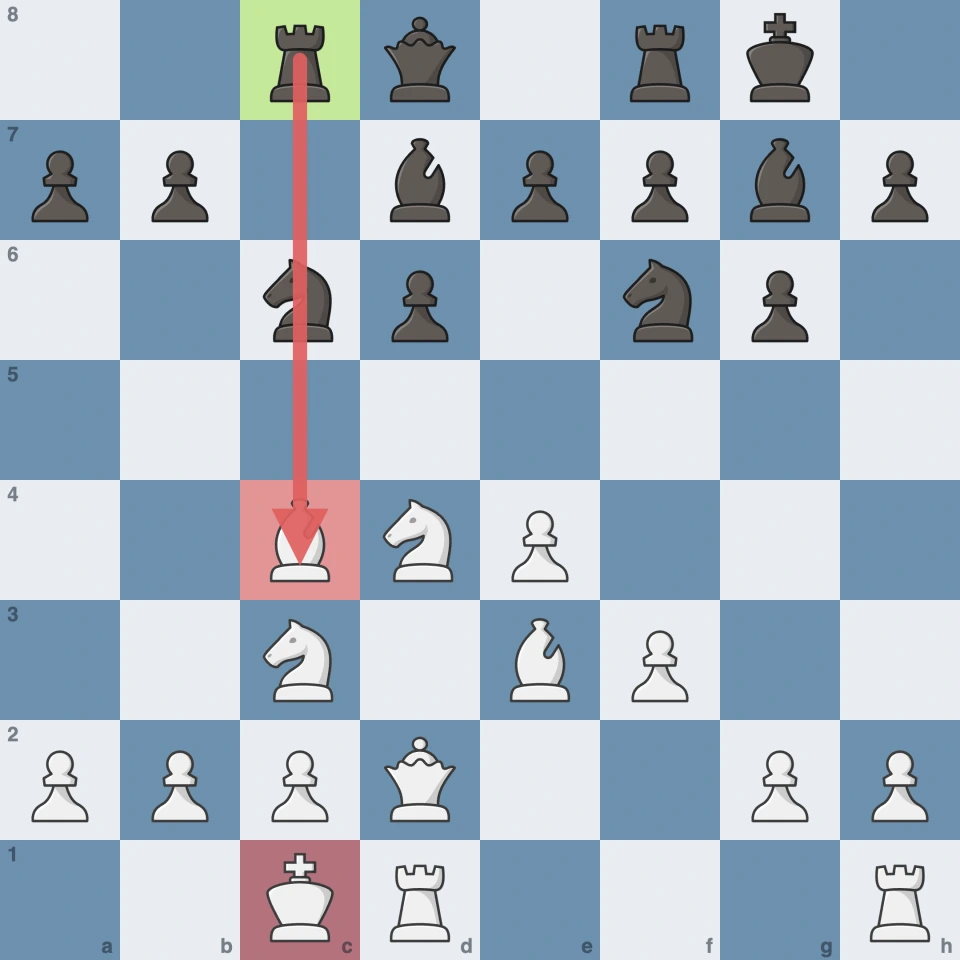
In the masters database 10…Rc8 is the main move: 1,870 games out of 3,604. Black traded the c-pawn for White's d-pawn back in the opening, and their whole game is built on the file that opened then. White castled long, right onto it. Later in the Dragon you'll even see the exchange sacrifice …Rxc3: the rook gives itself up to smash the pawns in front of the king.
That gives you a rule for where to put your rooks: look not only at whether a file is open, but at what sits at the end of it. A semi-open file aimed at the king is worth more than an open file leading nowhere.
Double up, then invade the seventh
Taking a file is only half the job. If your opponent puts a rook opposite yours, after the trade the file belongs to whoever has a second rook behind the first. That's why you double rooks on an important file: one in front, one behind. A queen behind a rook does the same job.
And what is the file for? An entry square. An open file whose every square in the enemy camp is covered is a corridor with no door. A rook that reaches the seventh rank hits pawns from the side, where they can't protect each other, and pins the king to the back rank. The seventh rarely wins on the spot, but your opponent has to throw pieces at it — pieces they'll be missing elsewhere. It matters most once you're already ahead; for turning that into a win, see how to convert a winning position.
How to do it over the board
Once your minor pieces are out and you've castled, ask one question: "Where are pawns touching right now?" The answer almost always points to the next file that will open. Put a rook there, even if it seems to be "doing nothing." It's a move into the future, not into thin air. It also answers "what do I do when I don't know what to do?" — the subject of our piece on making a plan. And if you're cramped with no pawn contact at all, you create it with a pawn break — more on that in our article on space.
In the trainer's opening schemes the rook has its own square on the setup checklist. In the Italian it's e1, behind the e4 pawn: the rook goes there before the centre opens, exactly by this rule. Run the scheme a few times and your hand will reach for the rook on move ten, not move twenty.
A rook shouldn't wait for someone to open the door. It should already be standing at the door when it opens.