
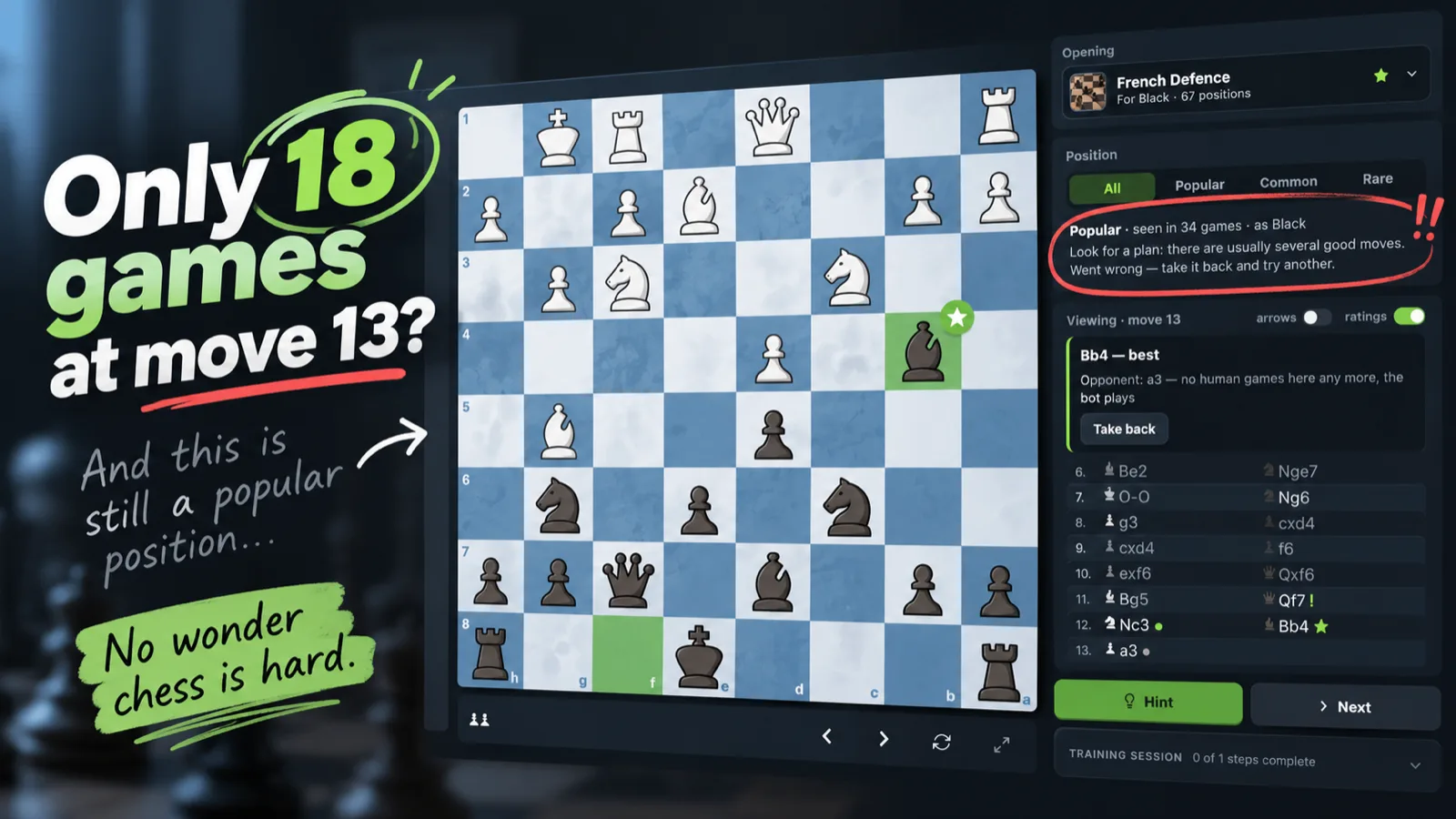
You've learned your opening. You know where the bishop goes, when to castle, what to do against every reply. Move 13. You check the lichess database — billions of games — and it shows 18 games with your position. And this is one of the "popular" ones.
That's not a weird sideline. That's what the middle of every game looks like, and it's exactly why you can't memorize the middlegame the way you memorize an opening or an endgame.
Why you can't memorize the middlegame: the numbers, move by move
Take the London System, one of the most played openings at club level. Its most beaten path, every move ordinary, no traps: 1.d4 d5 2.Bf4 Nf6 3.e3 e6 4.Nf3 c5 5.c3 Nc6 6.Nbd2 Bd6 7.Bg3 O-O 8.Bd3 b6 9.Qe2 Bb7 10.e4 Be7 11.e5 Nh5 12.Rd1 g6. Now count how many lichess games reached each move — no filters, every time control, every rating:
- move 1 — 7.8 billion games;
- move 6 — 4.8 million;
- move 10 — 66,903;
- move 11 — 1,850;
- move 13 — 26.
Roughly every two moves, the number of games drops tenfold. In the masters database — over-the-board games — this position appears twice.
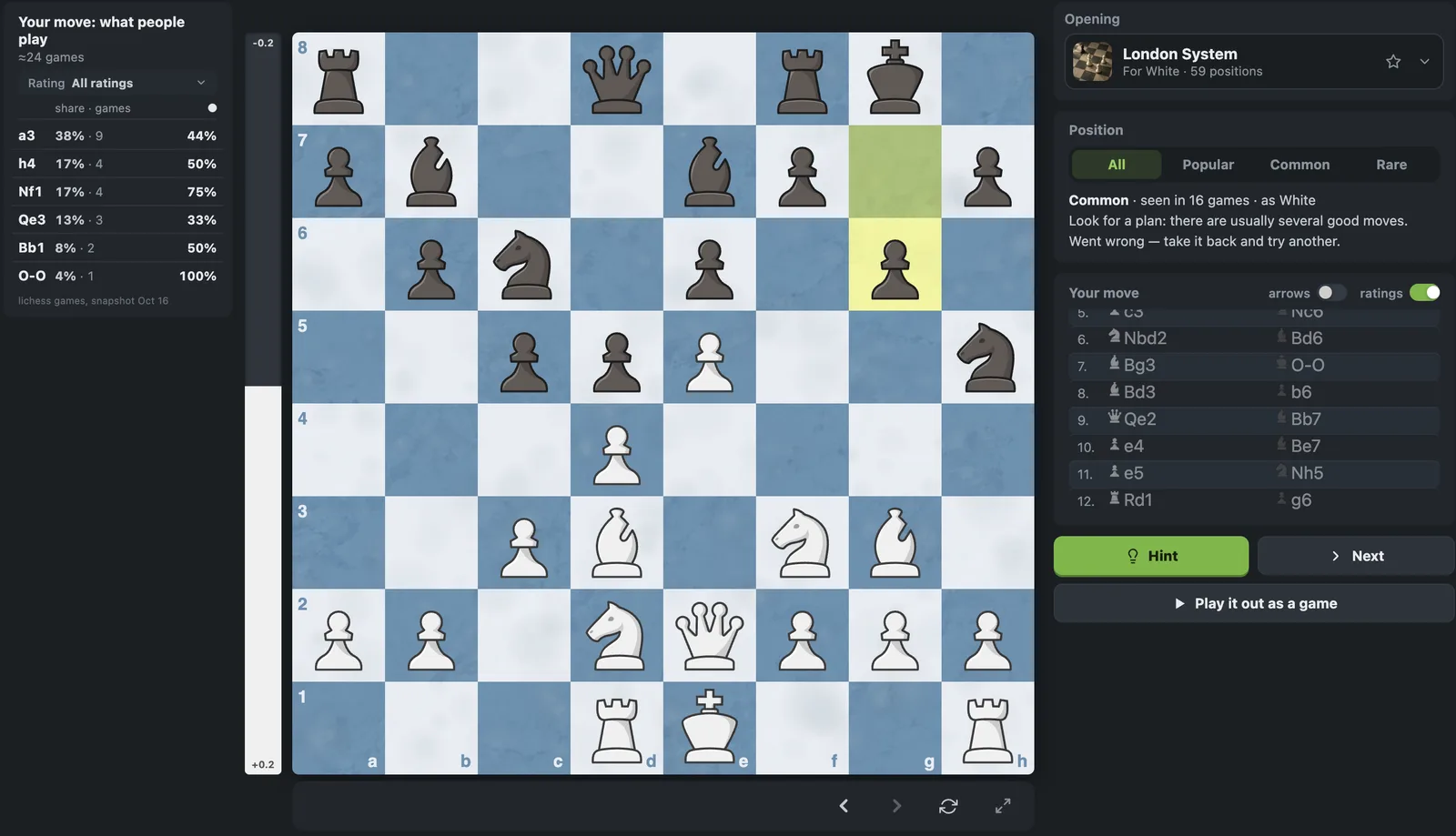
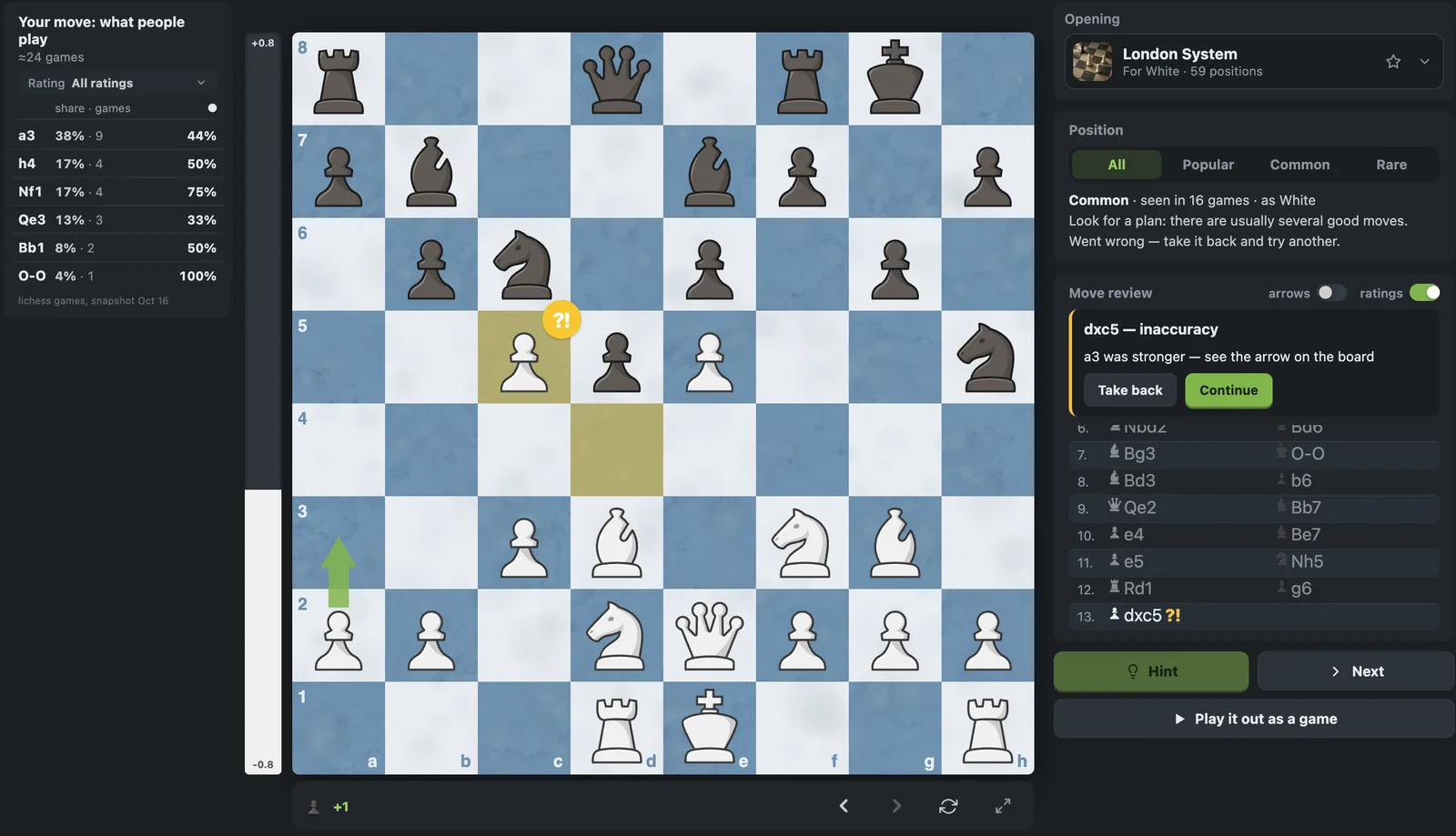
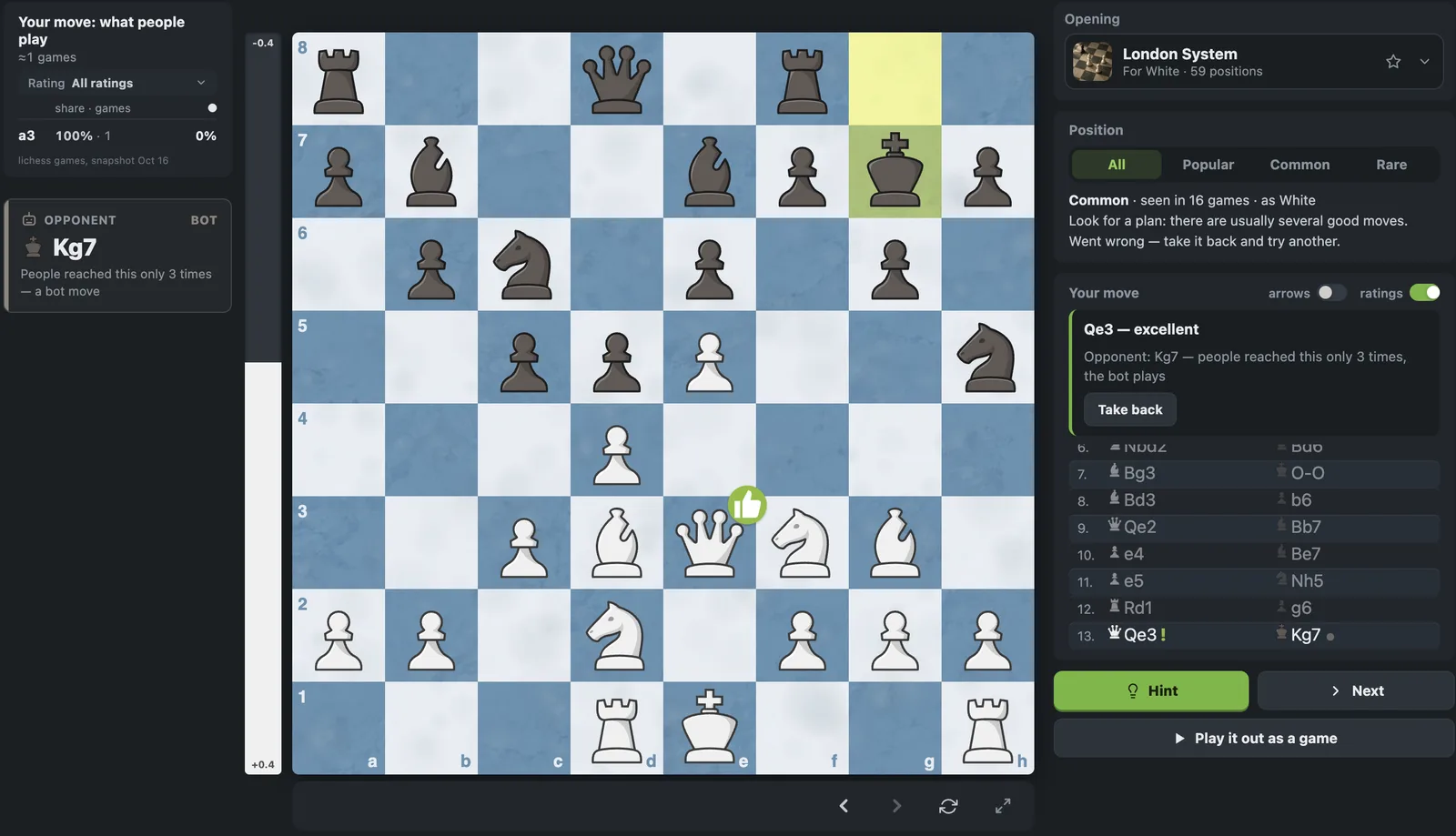
Now play one more move. The engine calls 13.Qe3 excellent — and after it, the entire lichess database holds three games. 13.dxc5 is a natural move, a master even played it once — and there are zero. It's move 13 and nobody has been here before you.
You can learn the opening and the endgame. Not the middle
The endgame is finite. Queen mate, opposition, the rook behind the passed pawn — a few dozen techniques that work the same way across thousands of positions. Learn them once, use them forever. We covered three endgames you must know separately.
The opening is wide but well-trodden. Every strong line has millions of games behind it, and you can learn it to move 10–12 knowing you've seen almost everything your opponent will try. The real question is when the opening actually ends.
The middlegame is an explosion. The tree branches on every move, and by move 15 most positions have been played a handful of times or never. To "know" it, you'd have to memorize positions nobody has ever played. Memory gives you typical structures and ideas — not moves.
That is what you should carry out of the opening. In our position it pays to remember ideas, not moves: the e5 pawn takes f6 away from Black's knight, White plays on the kingside — h4, the knight rerouted via f1 — and Black looks for trades in the centre and play on the queenside. With that in your head the position feels familiar in meaning, even with zero games in the database.
What to train instead of memorizing
If you can't remember the position, you have to find the move. That is chess: spot the threats, list the candidates, figure out what the fight is about, and calculate two or three moves deep — but correctly. When no plan comes, seven plain-language questions about the position help.
The good news: there's almost never just one right move. In our London position the engine is equally happy with a3, Qe3 and h4, and people played six different moves here. There's no "only answer" to memorize, because it doesn't exist. What you can learn is telling a good move from a bad one.
So the best middlegame trainer isn't a book of variations. It's lots of unfamiliar positions and an honest review after every move: where you spotted the threat and where you walked past it.
How we train the middlegame
We built a separate section for it: Middlegame. Pick your opening and the trainer sets up a real position from move 12–20 of lichess games that grew out of it — popular, common or rare, your choice. Then you play. After every move you get a review: a good move, or "this was stronger" with an arrow on the board. Take the move back and try another, or replay from any point in the line.
The opponent answers the way people answered — common replies and rare ones, so you end up in different branches. On the left you see how many games are left in the position and how they ended. When the human games run out, a bot takes over, and the trainer tells you so.
You can learn the opening and drill the endgame. The middlegame you can only play — so train exactly that.